
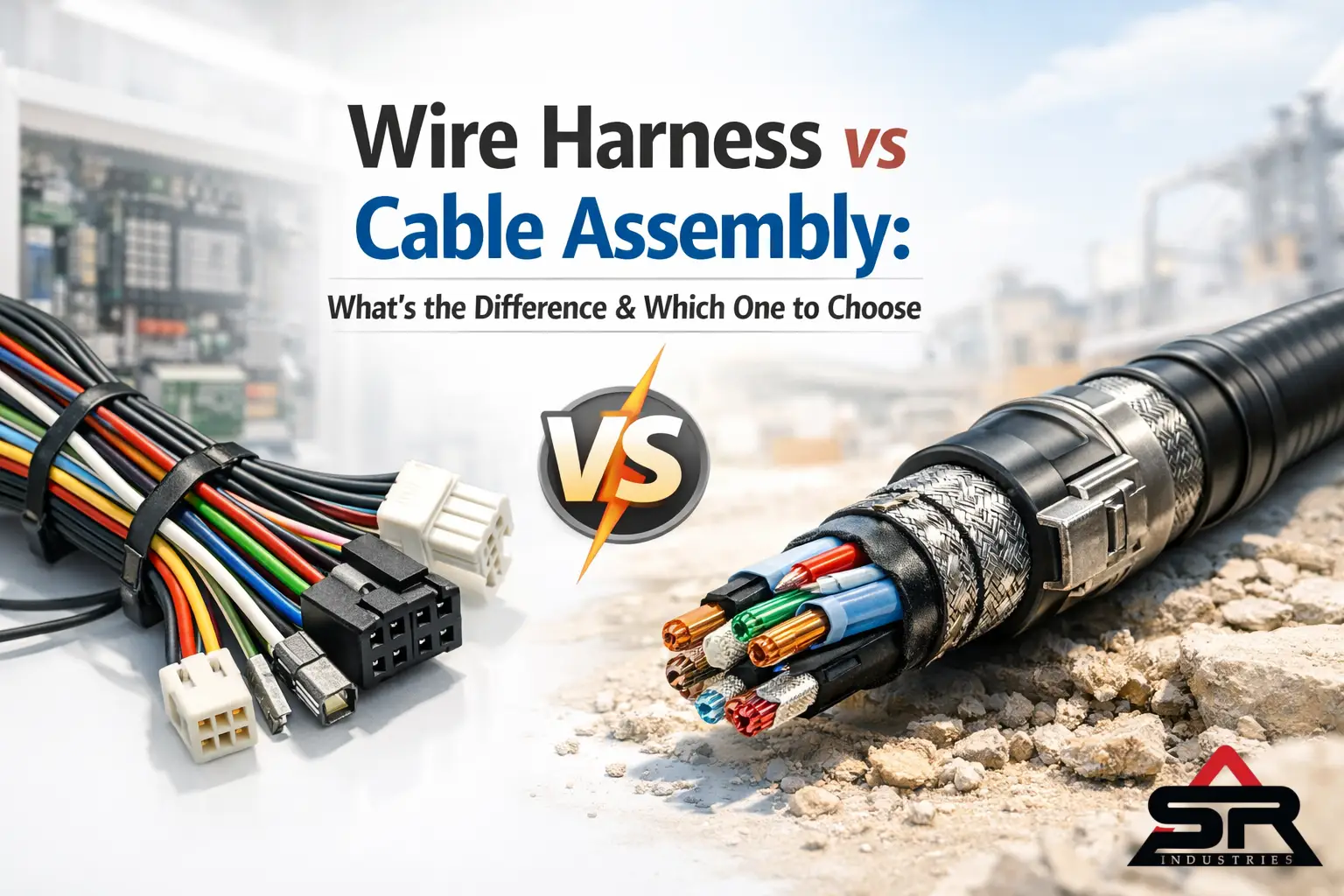
Wire Harness vs Cable Assembly: What’s the Difference & Which One to Choose
Specifying the wrong connectivity architecture is a critical error in mechanical and electrical design. The choice between a wire harness vs cable assembly directly impacts product reliability, manufacturing costs, and long-term maintenance. Too often, I see design teams treat these components like identical twins. They look at a schematic, see a line connecting Point A to Point B, and assume any bundle of copper will get the job done.
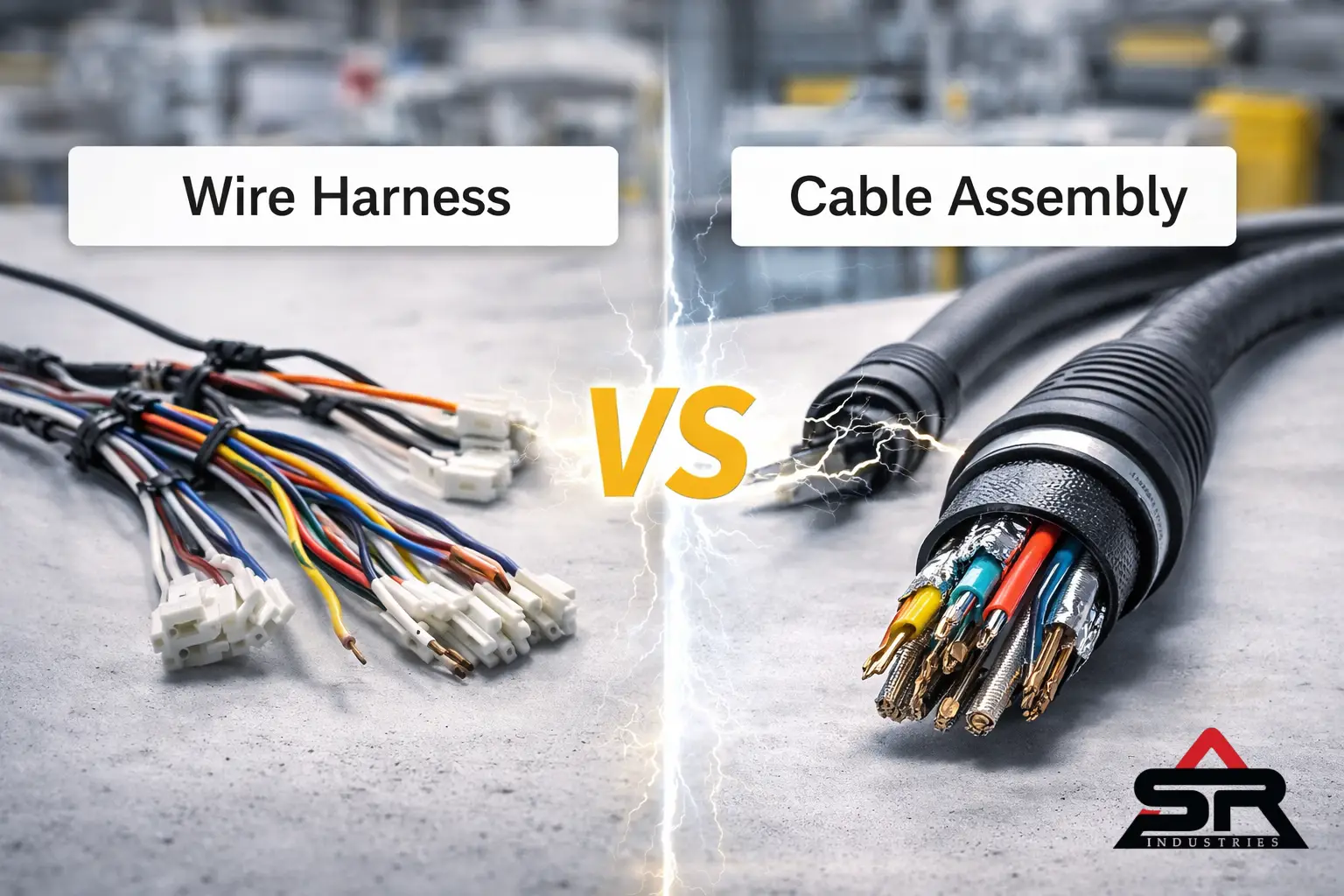
These components serve distinct structural purposes. A wire harness optimizes internal space and organizes complex routing. In contrast, a cable assembly provides environmental shielding against abrasion, moisture, and EMI (Electromagnetic Interference) for exterior applications.
If you fail to account for these specific nuances at the board level, you aren’t just going to face minor inconveniences. You are going to face massive reliability headaches, intermittent signal drops, and skyrocketing maintenance costs during final product integration.
This guide breaks down the structural architectures, hidden installation costs, and exact specifications required to prevent field failures.
Quick Answer: The Core Difference
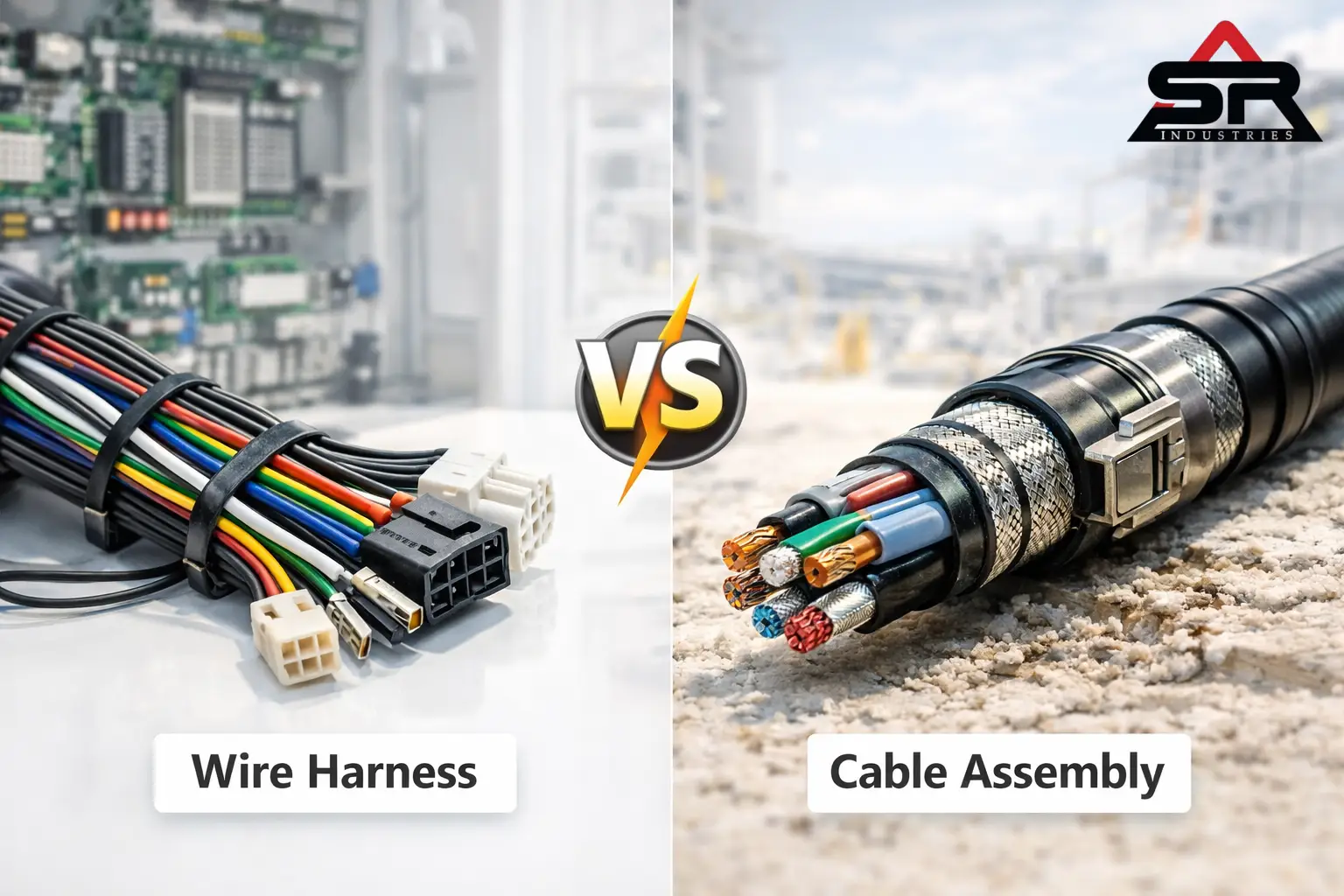
The primary difference between wire harness and cable assembly comes down to their outer protective structure and intended operating environment. A wire harness is a basic, unshielded bundle of wires bound by zip ties or loom, designed strictly for internal organization and routing inside a protected enclosure. A cable assembly is a heavy-duty, unified component encased in a rugged outer jacket, built to protect internal conductors from moisture, friction, chemical exposure, and electromagnetic interference (EMI) in harsh exterior environments.
Strategic Comparison Matrix: At a Glance
Before we break down the underlying engineering, let’s look at the high-level structural differences.
Feature | Wire Harness | Cable Assembly |
Primary Driver | Space Economy & Flexibility | Environmental Hardening & Defense |
Protective Barrier | Minimal (Loom, zip ties, localized tape) | Maximum (Extruded TPU, PVC, or PUR jackets) |
Flexibility Profile | Unconstrained, branching easily in 3D space | Stiffer, featuring a uniform outer diameter |
Ideal Environment | Internal panels, enclosures, dashboards | External routing, cross-barrier, harsh weather |
EMI Shielding | None (acts like an open antenna) | High (utilizes braided copper or foil shields) |
Installation Method | High-touch, requires precise routing/pin-out | Low-touch, true “plug-and-play” module |
What is a Wire Harness?
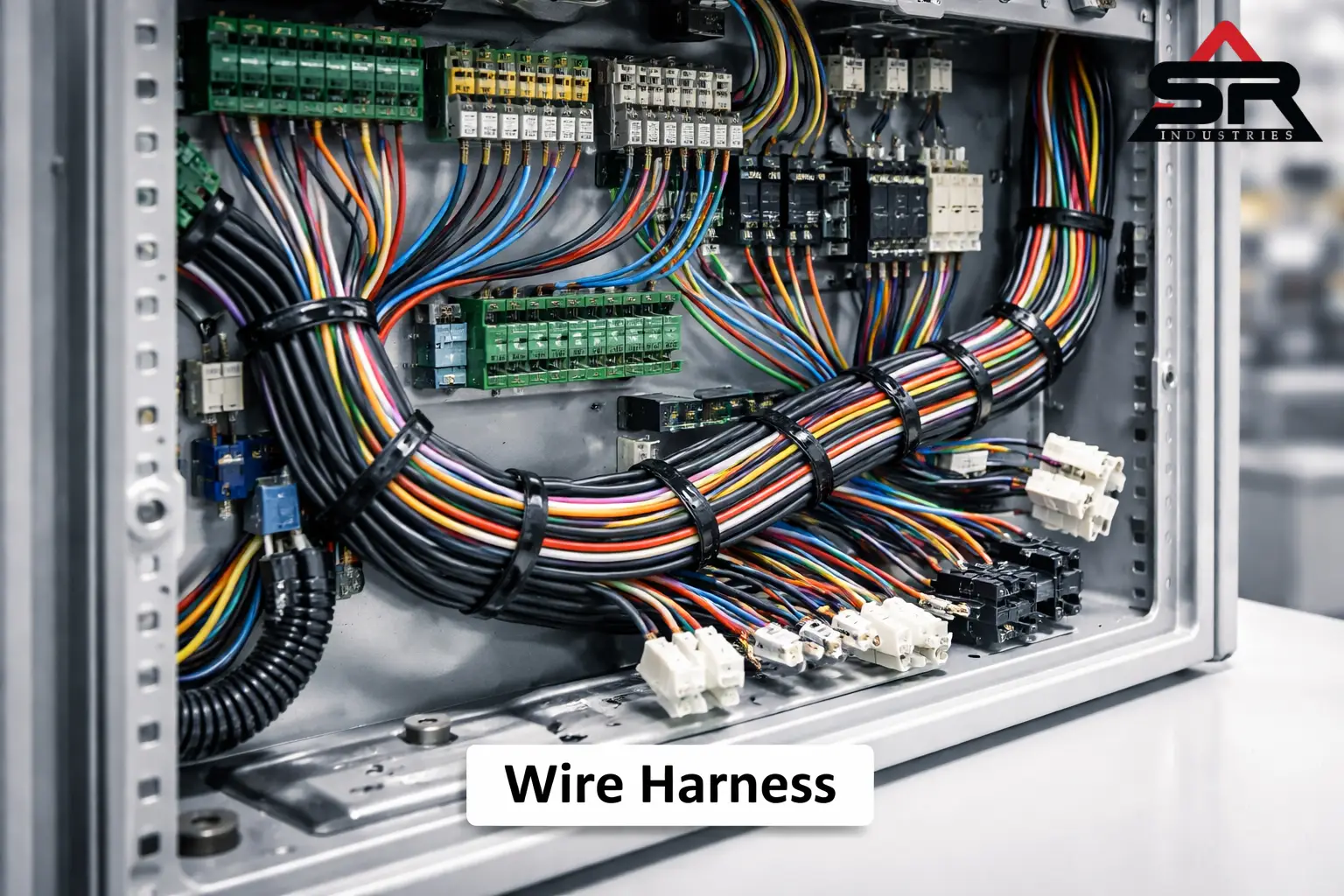
At its core, a wire harness is an open-architecture configuration. A wire harness creates structured routing for complex electrical systems.
Think about the inside of an industrial control panel or the dashboard of a commercial vehicle. You have hundreds of individual signals traveling from microcontrollers to sensors, relays, and power supplies. If you just tossed individual wires in there, it would be a catastrophic mess. Troubleshooting a short circuit would be impossible.
A wire harness takes those individual leads and binds them together using cost-effective materials like basic zip ties, braided sleeving, or split loom.
The Geometry of the Build
Designing a harness is less about standard electrical engineering and much more akin to solving a massive spatial jigsaw puzzle. You are trying to snake thousands of millimeters of conductor length into a tight, vibration-heavy enclosure.
When you define a harness on a CAD file, you start with the physical geometry. Where are your terminal blocks? How do the wires need to “fan out” across the chassis to reach their designated ports? Unlike a standardized cable, a harness is built “to fit.” It is a highly customized spiderweb tailored exclusively to the internal dimensions of one specific machine.
Because there is no thick, extruded plastic jacket holding everything in a rigid cylinder, the harness remains incredibly pliable. It can bend around sharp sheet metal corners and navigate complex internal topography.
What is a Cable Assembly?
If a harness is the internal nervous system of a machine, a cable assembly is a heavy-duty protective suit.
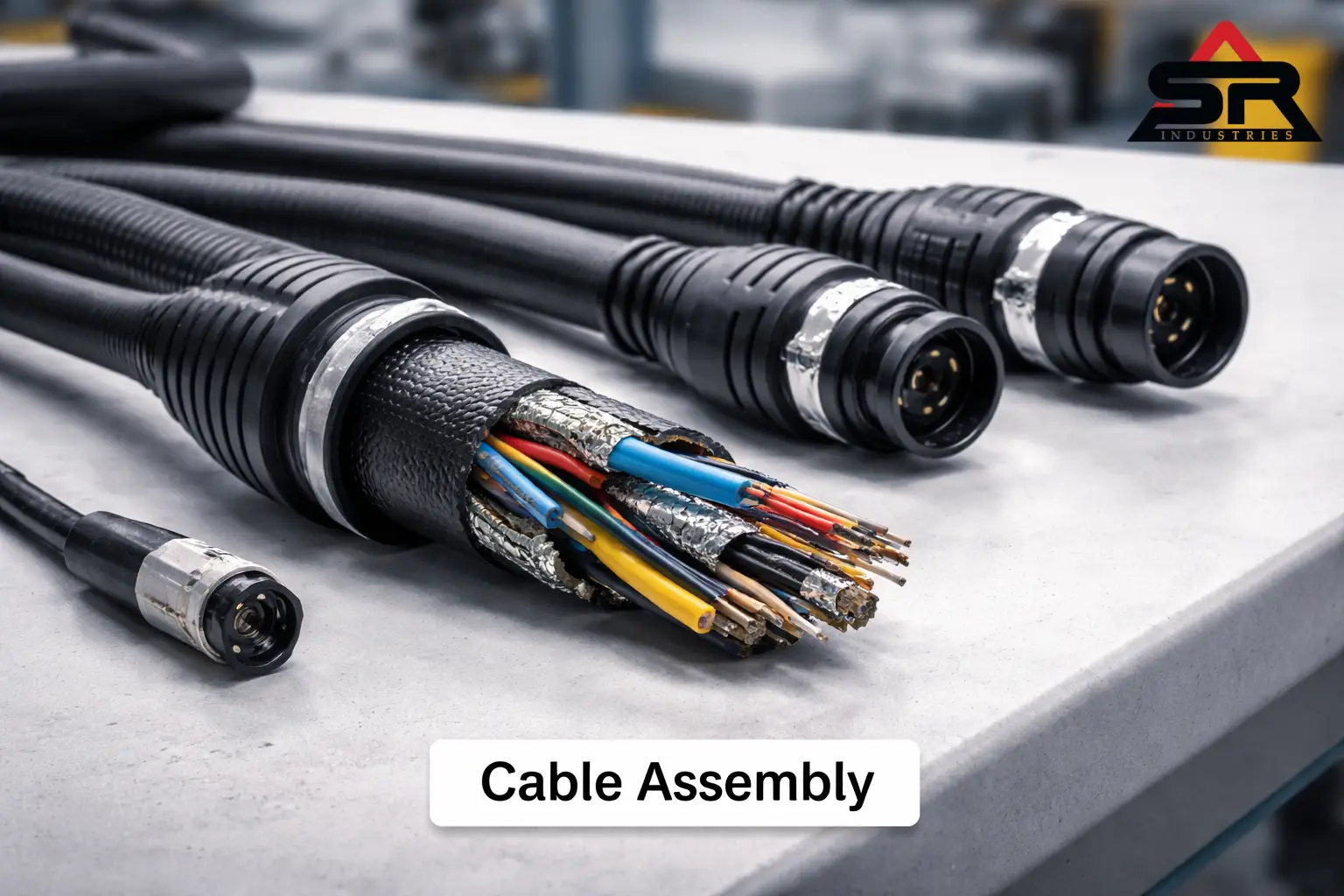
Also known as a multi-conductor cable, this is a fully unified, closed-architecture component. You don’t just have a loose bundle of wires. Instead, the internal conductors are meticulously arranged—often twisted at specific intervals to cancel out crosstalk—and then wrapped in specialized insulating foil. Finally, the entire bundle is fed through an extruder to create a rugged exterior jacket.
This jacket might be made of basic Polyvinyl Chloride (PVC) for standard indoor use, Thermoplastic Polyurethane (TPU) for extreme flexibility, or even braided stainless steel if physical crushing is a genuine threat on the factory floor.
Engineering a Bridge
When we talk about cable assembly manufacturing, we are really talking about engineering a bridge. You select this component when your signal needs to leave the safety of the metal cabinet and travel out into the harsh world.
It arrives at your assembly line as a finished, “all-in-one” product. There is no manual routing of individual pins required. You simply take the molded connector on end A, plug it into your machine, and take the connector on end B and plug it into your peripheral.
Key Differences Between Wire Harness and Cable Assembly
The cable assembly vs wiring harness debate is effectively an argument between internal organization and external survival.
Let’s look at a few critical areas where these two diverge on a mechanical level:
1. Structural Constraint vs. Freedom
A harness is unconstrained. If you hold a wire harness in your hand, you can physically separate the wires. You can see the individual colored insulations. A cable assembly is entirely constrained. The internal wires are completely invisible, locked away behind the heavy outer jacket.
2. Handling Mechanical Stress
There is a specific tactical advantage to a harness being “loose.” In a 3D space, an open harness can twist and bend without putting extreme mechanical pressure on the individual connector pins. If you tried to force a thick, rigid cable assembly into that exact same tight bend radius, the torque at the connector junction would be immense. Under constant vibration, that rigid tension will literally snap the copper pin right out of its plastic housing in under a thousand cycles.
3. The EMI Factor
One detail that consistently triggers failures in field deployments is Electromagnetic Interference (EMI). If you are running sensitive data signals near high-voltage motors, AC power lines, or variable frequency drives, you have a major problem on your hands. An open wiring harness acts exactly like a giant antenna. It will capture every single ripple of background electrical noise, leading to phantom sensor readings and dropped packets.
A cable assembly changes the math entirely. By shielding the internal wires within an aluminum or braided copper cage, the assembly effectively isolates your data from the noisy outside world.
When to Use Wire Harness vs Cable Assembly
Making the right choice early in the prototyping phase saves thousands of dollars in rework later. Here is how you should break down your decision tree.
You Need to Spec a Wire Harness When:
- The environment is completely static and protected. If the wiring is going to live its entire life locked inside a NEMA-rated steel box, you do not need heavy exterior jacketing.
- Space is at an absolute premium. Harnesses have a significantly smaller physical footprint.
- You need complex, multi-directional breakouts. If one central power supply needs to branch out to 15 different locations inside a chassis, a harness is the only logical way to manage that spiderweb.
You Need to Spec a Cable Assembly When:
- The connection crosses a physical barrier. The moment a wire leaves your enclosure, it becomes a cable assembly.
- Moisture, oil, or chemicals are present. A harness will soak up machine coolant or oil, degrading the wire insulation rapidly. A polyurethane-jacketed assembly will shrug it off.
- The application involves constant motion. (Think of an automated robotic arm).
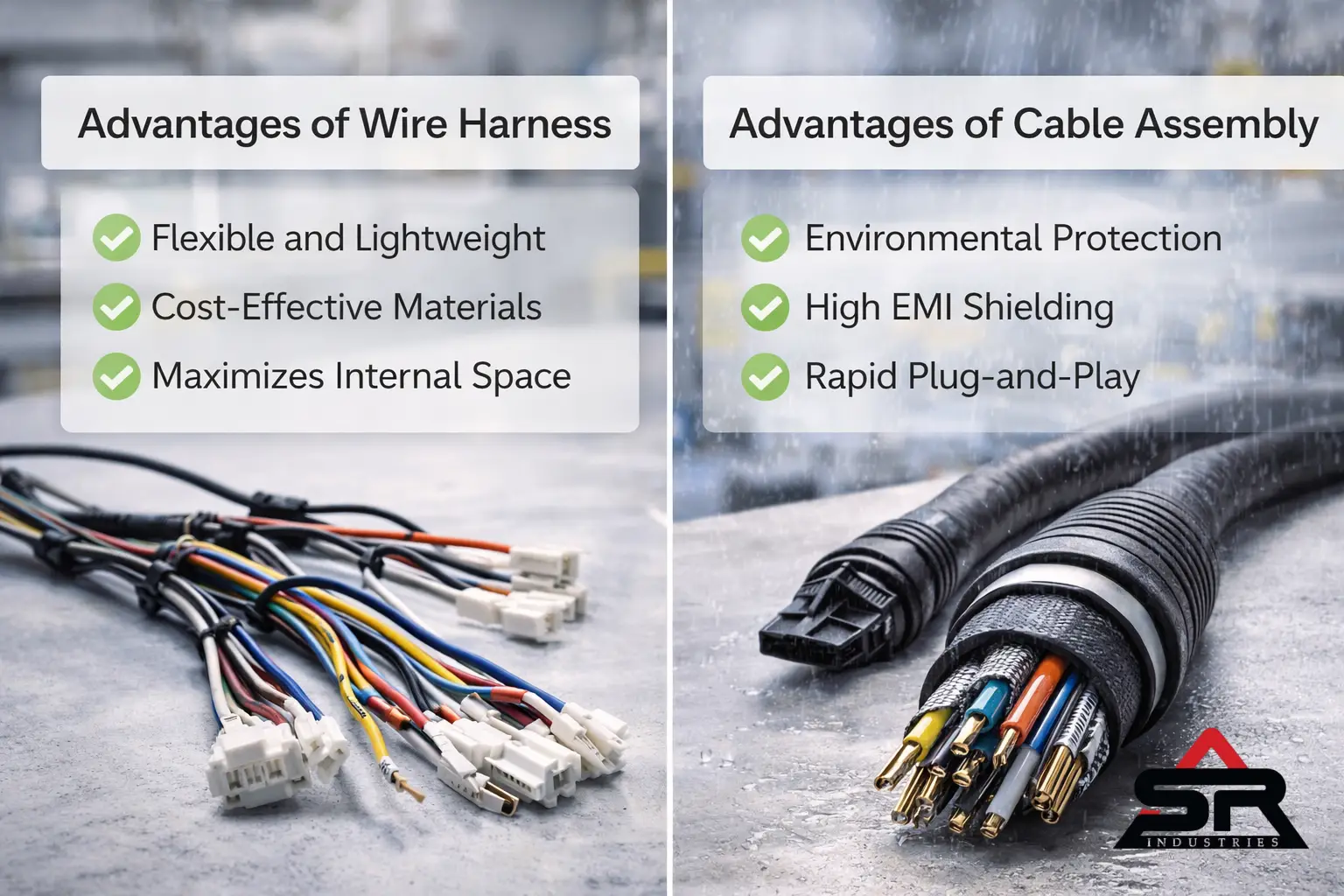
Advantages of Wire Harness
There is a reason the automotive and white-goods industries rely so heavily on harnessing.
Incredible Spatial Flexibility
Because they lack a rigid spine, harnesses can be manipulated into incredibly tight spaces. They form to the shape of the chassis rather than forcing the chassis to accommodate a bulky cable.
Massive Weight Reduction
Extruded plastics and braided copper shields are heavy. By eliminating the outer jacket, you drop the weight of the connectivity system dramatically. This is why you see massive harnesses utilized inside automotive dashboards; carrying unnecessary plastic weight reduces fuel efficiency.
Lower Raw Material Costs
You are paying for copper, terminals, and a few cents worth of zip ties or loom. The raw Bill of Materials (BOM) is significantly lower than a fully shielded assembly.
Expert Pro-Tip on Harnessing: Don’t skip friction management. When you lay out a harness in CAD, mark every single contact point where the bundle touches a sheet-metal edge. Instruct your floor team to wrap these specific areas with sacrificial abrasive tape. Most engineers ignore the wear-and-tear caused by high-frequency vibration inside a metal enclosure. A year later, the metal edge slices through the thin insulation, causing intermittent shorts that take days to troubleshoot.
Advantages of Cable Assembly
While harnesses win on interior flexibility, cable assemblies are the undisputed kings of the wild.
Unmatched Environmental Hardening
Whether it’s the under-chassis of a mining vehicle dealing with flying rocks, or a food processing plant where equipment is blasted with high-pressure caustic washdowns daily, the outer jacket of an assembly is built to take a beating so your signal doesn’t have to.
Flawless Signal Integrity
As mentioned earlier, shielding is everything in modern high-speed data transmission. Medical sensors, where signal fidelity is literally a life-or-death scenario, are strictly built as hardened assemblies rather than open harnesses.
Rapid Field Diagnostics
Downtime is expensive. When a machine goes down on a factory floor, every minute costs money. Troubleshooting a harness is a nightmare; finding a single broken wire inside a bundled mess requires slicing open miles of loom tape. With a cable assembly, diagnostics are binary. You test the line. If it fails, you unplug the entire assembly, toss it in the bin, click a new one into place, and the machine is back online in 60 seconds.
Expert Pro-Tip on Assemblies: Be highly critical of over-mold quality. A thickly molded plug on an assembly looks great on paper. But if your supplier’s molding process generates too much heat, it can actually melt and soften the internal wire insulation, creating invisible internal shorts. Always insist on “short-shot” X-rays or cross-sectional audits during your prototype runs to verify internal integrity.
Common Applications of Both
Innovation often happens when engineers decide to break the status quo and utilize these architectures in unexpected ways.
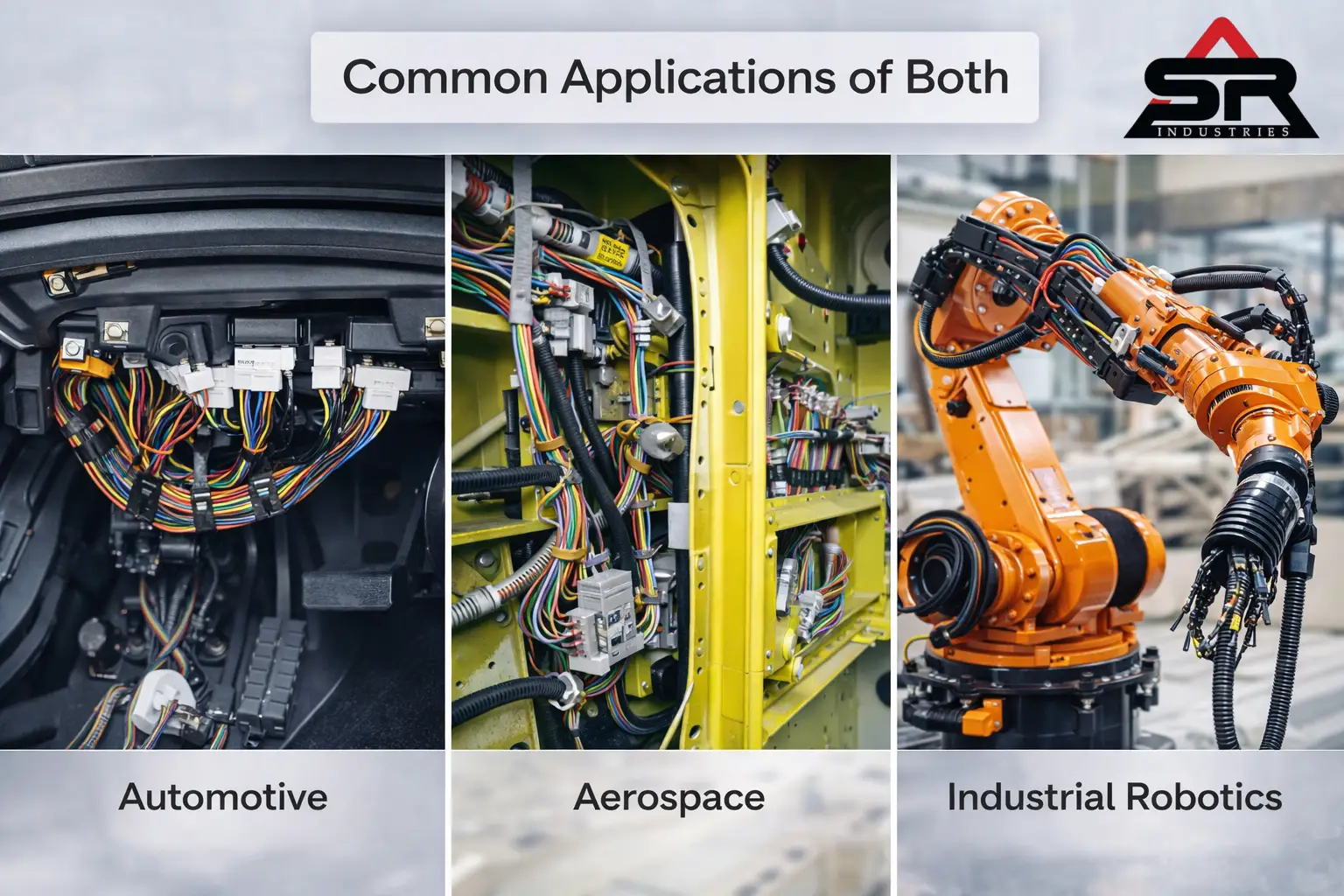
Let’s look at standard wiring harness applications. You will find them dominating automotive wiring, HVAC internals, consumer electronics, and stationary telecommunications racks. However, the aerospace sector is a fascinating exception. Traditionally, aerospace relied on massive, heavily shielded cable assemblies for safety. But to drop launch weight, modern manufacturers are shifting toward “harnessing-on-the-go”—integrating micro-connectors into highly engineered sub-harnesses. It saves massive tonnage, but introduces a level of manufacturing complexity that can only be handled by shops certified to strict AS9100 aerospace standards.
Conversely, cable assembly applications rule the mobile and harsh-environment sectors. You will find them in military field radios, marine engine rooms, and medical imaging devices.
Industrial Robotics is perhaps the best example. Six-axis robots use high-flex cable assemblies exclusively. Why? Because the robot is moving violently at rapid velocities. A standard wire harness, even one bundled tightly with high-end zip-ties, will succumb to metal fatigue. The friction will cause internal shorting within days. Robots require the uniform, smooth outer diameter of a cable assembly so it can glide effortlessly back and forth inside specialized high-flex energy chains (drag chains) for millions of cycles.
Cost Comparison: Wire Harness vs Cable Assembly
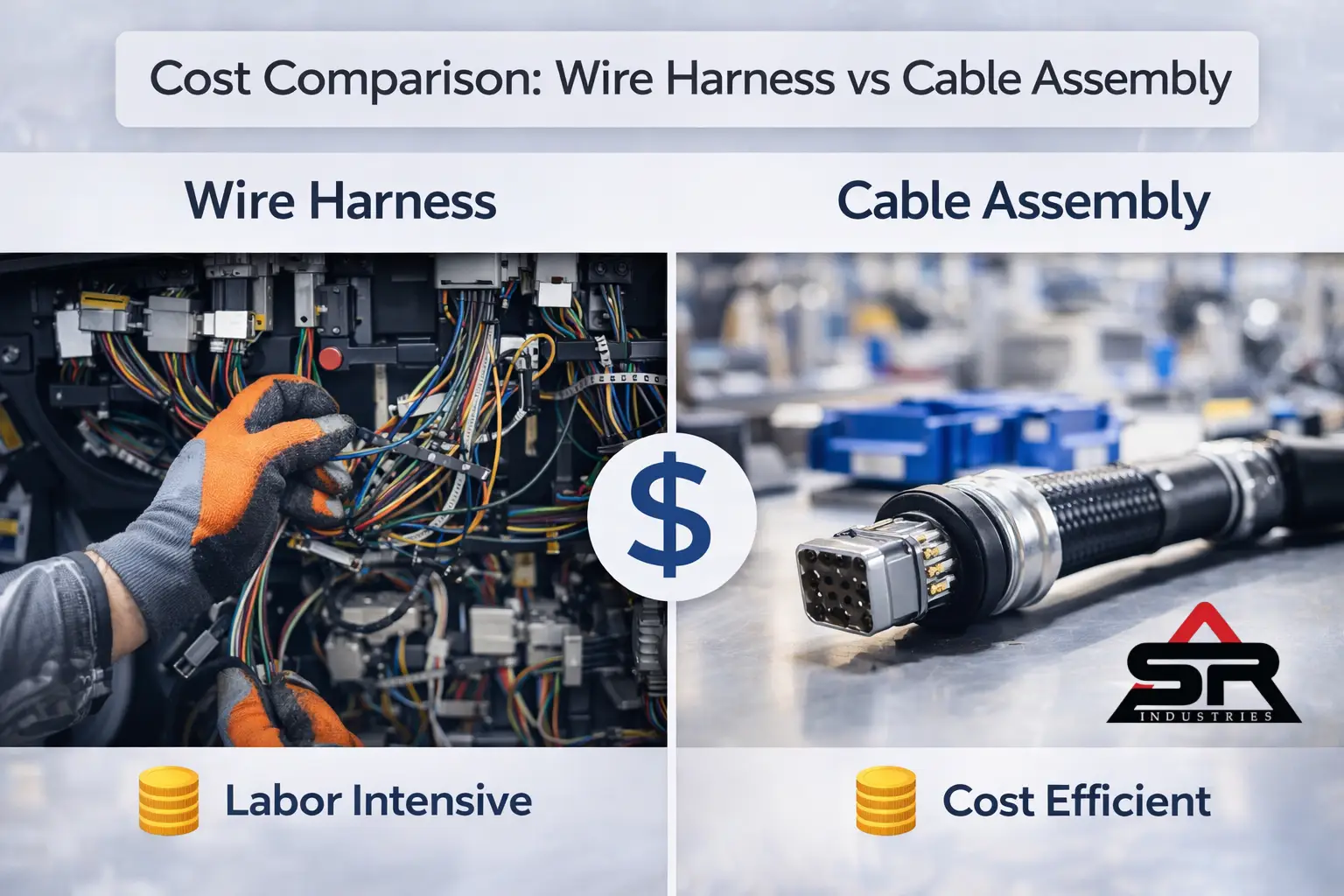
If you are comparing a wire harness vs cable harness solely by looking at raw copper prices, you are walking into a trap. Procurement managers love the low per-foot cost of a harness, but this completely ignores the reality of “installed cost.”
Let’s break down the invisible economics:
1. Engineering and R&D Hours
The design phase of a custom wire harness is brutally time-consuming. Because it branches out to multiple locations, your engineers have to specify exact breakout lengths, tolerance stacking, and routing paths. This can easily take three times the design hours compared to specifying a generic, point-to-point circular cable assembly.
2. Assembly Labor and Skill Requirements
How long does it take your floor technician to install a harness? It requires a high level of training to route it correctly, strip the wires, and terminate them into a housing. If an operator makes a mistake on the pin-out, the entire harness is usually ruined because re-routing or re-pinning tightly cut wire is virtually impossible.
Cable assemblies eliminate this labor bottleneck entirely. Because it is a finished module, even an entry-level operator can install it flawlessly.
3. Inventory Carrying Costs
When your purchasing department buys a cable assembly, they are tracking a single part number. Inventory stays incredibly clean. When you build a harness, you might have twenty separate component part numbers to track, monitor, and re-order—including different gauges of wire, specific terminal crimps, three types of tape, routing clips, and plastic stand-offs. The logistical overhead is significant.
4. The Risk Profile
Ultimately, a harness failure can cause a total product recall because it is deeply integrated into the chassis of your machine. A bad cable assembly is usually isolated to the cable itself. The overall risk profile of an assembly is fundamentally lower for a global OEM.
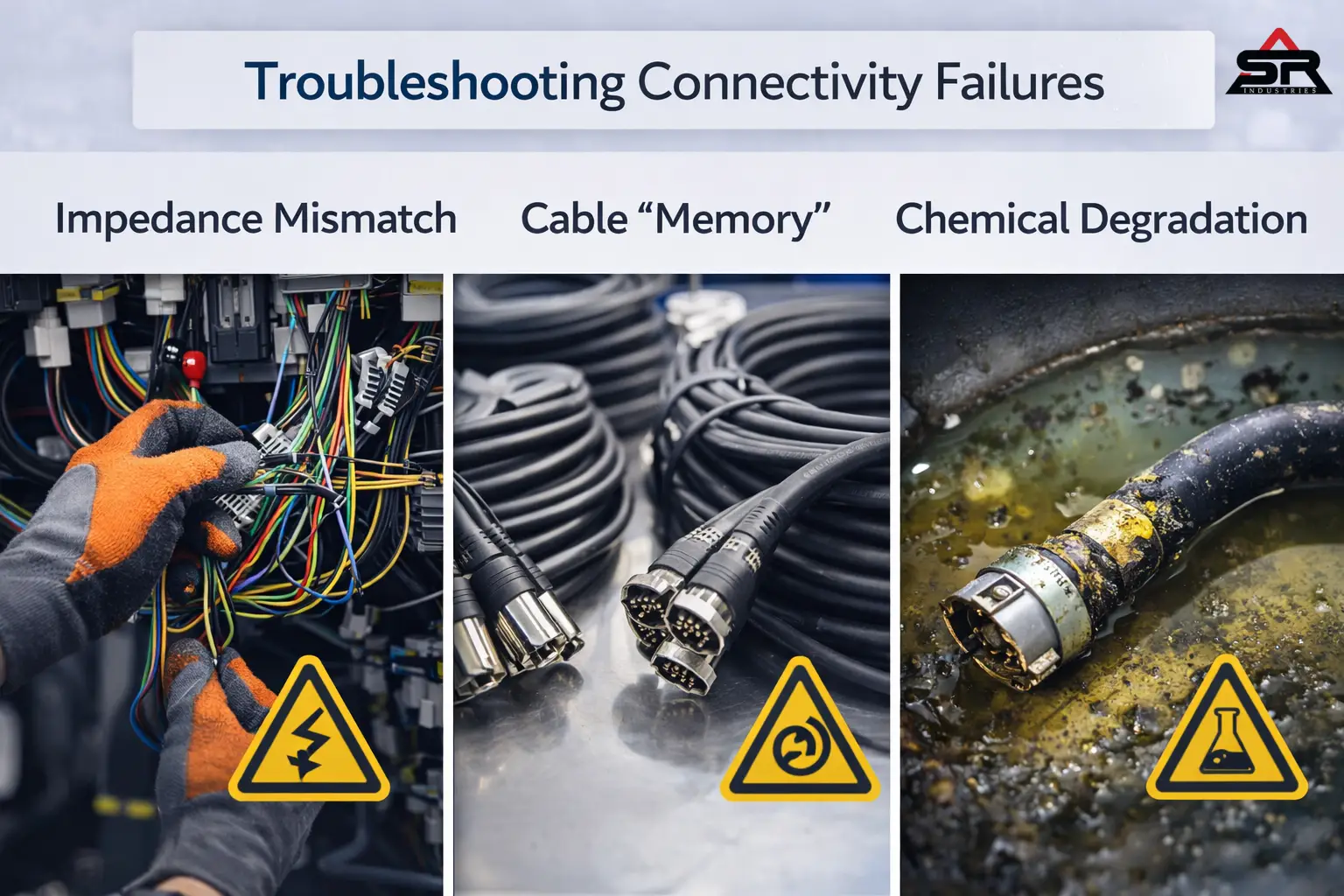
Deep Dive: Troubleshooting Connectivity Failures
I see the same problems every time I consult on factory floor failures. If you are experiencing connectivity issues, look for these three culprits:
Impedance Mismatch: In high-speed data transmission, the physical layout of an open harness varies slightly based on the human being who built it. One technician pulls it tighter than another. This actually changes the signal impedance constantly. If your high-speed sensors keep dropping data, stop blaming the sensors. Look at the inconsistency of your harness routing.
Cable “Memory”: If your purchasing team buys cable assemblies in bulk and stores them tightly coiled on small reels for six months, the stiff plastic jacket will retain that “memory.” When you install them, they will create floating loops that act as trip hazards for operators. Always account for proper spooling diameter.
Chemical Degradation: I once worked with a client who lost 15% of their production efficiency due to cables degrading in an oil-rich CNC environment. They had specified standard PVC jacketing. The oil literally ate through the plastic in weeks. Once we switched the spec to a PUR (Polyurethane) jacketed cable assembly, the failures ceased completely. You have to match the material science to the threat.
Structuring the Production Partnership
If you decide to outsource your connectivity, your goal is to find a partner, not just a shop that cuts wire. You need an extension of your own engineering team.
When vetting suppliers, ask them for their first-pass yield statistics. Any contract manufacturer who stammers or cannot tell you exactly how often they fail their own internal integrity tests is not using modern inspection methods.
An effective supplier will use an automatic continuity and short-check fixture (a test-on-the-line protocol) for 100% of finished assemblies. This ensures that what arrives at your loading dock is completely flawless.
Furthermore, when finalizing your CAD drawings, make sure your dimensions allow for reality. A harness drawing must have a defined range of acceptable looseness (tolerance stacking). A cable assembly drawing must have an explicit outer diameter constraint so your procurement team doesn’t accidentally buy a heavy-duty shielded cable that physically will not fit through the routing holes in your chassis.
Conclusion
Engineering for longevity is never just about using the “best” or most expensive wire. It is entirely about using the “correct” physical housing for the specific environment your machine will live in.
When you start viewing every copper lead not just as a power transmitter, but as a vulnerable component that actively interacts with vibration, friction, heat, and human operator error, your entire design philosophy changes. You stop treating connectivity as an afterthought. You start treating it as the backbone of your mechanical design.
This is how you create a massive competitive edge. By deeply understanding the strategic differences between a wire harness and a cable assembly, you make your gear easier to build on the floor, easier to ship globally, and significantly harder to break in the field.
Frequently Asked Questions (FAQ)
Q1: How can I tell if my current wire harness needs to be converted into a heavy-duty cable assembly?
A: The data is in your warranty return logs. If your client failures are listed as “intermittent,” if they occur in areas of the machine prone to extreme heat or motor vibration, or if the logs mention physical wire snapping, your harness is succumbing to environmental factors. That is a clear, undeniable signal to upgrade to a protective assembly.
Q2: What is the most common reason for voltage drop issues in a massive wire harness?
A: It is almost always a combination of poor cross-sectional area sizing relative to the current flow, coupled with heat buildup. Heat naturally increases electrical resistance. Because the harness bundle is packed incredibly tight with zip ties, that heat has nowhere to dissipate. If you notice performance flagging in long, dense bundles, you need to increase your wire gauge by 1-2 sizes.
Q3: Are there hybrid designs that bridge the gap between harness and assembly?
A: Yes, you will often see what the industry calls “protected harnesses.” This is essentially an internal wire bundle where only the specific segments prone to sharp edges or high vibration are shielded with localized flexible protective sleeves (like corrugated tubing). The rest of the bundle remains an open-routed harness to keep your BOM costs low and your flexibility high.
Q4: Is it ever “better” to do wire harness design and assembly in-house?
A: It is highly recommended during the R&D and Prototype stages. You need your internal engineering team to iterate rapidly on routing paths. However, once you hit mass production, you should almost always transition the drawing package to a professional contract manufacturer. Hand-assembly at scale is a massive labor bottleneck. Professional shops have automated stripping, crimping, and testing machinery you simply cannot afford to maintain internally.
Q5: Which industry standard dictates the quality and production of these electrical parts?
A: The gold standard is IPC/WHMA-A-620 (Requirements and Acceptance for Cable and Wire Harness Assemblies). If your chosen supplier does not manufacture to this standard, or if your engineering prints don’t explicitly cite it, you have zero leverage to verify if their quality is actually meeting acceptable industrial safety levels.