
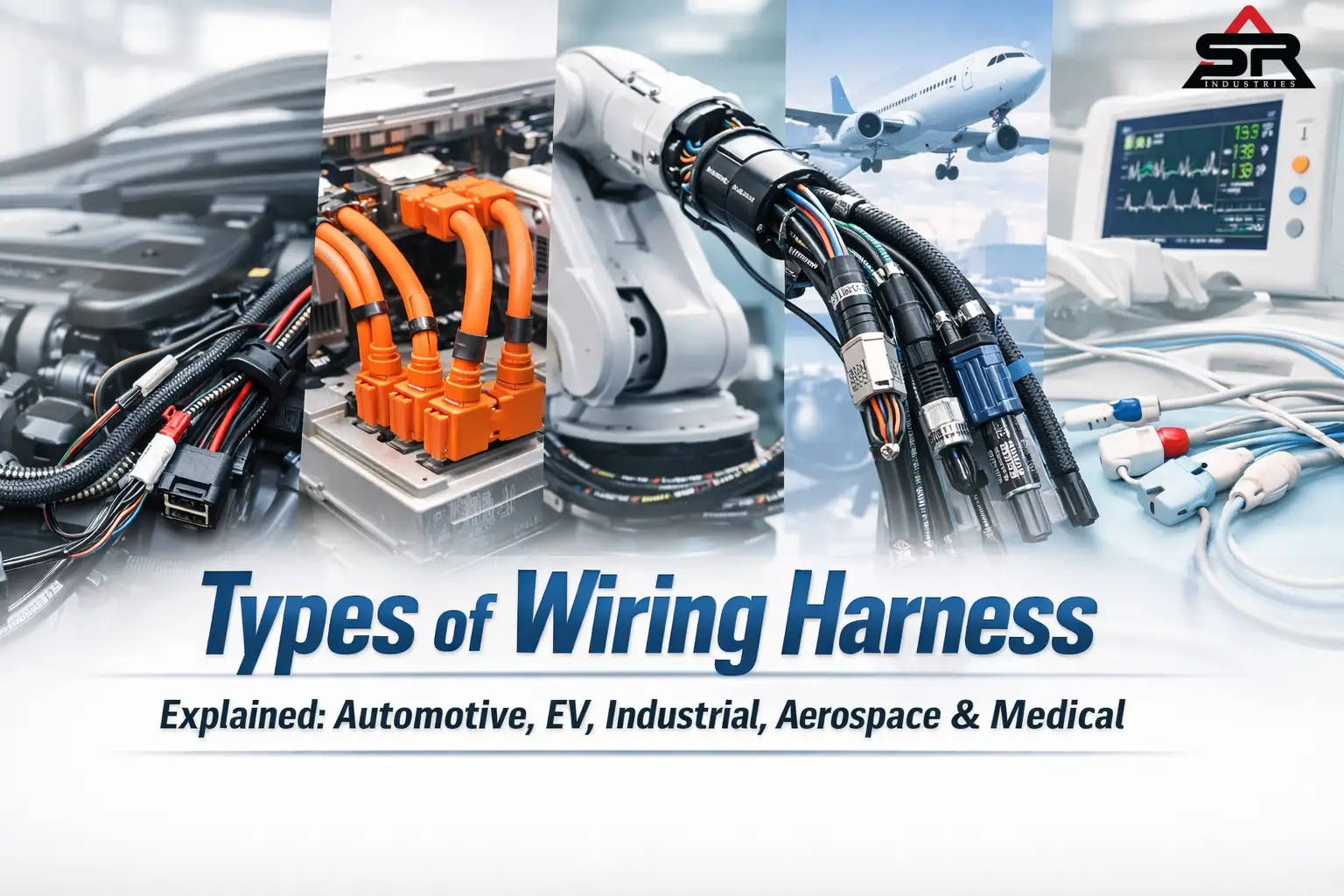
Types of Wiring Harness Explained: Automotive, EV, Industrial, Aerospace & Medical
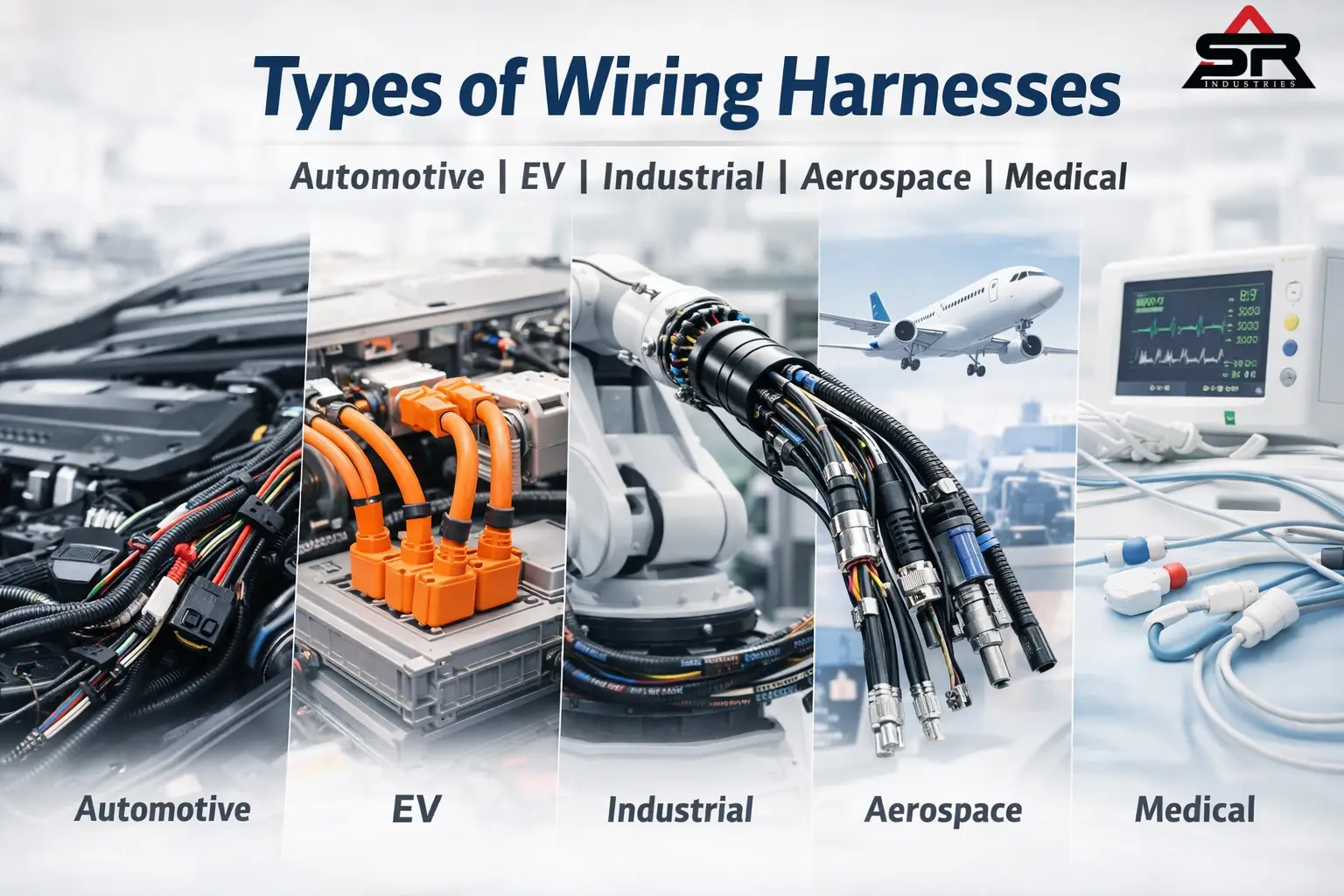
Types of Wiring Harness: There are 5 main types of wiring harness used across industries:
- Automotive Wiring Harness
- EV (Electric Vehicle) Wiring Harness
- Industrial Wiring Harness
- Aerospace Wiring Harness
- Medical Wiring Harness
Each type is designed for specific environments such as high temperature, vibration, electromagnetic interference, or sterilization conditions.
What are the different types of wiring harness?
Think of it as the physical nervous system of any complex hardware. It is a highly organized, tightly bound group of cables routing power and data safely across a machine. The core categories dominating the market right now are standard automotive, high-voltage EV setups, heavy industrial machinery, aerospace, and strict medical-grade assemblies.
Each one has a completely different job. They rely on highly specific outer jackets, internal shielding, and exact connector types to survive their own unique thermal and chemical environments.
Most people don’t think about wires. They plug a thing in. It works. They move on.
But if you engineer hardware for a living, you know the truth. Wires are the enemy. They break. They melt. They pick up electromagnetic noise and completely ruin your sensor data. You can’t just throw a handful of cables into a chassis and hope for the best. You need a system.
That system is a wiring harness. It organizes the chaos. It forces dozens, sometimes hundreds, of disparate wires into a single, highly controlled routing channel.
But not all harnesses are created equal. Slapping a commercial-grade wire assembly into a six-axis industrial robot is a guaranteed way to cause a catastrophic failure. Knowing the exact types of wiring harness and their strict physical limitations separates a successful product launch from a multi-million dollar recall.
Let’s tear these systems apart. We are going to look at the exact mechanics, the physical constraints, and the real-world applications of every major electrical harness system.
What Determines Different Types of Wiring Harness?
Before we look at specific industries, we have to look at the basic anatomy. A raw wire just carries current. A wire harness protects that current.
What separates a custom wiring harness from a cheap, off-the-shelf cable assembly? It comes down to the sub-components. Change one variable, and you alter the entire application limit of the assembly.
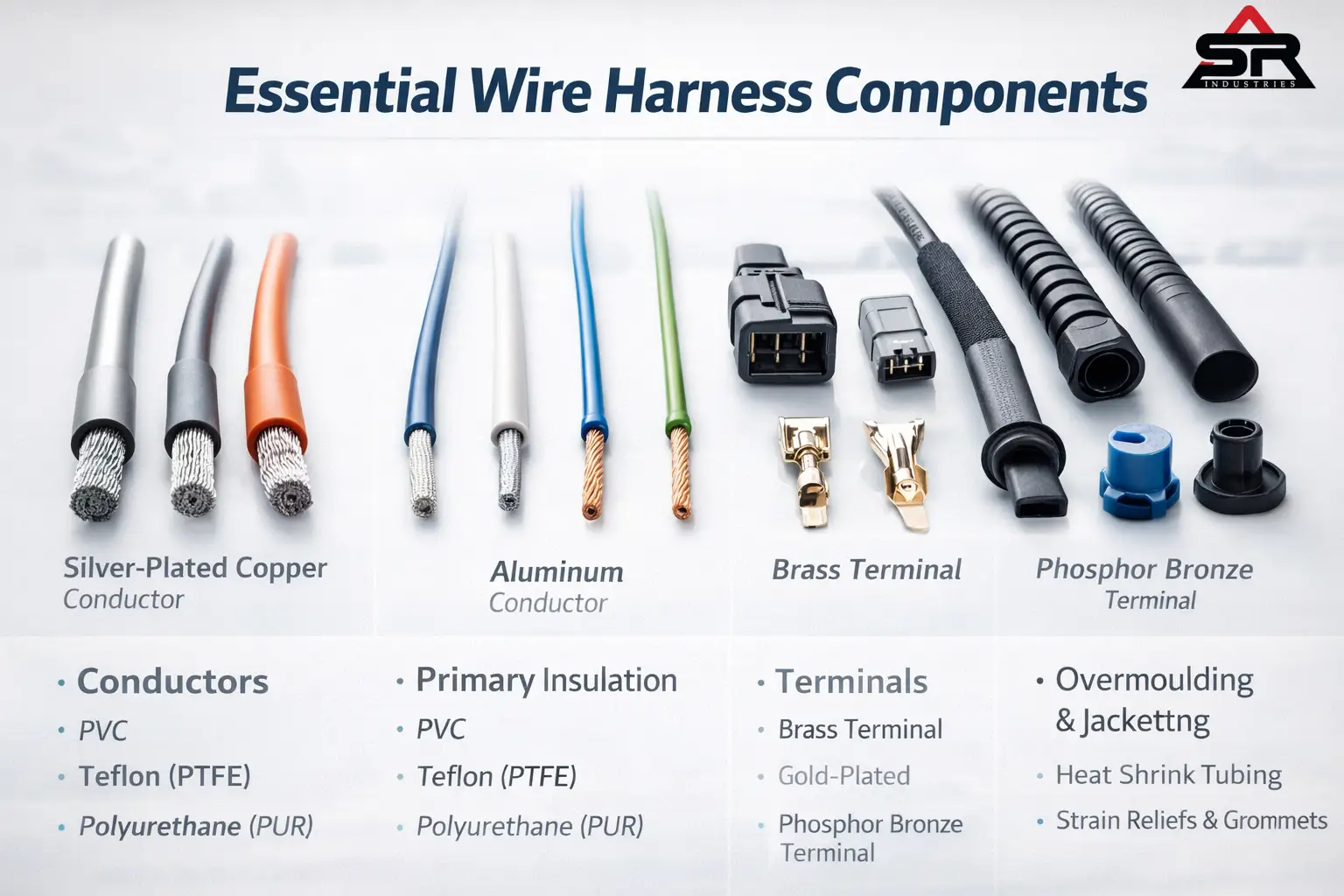
Essential Wire Harness Components
Every harness relies on a highly specific recipe of the following parts.
- Conductors: The actual metal. Usually, we use stranded copper for flexibility. Need to save weight in an airplane? You switch to silver-plated copper. Need to cut costs in a car? Aluminium is starting to take over.
- Primary Insulation: The plastic coating on the individual wires. PVC is cheap. It’s everywhere. But it melts. If you need extreme heat resistance, you jump to Teflon (PTFE). For high-flex mechanical environments, Polyurethane (PUR) dominates.
- Terminals: The metal contacts crimped onto the stripped wire. Brass, phosphor bronze, or gold-plated copper. Gold doesn’t oxidize, making it perfect for low-voltage sensor data.
- Housings and Connectors: The plastic shells holding those metal terminals. Brands like Molex, TE Connectivity, and Deutsch dictate if a connection is waterproof, vibration-proof, or blind-mate able.
- Over moulding and Jacketing: The outer defense layer. This is the braided nylon, the corrugated split loom, or the heat shrink tubing that stops the wires from chafing against a sharp metal chassis.
- Strain Reliefs & Grommets: The physical hardware that stops wires from tearing right out of the connector when someone inevitably pulls the cable instead of the plug.
Expert Pro-Tip: A massive rookie mistake in hardware engineering is designing the mechanical enclosure first and treating the wiring harness as an afterthought. Never do this. Always design your cable routes concurrently with your chassis. Forcing thick, heavy cables into tight bend radii destroys signal integrity. It guarantees early mechanical failure.
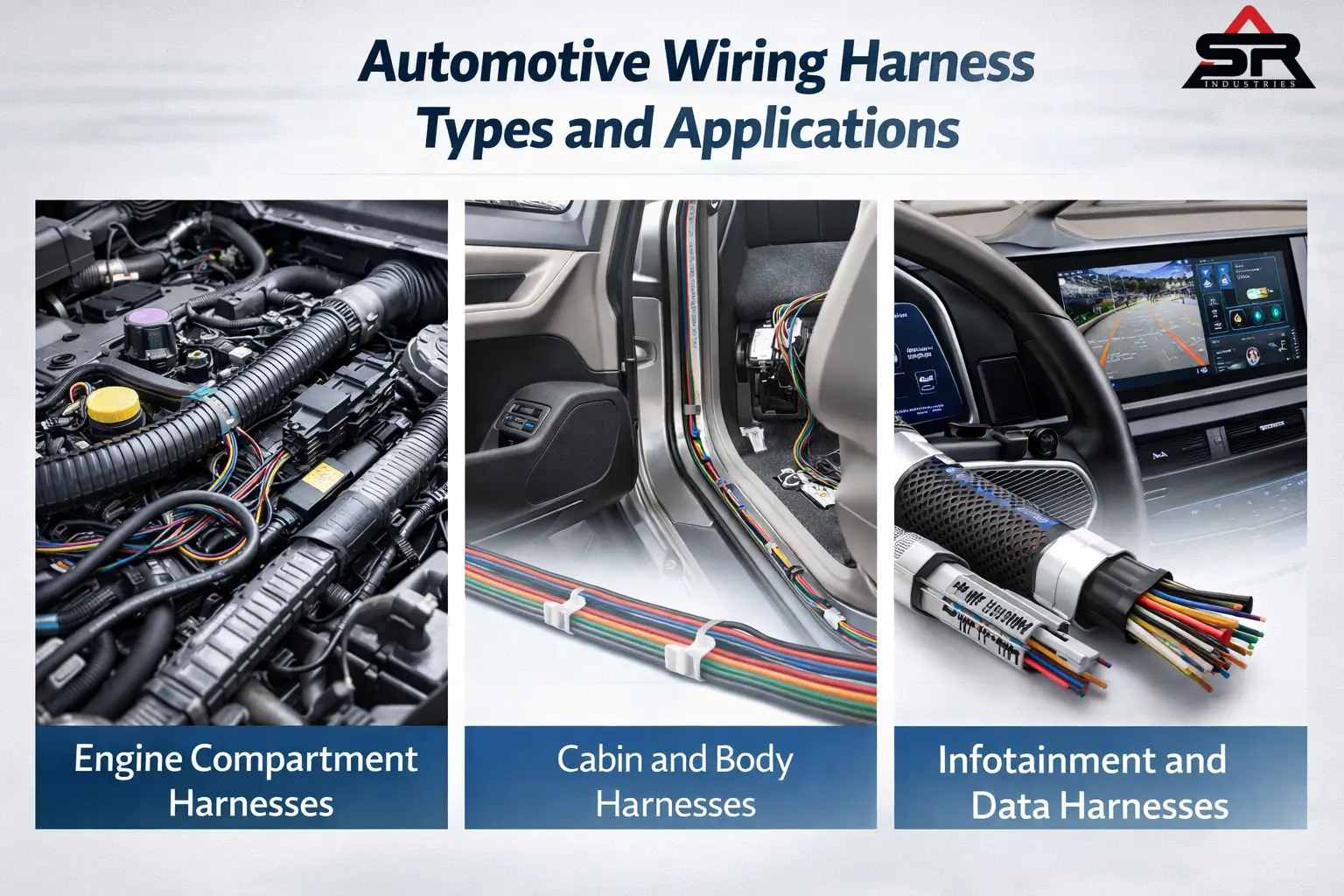
Automotive Wiring Harness Types and Applications
Key Features of Automotive Wiring Harness:
- Built to survive extreme under-the-hood temperatures and constant heat fluctuations
- Engineered to resist exposure to oil, coolant, fuel, and harsh automotive chemicals
- Includes multiple sub-harnesses like engine, body, and infotainment systems
- Designed with a strong focus on weight reduction to improve vehicle efficiency
- Optimized for tight spaces with flexible routing across complex vehicle structures
Ask any automotive engineer what keeps them up at night. Wire weight is easily in the top three.
The modern internal combustion engine (ICE) vehicle is basically a server rack rolling down the highway. It relies heavily on highly specialized automotive wiring harness types. A fully loaded luxury vehicle packs over two miles of copper wire. That wire weighs roughly 150 to 200 pounds. Because of this, an automotive wiring harness supplier must constantly balance electrical load with severe weight reduction targets.
Engine Compartment Harnesses
This is a brutal environment. Under the hood, temperatures easily spike over 150°C (300°F). Fluids leak constantly. Motor oil, coolant, brake fluid, and gasoline will eat through cheap plastics in weeks.
Engine harnesses utilize cross-linked polyethylene (XLPE) insulation. Why? It refuses to melt under sudden thermal shocks. We wrap these bundles heavily in heat-reflective foil tapes and high-temperature convoluted tubing to bounce the radiant heat of the exhaust manifold away from the copper.
Cabin and Body Harnesses
Inside the cabin, the temperature is friendlier. But the complexity is insane. The body harness connects the doors, power seats, window motors, ambient interior lighting, and the climate control system. Space is heavily restricted.
Engineers use flat wiring harness designs here. They snake them flat under the carpets and behind tight door panels where round bundles simply wouldn’t fit.
Infotainment and Data Harnesses
Twenty years ago, cars just needed a 12V power line to the AM/FM radio. Today’s vehicles require high-speed data transmission. Think 4K backup cameras, LiDAR modules, and massive OLED touchscreen displays.
These data harnesses rely on shielded twisted pairs and coaxial cables. They physically block the electromagnetic interference (EMI) generated by the alternator and the spark plugs from corrupting the digital video signals.
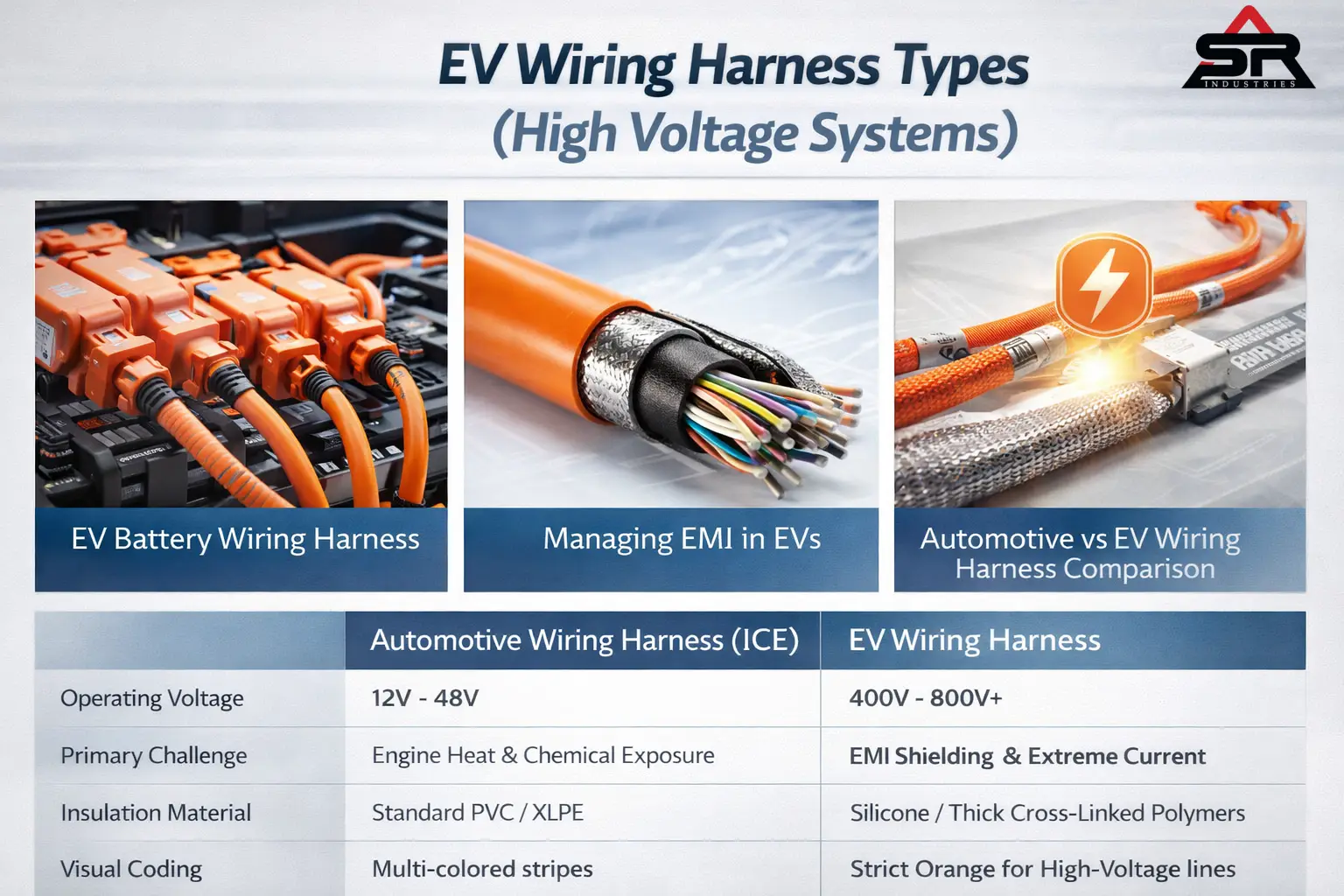
EV Wiring Harness Types (High Voltage Systems)
Key Features of EV Wiring Harness:
- Designed to handle high-voltage systems ranging from 400V to 800V and beyond
- Uses thick conductors to carry high current safely across battery and motor systems
- Advanced shielding to prevent electromagnetic interference (EMI)
- Clearly marked with orange insulation for high-voltage safety identification
- Built with heat-resistant and flame-retardant materials for maximum protection
Electric vehicles changed the entire engineering game overnight. The difference between standard automotive wires and EV wiring harness types is staggering.
A standard car runs on 12 to 48 volts. A modern EV operates at 400 to 800+ volts. That kind of power doesn’t just give you a bad shock. It instantly vaporizes metal tools.
The EV Battery Wiring Harness
The absolute core of an EV is the battery pack. The harness connecting that battery to the inverter and the electric traction motors is massive. We are talking about thick, heavy-gauge copper or aluminium cables capable of carrying hundreds of continuous amps.
These high-voltage cables share a universal safety standard across every manufacturer: they are bright orange. This aggressive visual coding tells first responders and mechanics to stay far away unless the system is fully discharged and locked out.
Managing EMI in EVs
High-voltage switching inside an EV inverter creates massive amounts of electromagnetic noise. If left unchecked, this noise will completely jam the vehicle’s low-voltage sensors, like the steering angle sensor or the airbag modules.
Therefore, an EV wiring harness manufacturer must heavily shield the high-voltage lines. They wrap the internal conductors in heavy-duty braided copper shields. They ground those shields directly to the vehicle chassis to drain the noise away from the sensitive data lines.
Automotive vs EV Wiring Harness Comparison
Feature / Metric | Automotive Wiring Harness (ICE) | EV Wiring Harness |
Operating Voltage | 12V – 48V | 400V – 800V+ |
Primary Challenge | Engine Heat & Chemical Exposure | EMI Shielding & Extreme Current |
Insulation Material | Standard PVC / XLPE | Silicone / Thick Cross-Linked Polymers |
Visual Coding | Multi-colored stripes | Strict Orange for High-Voltage lines |
Shielding Needs | Minimal (Mostly infotainment) | Heavy duty braided metallic shields |
As shown above, EV wiring harness systems are significantly more complex than traditional automotive wiring harness due to higher voltage, advanced insulation, and EMI shielding requirements.
Industrial Wiring Harness Types for Heavy Machinery
Key Features of Industrial Wiring Harness:
- Engineered for continuous 24/7 operation in harsh industrial environments
- Highly resistant to vibration, abrasion, and mechanical stress
- Protected with oil, chemical, and moisture-resistant outer jackets
- Designed for heavy machinery, automation systems, and robotics applications
- Uses secure locking connectors to prevent failure due to movement or impact
Factory floors destroy fragile equipment. It’s a fact of life. Industrial machinery operates continuously, 24/7. Downtime on an automated assembly line costs thousands of dollars per minute. Therefore, an industrial wiring harness must be incredibly rugged. We don’t care about weight savings here. We care about sheer survival.
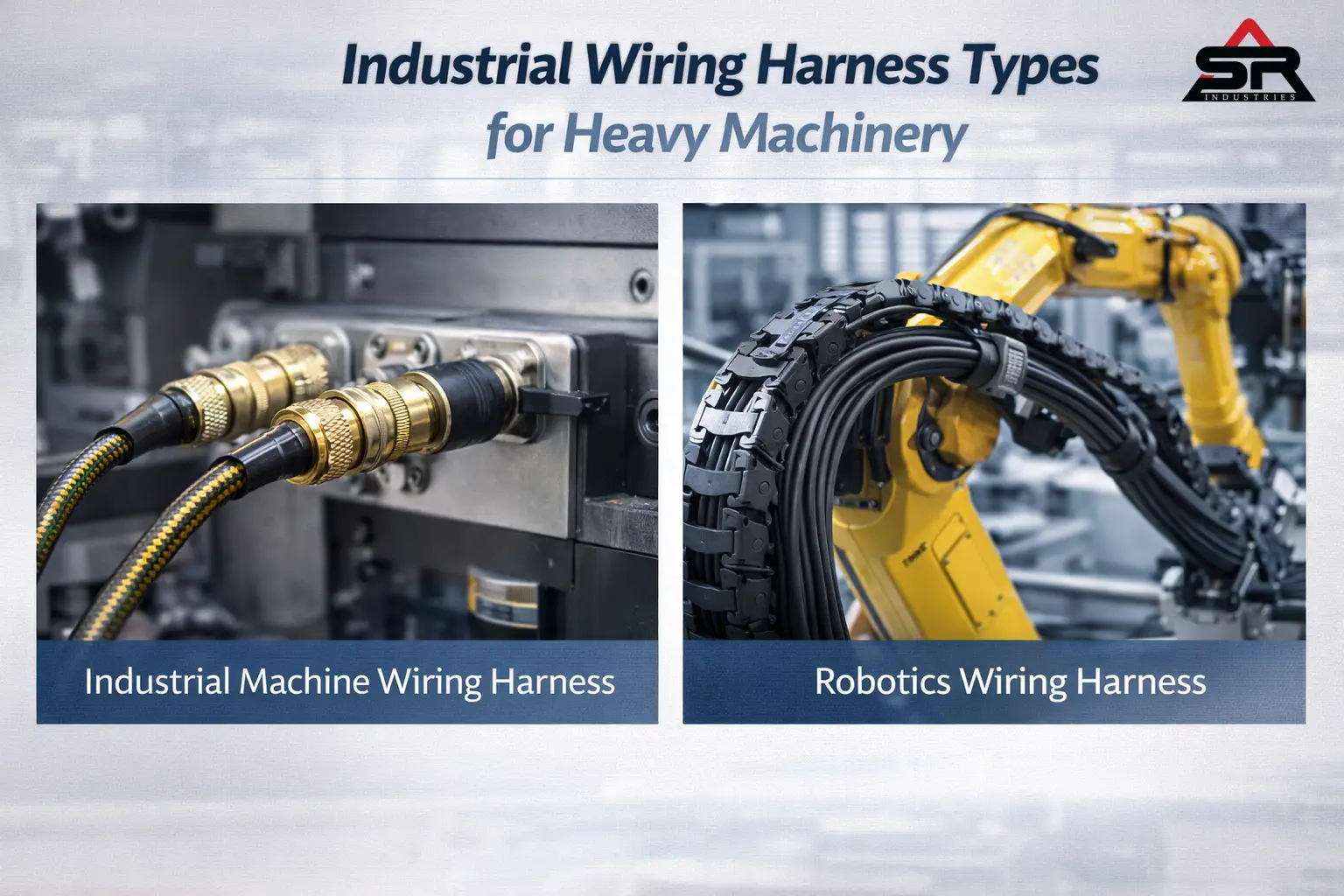
Industrial Machine Wiring Harness
Heavy machinery pulls massive power. Stamping presses, CNC mills, and automated conveyors vibrate violently all day long.
Constant vibration causes a phenomenon known as “fretting corrosion” at the connection points. The metal terminals rub against each other microscopically, wearing off the protective plating and increasing electrical resistance until the connection burns out. To combat this, industrial harnesses use heavy-duty, gold-plated circular connectors. They feature threaded locking mechanisms so they can never vibrate loose. They feature thick, oil-resistant outer jackets designed to withstand cutting fluids, hydraulic oil spills, and heavy impacts from dropped tools.
Robotics Wiring Harness
Key Features of Robotics Wiring Harness:
- Specifically designed for continuous bending, twisting, and motion cycles
- Uses high-flex cables with ultra-fine copper strands to prevent breakage
- Optimized for drag chain systems and dynamic movement environments
- Durable outer jackets like PUR to withstand abrasion and wear
- Ensures long operational life even under millions of flex cycles
Robotic arms present a totally different physical challenge. They move constantly. They bend, twist, reach, and retract thousands of times a shift. Standard copper wire will snap after a few thousand bends due to metal fatigue.
A robotics wiring harness uses “continuous flex” or “high-flex” cables. The individual copper strands inside the wire are extremely fine—almost like hair. This high strand count drastically increases flexibility. Furthermore, manufacturers lay these wires inside the jacket using special winding techniques to absorb torsional (twisting) stress.
Expert Pro-Tip: If your robotics harness fails after a million flex cycles inside a drag chain, you likely picked the wrong jacket material. Polyurethane (PUR) jackets outperform standard PVC significantly in high-abrasion, continuous-flex industrial environments. Stop cheaping out on the outer jacket. It costs you more in the long run.
Aerospace and Medical Wiring Harness Types
When a car harness fails, you pull over to the shoulder. When an aerospace or medical harness fails, people die. The manufacturing standards for these types of wire harness are incredibly strict. You do not cut corners here.
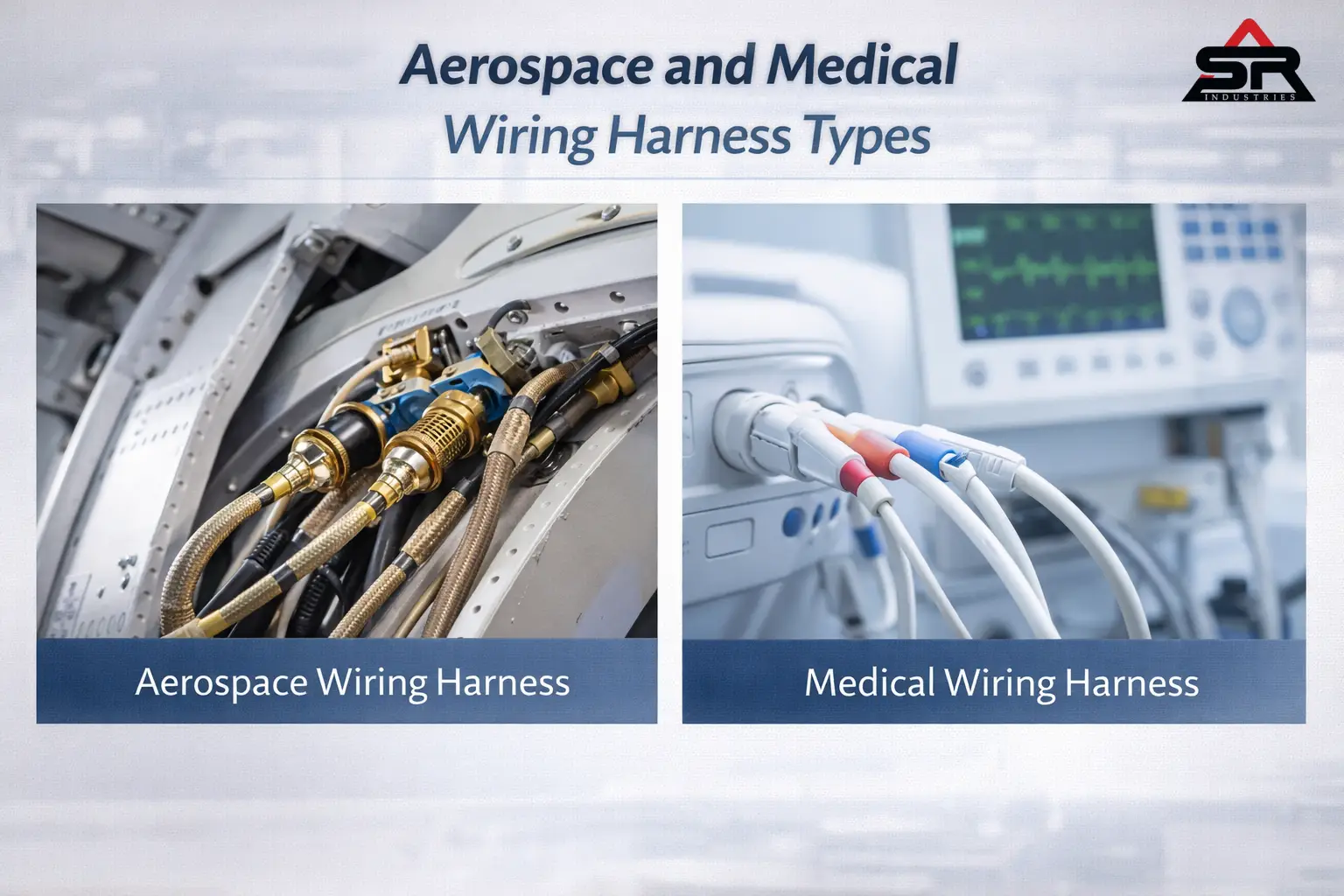
Aerospace Wiring Harness Types
Key Features of Aerospace Wiring Harness:
- Ultra-lightweight design to reduce overall aircraft weight
- Uses high-performance insulation like PTFE and Kapton for extreme conditions
- Resistant to high altitude temperature variations and fire hazards
- Built according to strict military and aviation standards (Mil-Spec, AS9100)
- Designed for maximum reliability with zero tolerance for failure
Weight is the enemy of flight. Every single ounce matters. Aerospace harnesses utilize exceptionally thin-walled insulation materials like extruded PTFE (Teflon) or Kapton tape. These materials are incredibly light. More importantly, they are completely fireproof and can easily withstand the massive temperature swings of high-altitude flight.
Connections in aerospace are rarely soldered. Solder is rigid. It cracks under the intense, high-frequency vibration of a jet engine. Instead, the aerospace industry relies on highly controlled, machine-calibrated crimping. The entire assembly must conform strictly to Mil-Spec (Military Specification) and AS9100 quality standards.
Medical Wiring Harness Applications
Key Features of Medical Wiring Harness:
- Manufactured using biocompatible materials safe for human contact
- Designed to withstand repeated sterilization and autoclave cycles
- Highly flexible and lightweight for medical device integration
- Ensures precise signal transmission for critical healthcare equipment
- Built under strict quality standards like ISO 13485
Medical harnesses face entirely different, yet equally severe threats. Biocompatibility is paramount. Wires attached to a patient’s skin—like EKG leads—cannot cause allergic reactions.
Furthermore, hospitals sterilize medical equipment constantly. Reusable surgical tools endure autoclaves. An autoclave blasts equipment with pressurized steam at 121°C (250°F). Standard plastics melt instantly in an autoclave. Medical wiring harness manufacturers use specialized, medical-grade silicone jackets. These jackets survive thousands of harsh sterilization cycles while remaining supple and flexible.
Wiring Harness Design Types: Off-the-Shelf vs. Custom Builds
When mapping out wiring harness applications for a new product, engineers face a hard choice: buy off-the-shelf or design custom.
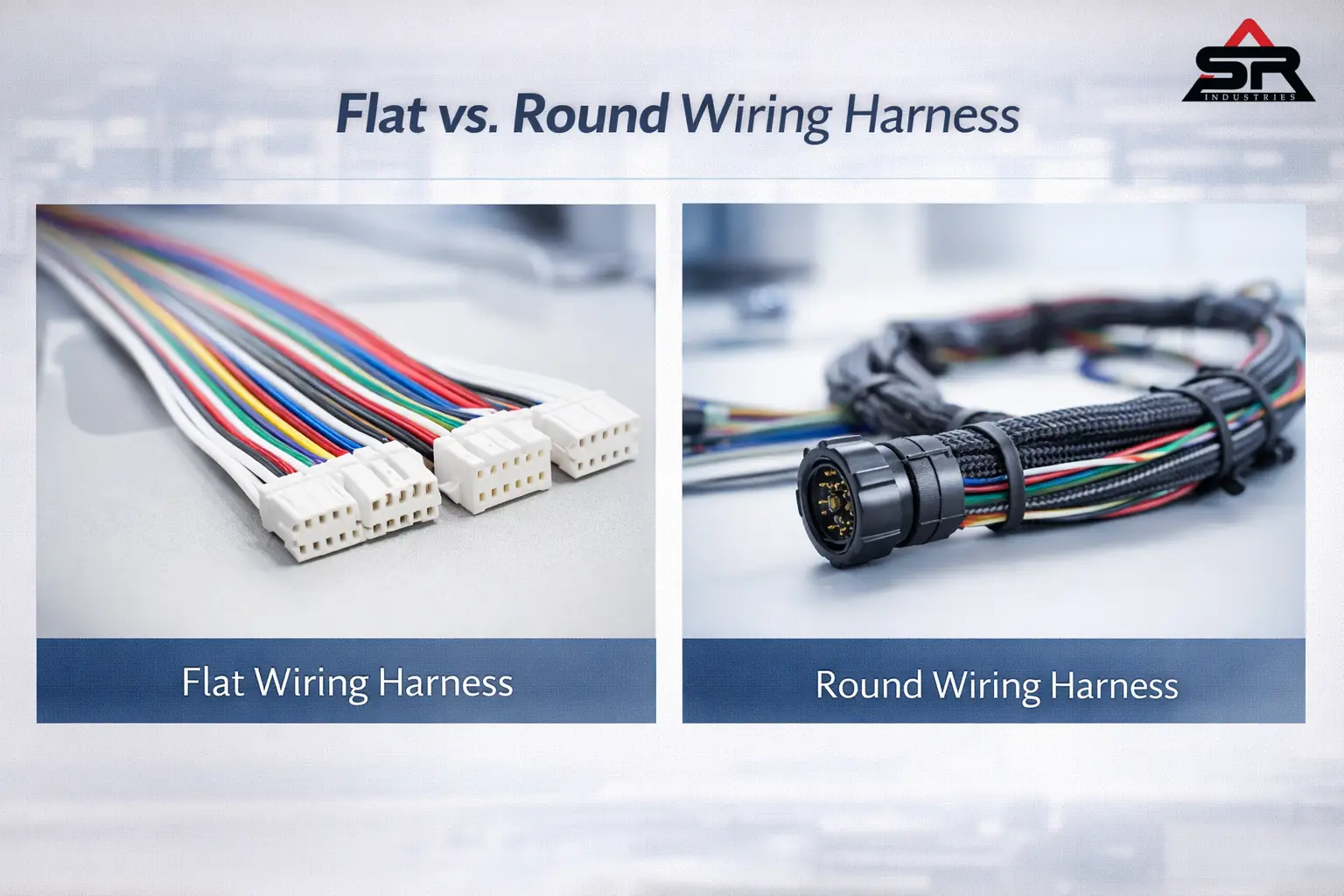
Flat vs. Round Harnesses
Key Differences Between Flat and Round Wiring Harness:
- Round harnesses offer better durability and are easier to protect against environmental damage
- Flat harnesses are ideal for tight spaces and provide better heat dissipation
- Round designs are more suitable for high-vibration environments
- Flat cables are commonly used in compact electronic systems
- Selection depends on space constraints, flexibility, and application requirements
The physical shape of the bundle matters immensely.
- Round Harnesses: This is the industry standard. Multiple wires bundled into a single round tube. They are easy to manufacture. They are easy to seal against water using circular rubber grommets. They are highly durable.
- Flat Harnesses (Ribbon Cables): Wires sit side-by-side in a flat plastic strip. They offer excellent heat dissipation because no wire is buried deep in the center of a bundle. They route easily under tight panels. However, they struggle badly with severe twisting motions.
Why Choose a Custom Wiring Harness Supplier?
For complex machinery, off-the-shelf parts rarely work. You need exact lengths. If the cable is too short, it won’t reach the sensor. If it’s too long, the excess cable loops around moving parts and gets shredded by a gear.
A custom wiring harness supplier maps the exact 3D routing of your machine. They select the precise wire gauge for your specific current draw. They choose connectors that mate perfectly with your chosen printed circuit boards (PCBs). Custom designs allow engineers to integrate “branches” and “breakouts” precisely where they are needed, creating a tailored, highly efficient electrical nervous system.
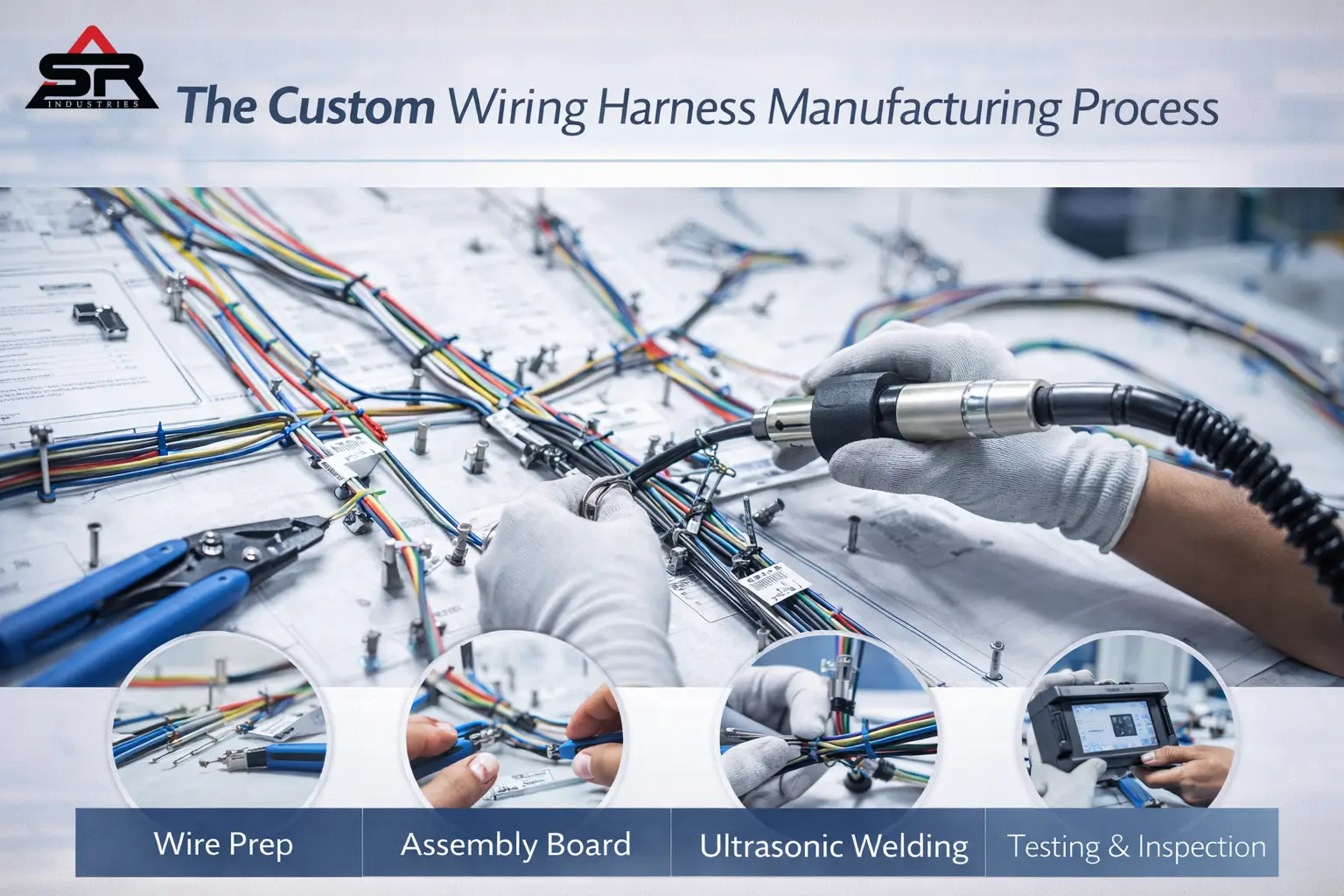
The Wiring Harness Manufacturing Process: Why Humans Still Build Them
We live in an age of highly automated factories. Yet, the wiring harness manufacturing process remains surprisingly manual.
Why? Because wires are limp, flexible, and entirely unpredictable. Robots excel at moving rigid parts like steel panels or heavy engine blocks. They struggle terribly with floppy strings of copper. While machines handle the basic prep work, human hands still dominate the final assembly. Here is the actual step-by-step breakdown.
1. Wire Prep: Cutting, Stripping, and Terminating
Robots run this initial phase entirely. Picture massive factory spools feeding raw cable into high-speed choppers. They cut it to exact millimeter lengths. Lasers or precision steel blades strip the plastic insulation off the ends without nicking the copper strands below. Finally, automated presses crimp metal terminals onto the bare wire using tons of mechanical force.
2. The Assembly Board (Pin Board)
This is where it gets highly manual. Workers stand in front of massive wooden or digital assembly boards covered in metal pegs. Think of the board as a life-sized, physical blueprint. Workers grab those pre-cut wires and weave them by hand through a maze of metal pegs. They build the assembly from the inside out—laying down the thick central trunk first, followed by the thinner breakout lines.
3. Splicing and Ultrasonic Welding
You’ll constantly run into situations where five or six wires must share one single ground. Instead of messy solder, factories use ultrasonic welders. The equipment shakes the bare copper strands together so fast—and so violently—that the friction melts the metal into one solid nugget. Zero external heat required.
4. Taping, Tying, and Looming
Once the wires are routed perfectly on the board, they must be bound together so they hold their shape. Workers wrap the bundles tightly in specialized fabric friction tape, apply zip ties at exact intervals, or slide the whole assembly into a protective corrugated plastic tube (split loom).
5. Exhaustive Testing Protocols
You never ship a harness without testing it. Advanced digital testing boards check every single connection.
- Continuity Checks: Does wire A actually hit sensor B? This instantly catches human errors, like a technician accidentally pinning a lead into slot 4 instead of slot 5.
- Destructive Pull Tests: A specialized machine grabs the crimped terminal and yanks it hard. If the wire slips out under pressure, the crimping press needs recalibration.
- Hi-Pot (High Potential) Zaps: We blast the assembly with way more voltage than it will ever see in the field. Why? To expose microscopic pinholes in the plastic jacket. A tiny scratch might look fine on the factory floor, but it causes a massive short circuit six months later.
Key Failure Modes in Electrical Harness Systems
Understanding the different cable harness types also means understanding exactly how they fail. Even the best designs die if misapplied. Here are the most common culprits.
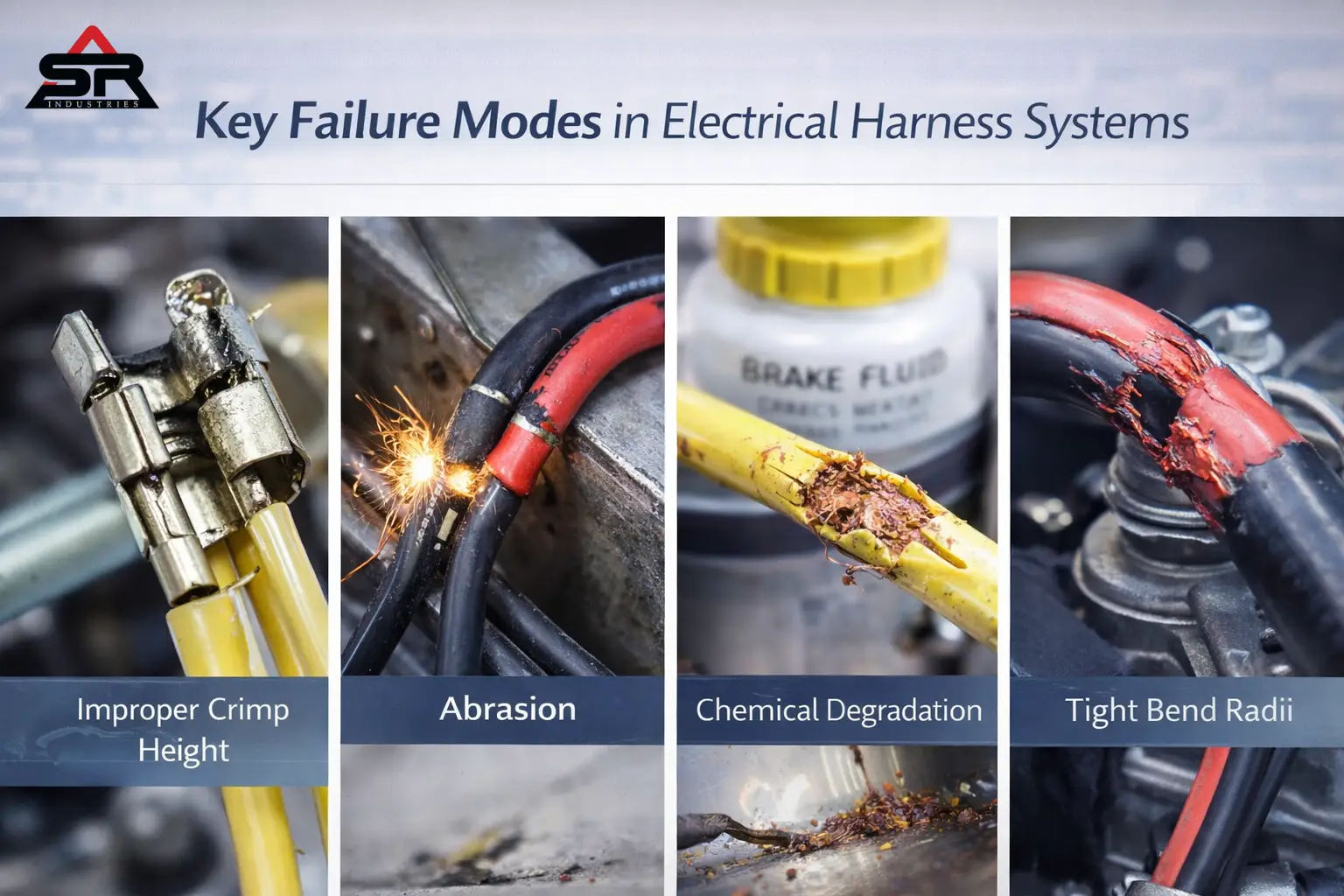
- Improper Crimp Height: If the automated press doesn’t squeeze the terminal hard enough, the wire easily pulls out. If it squeezes too hard, it crushes and fractures the copper strands. This drastically increases electrical resistance and creates a massive fire hazard.
- Abrasion: Wires rubbing repeatedly against a sharp metal chassis edge will eventually wear right through their insulation. This is exactly why heavy-duty jacketing and edge-protection grommets are non-negotiable in an industrial wiring harness.
- Chemical Degradation: Using standard PVC wire in an environment exposed to brake fluid or industrial solvents will cause the plastic to become brittle, crack, and expose bare live wires.
- Tight Bend Radii: Forcing a thick wire to make a sharp 90-degree turn strains the outer edge of the wire jacket. Over time, heat cycling causes that strained plastic to split wide open.
The Future: Zonal Architectures and Smart Cables
The traditional approach to vehicle and machine wiring is dead. It has reached its physical limit. You cannot keep adding more wires for every new sensor. The weight and complexity are becoming impossible to manage.
The engineering industry is rapidly shifting toward Zonal Architecture. Instead of one massive, heavy central harness routing every single wire back to a main computer, engineers are breaking the system down. A single, high-speed data backbone connects regional “hubs” located in the corners of the vehicle or machine. Shorter, smaller, localized harnesses then connect the sensors to their nearest hub.
This drastic shift severely reduces overall copper weight. It simplifies the manufacturing process. It makes diagnosing electrical faults infinitely easier.
Furthermore, we are seeing the rise of smart harnesses. These feature printed electronics and fault-detection sensors embedded directly within the jacket. These harnesses can literally tell the main computer if they are experiencing excessive heat or mechanical strain before a catastrophic electrical fire occurs.
Understanding the hard differences between automotive, industrial, and high-voltage EV applications gives you total control over your hardware design. Stop treating cables as an afterthought. Engineer your connections with the same rigorous, uncompromising logic you apply to your main processors and physical chassis.
Frequently Asked Questions (FAQ)
Q1. How many types of wiring harness are there?
A: There are five primary categories based entirely on industry application: Automotive, Electric Vehicle (High-Voltage), Industrial/Robotics, Aerospace/Military, and Medical. Within these broad categories, there are thousands of sub-variations depending on connector styles, insulation materials, and precise environmental requirements.
Q2. What are the best wiring harness types for industrial machines?
A: For harsh industrial machines, the best choice is a heavily jacketed, oil-resistant harness utilizing Polyurethane (PUR) or Thermoplastic Elastomer (TPE) insulation. If the machine involves moving parts like a robotic arm, you must specifically source a “continuous-flex” harness designed to endure millions of bending cycles without metal fatigue.
Q3. Why are EV wiring harness types so expensive?
A: EV wiring harnesses handle immense power (400V to 800V+) compared to standard 12V cars. They require highly specialized, thick-gauge copper or aluminum conductors. They need heavy braided metallic shielding to block electromagnetic interference (EMI). They also use highly engineered silicone or XLPE insulation to prevent melting and catastrophic high-voltage arcing. All of this drives the cost up significantly.
Q4. What is the difference between a cable assembly and a wiring harness?
A: Think of a cable assembly like a heavy-duty extension cord. It’s usually just one thick outer jacket protecting a few wires that all travel to the exact same destination. Simple. A wiring harness? That’s an entirely different beast. It’s a massive, sprawling network. You’ve got dozens—sometimes hundreds—of individual wires breaking out at completely different intervals. A harness routes specific power and precise data to ten different sensors across an entire machine, all physically held together by specialized looms, tape, or zip ties.
Q5. How do I choose the right custom wiring harness supplier?
A: Certifications. Period. If a manufacturer can’t hand you industry-specific paperwork on day one, walk away. Building medical gear? You strictly need an ISO 13485 facility. Supplying aerospace parts? Demand AS9100. But don’t stop at the paperwork. Ask about their testing floor. If they rely on workers just visually eyeballing the wire crimps, you will experience expensive field failures. Insist on partners who run high-voltage Hi-Pot machines and automated pull-force destruction tests on every single production batch.