
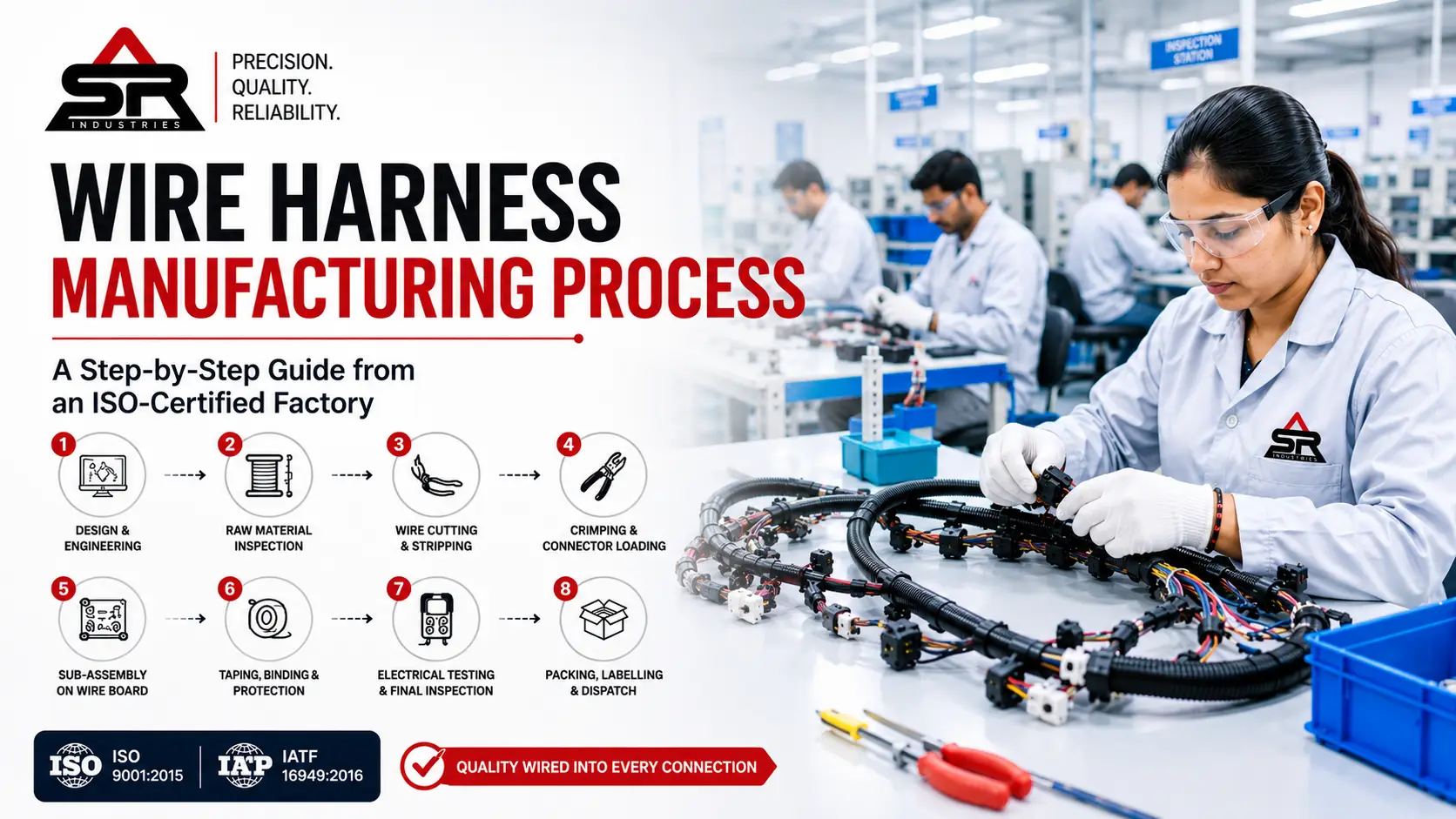
Wire Harness Manufacturing Process: Step-by-Step
Wire Harness Manufacturing Process: A Step-by-Step Guide from an ISO-Certified Factory
There is a number that tends to surprise people the first time they hear it.
A single passenger car — the kind sitting in millions of driveways right now — contains somewhere between 1,500 and 2,000 individual wires. Stretched out end to end, that wiring would cover nearly three kilometres. Every single wire has a job. Every single wire has to be exactly the right length, connected to exactly the right terminal, routed through exactly the right path, and verified before that vehicle goes anywhere near a customer.
That is what wire harness manufacturing actually is. Not just bundling wires together — engineering a system where nothing is left to chance.
Most content written about this topic reads like it was assembled from a glossary. Definitions stacked on definitions, with no sense of what actually happens on a factory floor. This guide is different. What follows is a detailed, honest account of how wire harnesses are built at ASR Industries — a manufacturer with over two decades of experience, five production facilities across India, and current certification to both ISO 9001:2015 and IATF 16949:2016.
Wire Harness vs Cable Assembly vs Wiring Loom — Getting the Terms Right
Before anything else, it is worth being precise.
A wire harness is a structured, application-specific assembly of multiple wires and cables, routed and bundled according to a defined circuit layout. It has a specific geometry. It is built for a specific product. The routing, branch points, connector positions, and protective elements are all engineered to match exactly where that harness will live inside the finished product — whether that is an automobile, an EV battery system, a solar inverter, or a home appliance.
A cable assembly is simpler. Typically one or more cables, terminated at both ends with connectors, without the complex branching architecture of a harness. Think of it as a single connection point to point. A wire harness, by contrast, might serve twenty different circuits simultaneously, with branches running in four different directions.
The term wiring loom means the same thing as wire harness. It is older British automotive industry terminology that still shows up regularly in technical documents, particularly in the UK and in legacy documentation for European OEMs.
The components that go into any harness — regardless of complexity — are relatively consistent: copper conductors of a specified grade and gauge, insulation material selected for the temperature and voltage environment, terminals crimped onto wire ends, connector housings that position and protect those terminals, and a range of protective elements (tape, conduit, grommets, heat-shrink tubing, clips) that hold everything in place and shield it from the mechanical and environmental conditions it will face in service.
ASR Industries manufactures harnesses across all major application categories — automotive, EV, two-wheeler, solar, home appliances, inverters, and general industrial electronics. That breadth matters, because it means the production process has to be genuinely flexible. A two-wheeler instrument cluster harness and a high-voltage EV battery harness are very different products, but both demand the same underlying commitment to process discipline.
Step 1: Design and Engineering
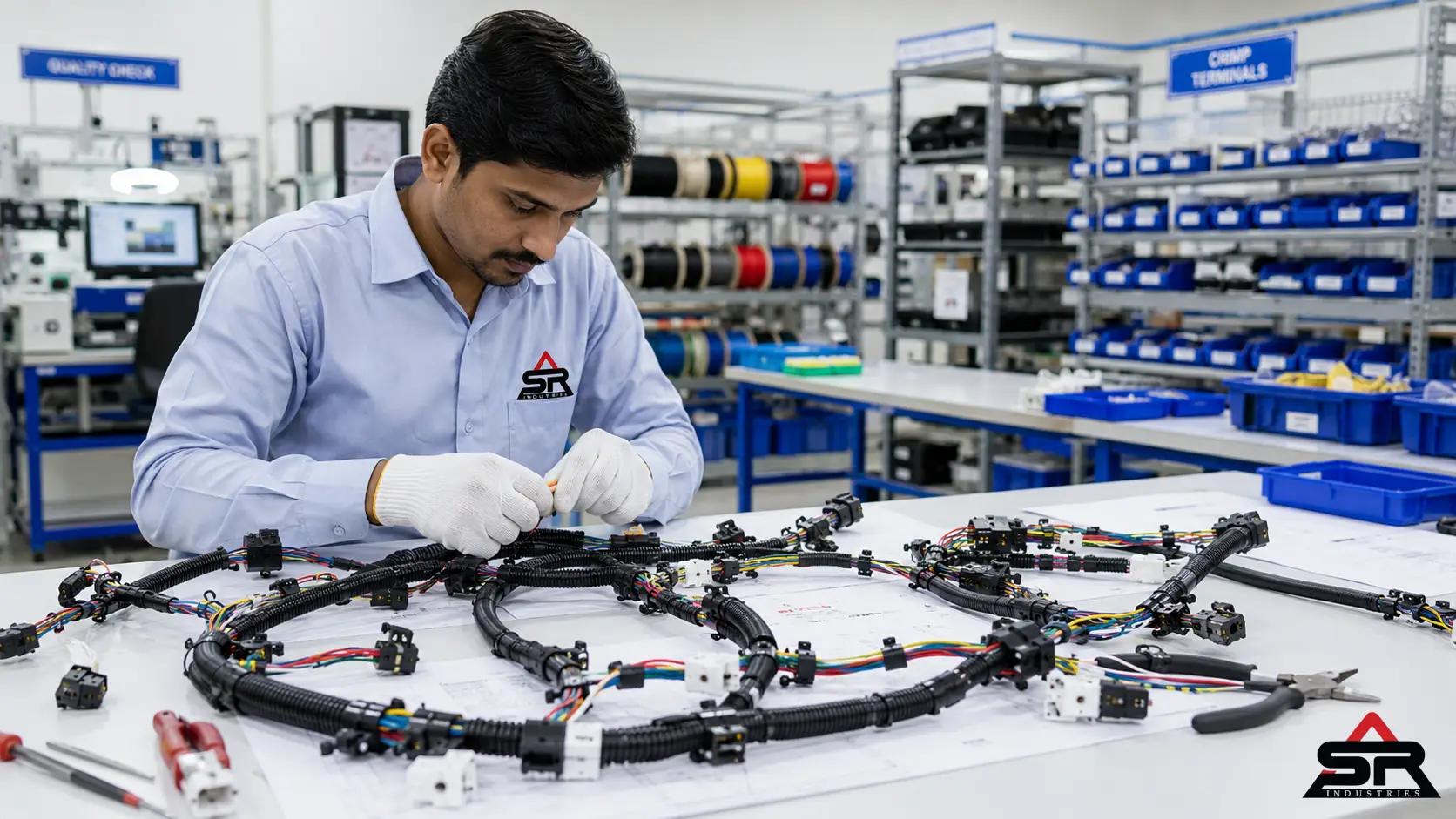
Nothing goes to the production floor without a complete, approved design. That sentence sounds obvious. In practice, skipping or shortcutting this stage is the single most common reason wire harness projects go wrong.
The process starts with the customer’s technical requirements. Not a conversation, not a rough sketch — a formal specification. Current and voltage ratings for every circuit, connector types and approved part numbers, wire gauge requirements, routing constraints (which often come from a 3D model of the product showing exactly where the harness has to travel), temperature and environmental ratings, regulatory and certification requirements, and any OEM-specific standards that apply on top of the industry baseline.
From those requirements, the engineering team builds a schematic — a complete circuit map that defines every electrical connection in the harness. Wire gauge is selected by calculating the current-carrying requirement for each circuit and then applying the appropriate derating factors for temperature, bundling, and insulation type. Connector selection balances electrical performance, environmental rating, mating force, and compatibility with the customer’s corresponding connector on the mating side.
The schematic drives the Bill of Materials, which is exactly what it sounds like: a complete list of every component that will go into one unit of the harness, with exact specifications and quantities. The BOM is not just a purchasing document — it is the reference point that quality control uses at every subsequent stage of production.
Running alongside this is a Design Failure Mode and Effects Analysis, known as DFMEA. This is a structured, formal exercise where the engineering team systematically asks: what could go wrong with this design, how bad would it be if it did, and what needs to be built into the design or the process to prevent it? Under IATF 16949 — the automotive quality standard that governs ASR Industries’ production — DFMEA is not optional. It is a required deliverable, documented and traceable.
The design is released to production only after customer sign-off. In many cases, that sign-off follows a prototype build and first-article inspection. This adds time at the front of a project, but it eliminates the far more expensive problem of discovering design issues after volume production has started.
Step 2: Raw Material Sourcing and Incoming Inspection
A harness manufactured to a correct design from substandard materials will still fail. This is not a theoretical concern — it is the root cause of a significant proportion of real-world field failures that get attributed to “manufacturing defects” when the actual problem is material quality.
Wire selection starts with conductor material. Copper is the default for automotive and industrial applications because of its combination of electrical conductivity, flexibility, and ductility. Within copper, conductor grade, stranding configuration (how many individual strands make up the conductor, and at what diameter), and temper all influence how the wire performs in use — particularly in applications where it will be flexed repeatedly or exposed to vibration.
Insulation material is chosen based on the operating environment. Standard PVC insulation handles most conventional applications. Cross-linked polyethylene (XLPE) is specified where higher temperature resistance is required. PTFE (Teflon) goes into applications where chemical resistance or high-temperature performance is critical. For high-voltage EV applications, insulation requirements are substantially more demanding than conventional 12V automotive wiring — both in terms of dielectric strength and mechanical robustness.
Connectors and terminals come from an approved vendor list — suppliers who have been formally qualified and who supply material certifications with every delivery. ASR Industries works with a network of over 300 qualified component suppliers.
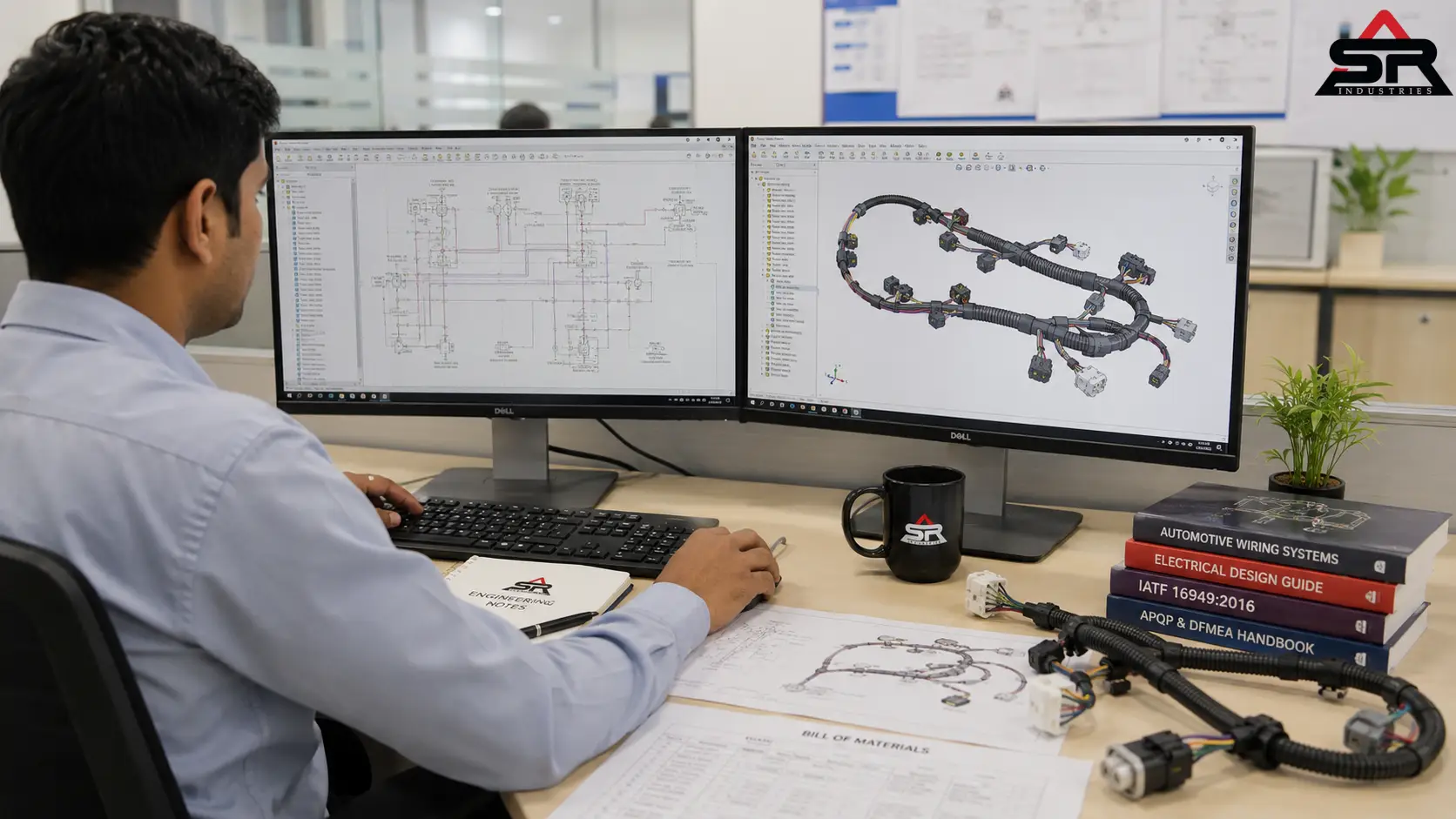
When materials arrive, they go through Incoming Quality Control before being released to production stores. Dimensional checks on terminals, visual inspection for damage or contamination, verification of material certifications against the specified requirements. Batch numbers are recorded at intake and tracked through every subsequent production stage. If a quality issue surfaces at any point downstream, that traceability allows the affected batch to be identified and contained immediately.
Material that does not pass IQC does not enter the production line. Full stop.
Step 3: Wire Cutting and Stripping
This stage looks straightforward from the outside. It is not.
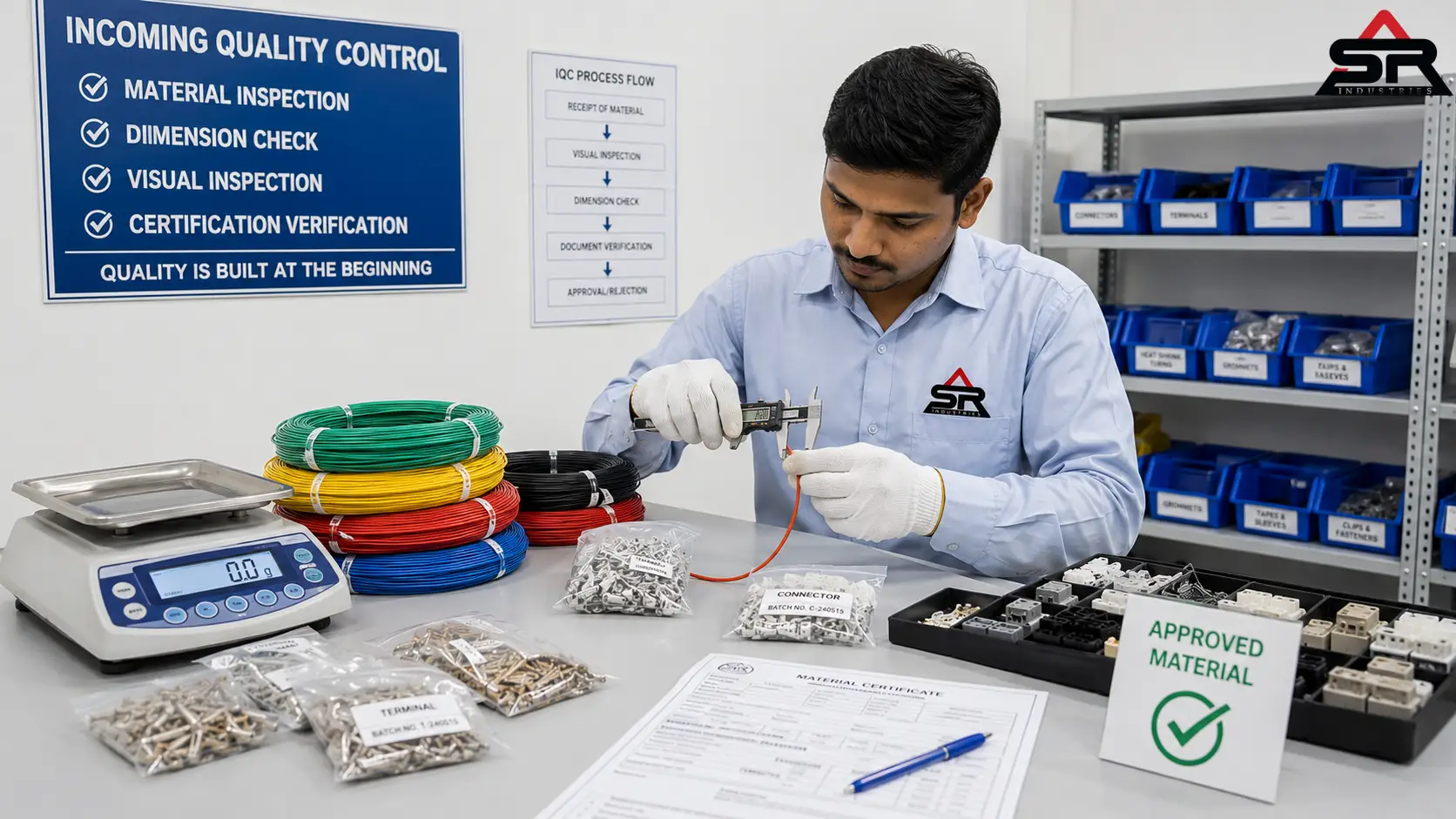
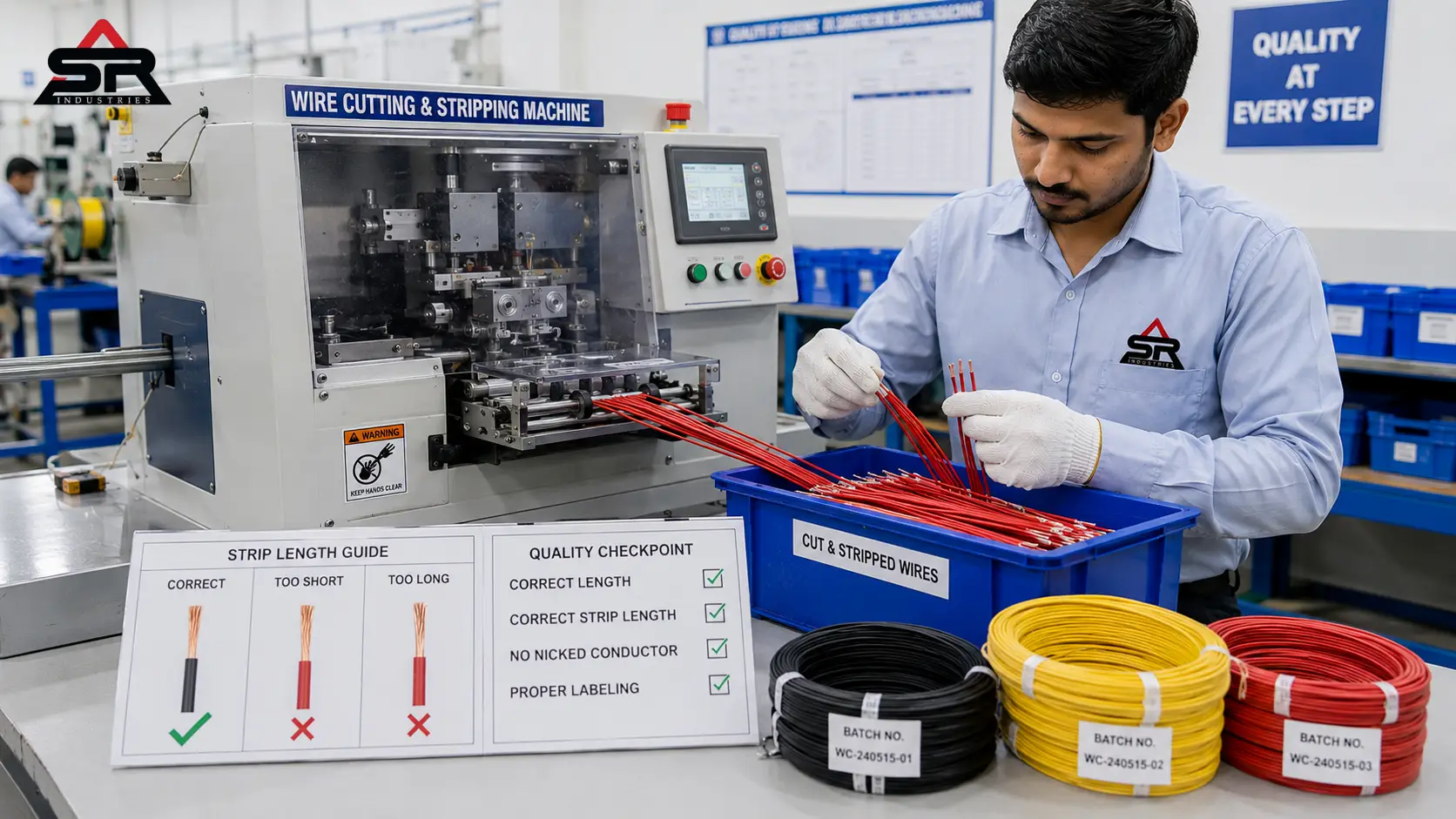
Wire cutting uses automatic equipment that processes each wire to the exact length specified in the BOM. Length tolerance is a real engineering parameter — ASR’s cutting equipment maintains tolerances of ±0.5mm across production runs. A wire cut slightly short puts stress on connector pins during routing. A wire cut slightly long creates slack that has to go somewhere, and in a tightly packaged product, that slack tends to find the worst possible place to go.
Stripping — removing insulation from the wire ends — happens simultaneously with cutting on automatic equipment. The strip length is specified precisely for each wire type and terminal combination. Too little conductor exposed and the crimp joint will be mechanically weak. Too much and the bare conductor extends beyond the terminal barrel, creating a short circuit risk wherever that wire end sits in proximity to anything conductive.
Quality checks happen at this stage before the batch moves forward. Visual inspection for correct strip length, absence of nicked conductors (where the stripping blade has damaged individual strands), and correct labelling of cut wire batches. Batches that do not pass the check do not move to the crimping stage.
ASR Industries operates 15 dedicated cutting machines for wire harness production, which provides both the capacity for volume production and the flexibility to run multiple wire types simultaneously across different production orders.
Step 4: Terminal Crimping and Connector Loading
If there is one stage in wire harness manufacturing where the difference between a competent supplier and a mediocre one shows up most clearly, it is here.
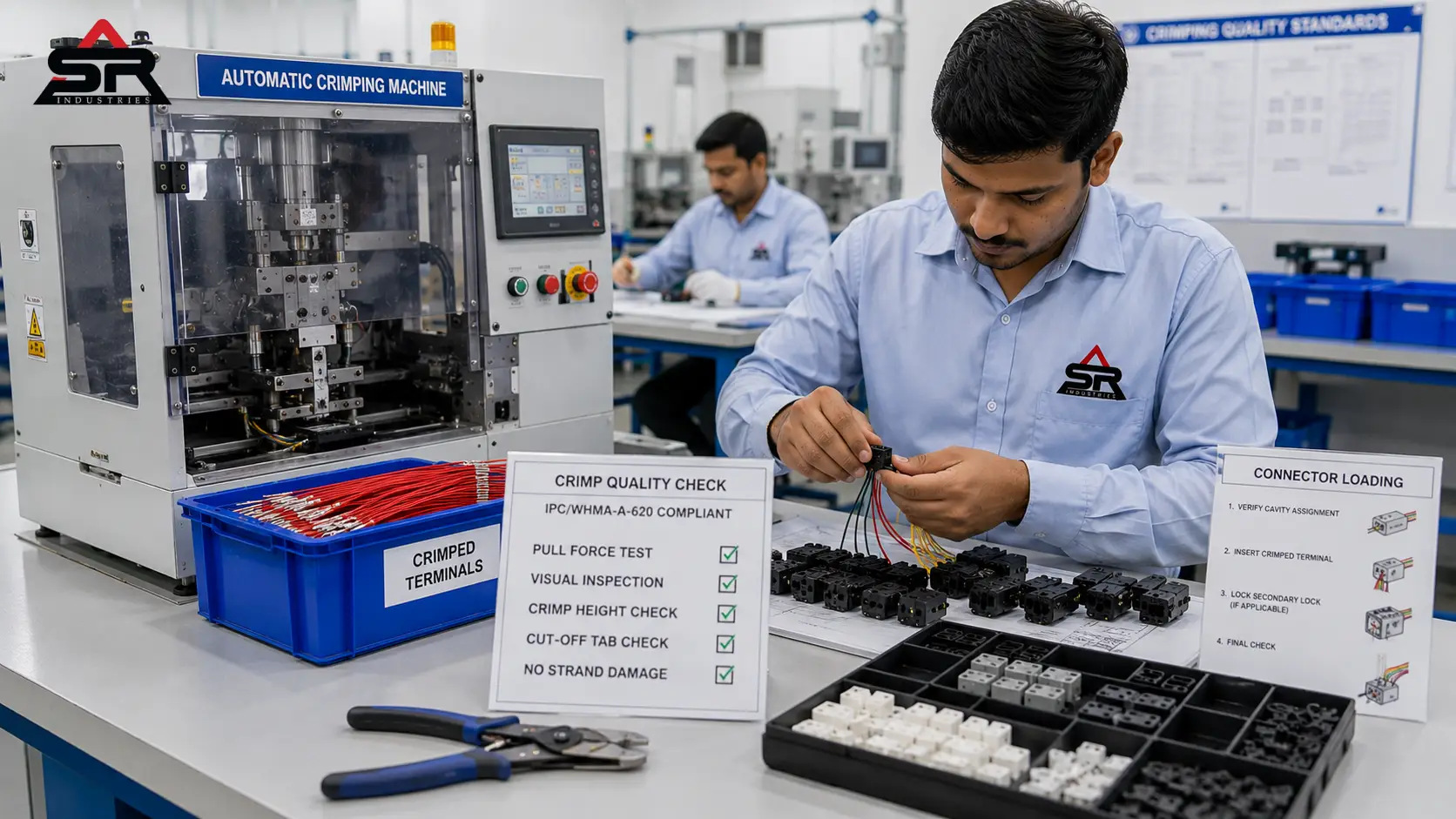
Crimping is the process of mechanically deforming a metal terminal barrel around the stripped end of a wire to create a gas-tight, low-resistance electrical connection. Done correctly, a crimped connection outperforms a soldered one in virtually every automotive and industrial performance metric — lower contact resistance over time, better vibration resistance, better performance through repeated thermal cycling. Done incorrectly, a crimped connection looks fine, tests fine initially, and then degrades in service in ways that are genuinely difficult to diagnose.
The quality of a crimp depends on three things that have to be precisely matched: the terminal specification, the wire specification, and the crimp tooling. Specifically, the die set geometry and the applied crimping force. Using the correct terminal with the correct wire but the wrong die produces a defective crimp — often with pull strength that meets the minimum requirement initially but contact resistance that rises over time as the joint works loose under thermal cycling.
ASR Industries runs 10 automatic cutting and double crimping machines. Automatic crimping equipment applies consistent, controlled force on every single cycle — eliminating the variability that comes with manual crimping. Pull force testing is conducted on samples from each production run against the requirements of IPC/WHMA-A-620, the international standard for cable and wire harness assembly acceptance. Periodic cross-sectional examination of crimp joints under magnification verifies conductor fill and compression ratios against specified targets.
After crimping, terminals are loaded into the correct cavities of connector housings. Cavity assignment has to exactly match the circuit schematic. A terminal inserted into the wrong cavity produces a harness that passes every mechanical test but fails every electrical test — and diagnosing which terminal is in which wrong cavity in a complex multi-circuit harness is exactly as tedious as it sounds. Getting it right the first time is the only acceptable approach.
Step 5: Sub-Assembly on the Wire Board
This is where the harness stops being a collection of components and becomes a recognisable product.
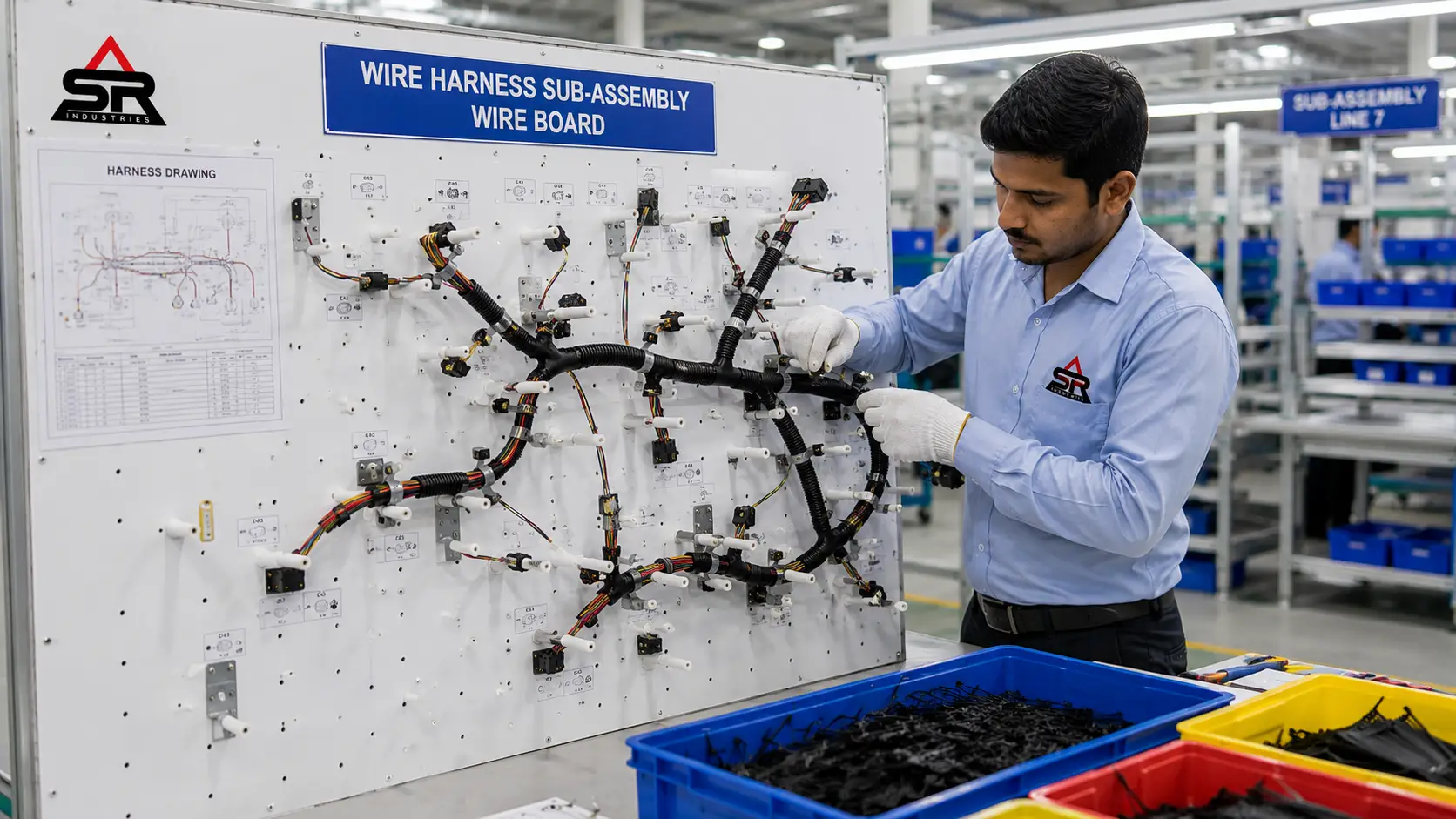
An assembly board — also called a wire board or fixture board — is a physical representation of the harness’s routing geometry. Pegs, clips, and fixtures are positioned on the board according to the approved harness drawing, mapping out exactly where each branch runs, where it bends, where connectors sit, and where protective elements are placed.
Assemblers route each sub-bundle along the correct path on the board, ensuring that branch separations happen at the correct positions and that the overall form matches the engineering drawing. Protective sleeves are slid over specified wire segments at this stage. Heat-shrink tubing — where specified — is positioned but not shrunk yet; that happens after the final geometry is confirmed.
ASR Industries operates 20 dedicated production lines for wire harness sub-assembly. Multiple product variants can run simultaneously without cross-contamination of materials or documentation. Each line operates from written Work Instructions that are controlled documents under the quality management system — reviewed, approved, and updated through a formal change management process. Operators are trained against those specific work instructions, and training records are maintained and auditable.
Step 6: Taping, Binding, and Protection
Once the harness geometry is established on the assembly board, the bundles are secured and protected.
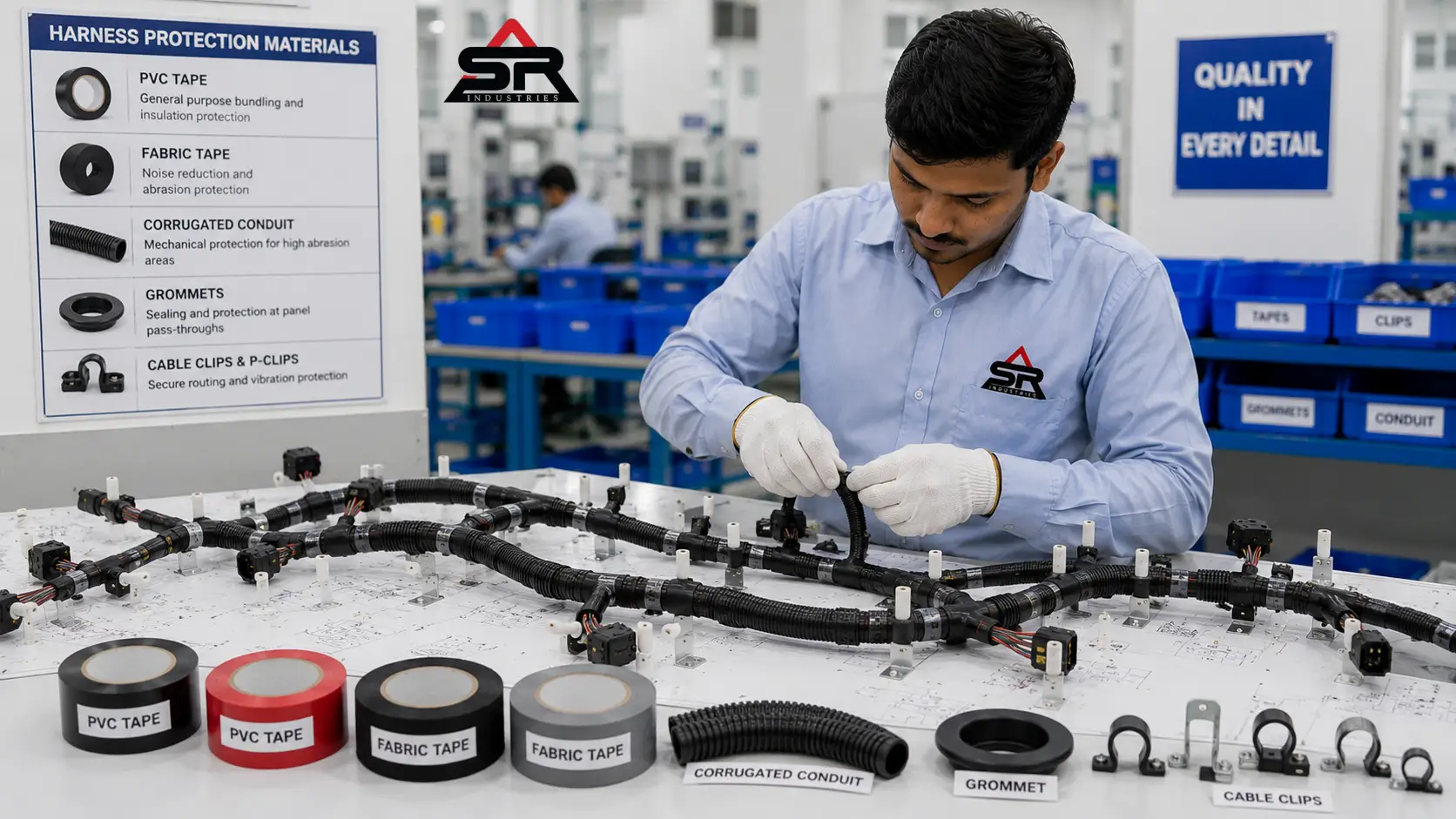
The wrapping material is not a cosmetic choice. PVC tape is the standard for general-purpose applications — cost-effective, available in multiple colours for circuit identification, and adequate for most operating environments. In automotive cabins and EV battery enclosures, fabric tape is often specified instead of PVC. Fabric tape has slight damping characteristics that reduce the noise generated by wires vibrating against vehicle structure — relevant because NVH (noise, vibration, and harshness) performance is an OEM requirement, not just a comfort preference.
Where the harness routes through areas with elevated abrasion risk, sharp edges, or higher temperatures, corrugated split conduit provides the mechanical protection that tape alone cannot deliver. Grommets seal and protect harness pass-throughs at panel apertures — preventing moisture and contaminants from migrating through the opening and protecting the harness from the panel edge. Cable clips and P-clips are installed at specified intervals to provide positive routing and prevent the harness from contacting moving components.
None of these choices are made by the assembler on the day. They are all specified in the engineering design, controlled by the work instructions, and verified at inspection.
Step 7: Electrical Testing and Final Inspection
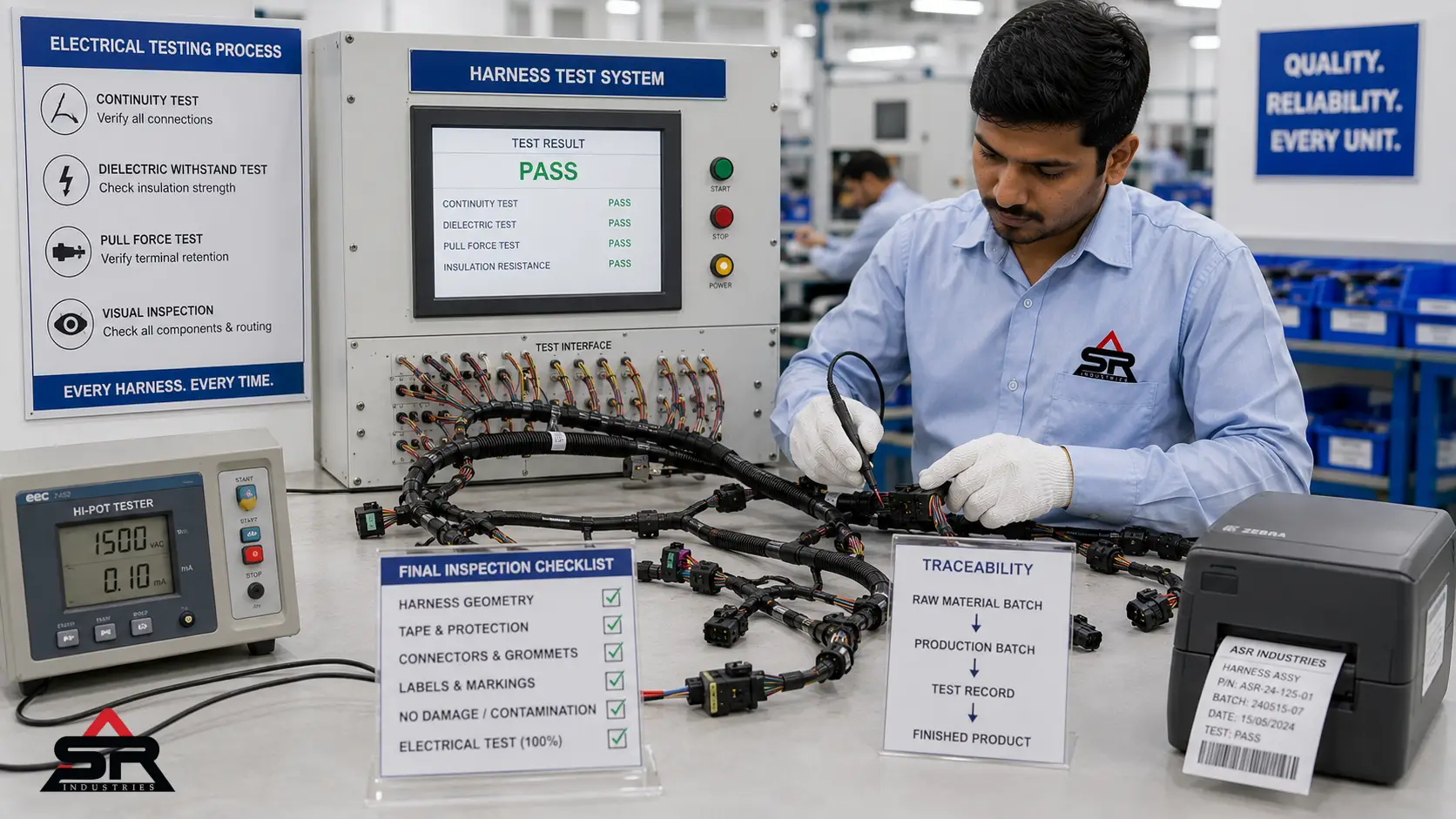
Every unit. Not every tenth unit, not a statistical sample — every single harness produced at ASR Industries goes through electrical testing before it is released.
Continuity testing verifies that every electrical connection is correctly made — that the circuit from connector A pin 3 to connector B pin 7 actually exists, and that no unintended connections exist between circuits that should be isolated. This is done using a dedicated harness test board that mirrors the complete circuit map of the harness, checking every connection simultaneously.
Dielectric withstand testing (high-voltage testing) applies a voltage significantly higher than the harness’s rated operating voltage across the insulation system to verify that the insulation can withstand transient overvoltages. Pass criteria depend on the application standard. For high-voltage EV applications, the test voltage requirements and acceptance criteria are substantially more demanding than conventional low-voltage automotive.
Pull force testing on the completed assembly verifies that terminals are properly seated and retained in their connector housings. A terminal that is not fully inserted — a condition sometimes called TNFS (terminal not fully seated) — will pass a continuity test. It will also disengage in service at the first significant connector mating cycle or vibration event.
Visual inspection by trained QC personnel runs in parallel, working against a defined checklist: harness geometry against drawing, tape coverage and quality, connector and grommet installation, label position and legibility, absence of any visible damage or contamination.
Test records for every unit are maintained as quality documents — traceability from finished product back to the raw material batch, in both directions. That traceability is an IATF 16949 requirement, and it is also genuinely useful when something unexpected happens in the field.
Step 8: Packing, Labelling, and Dispatch
A harness that has passed all testing can still be damaged or create downstream problems if the packing stage is handled carelessly. This is the part of the process that manufacturing people sometimes undervalue, and procurement people — who deal with the consequences — tend to feel strongly about.
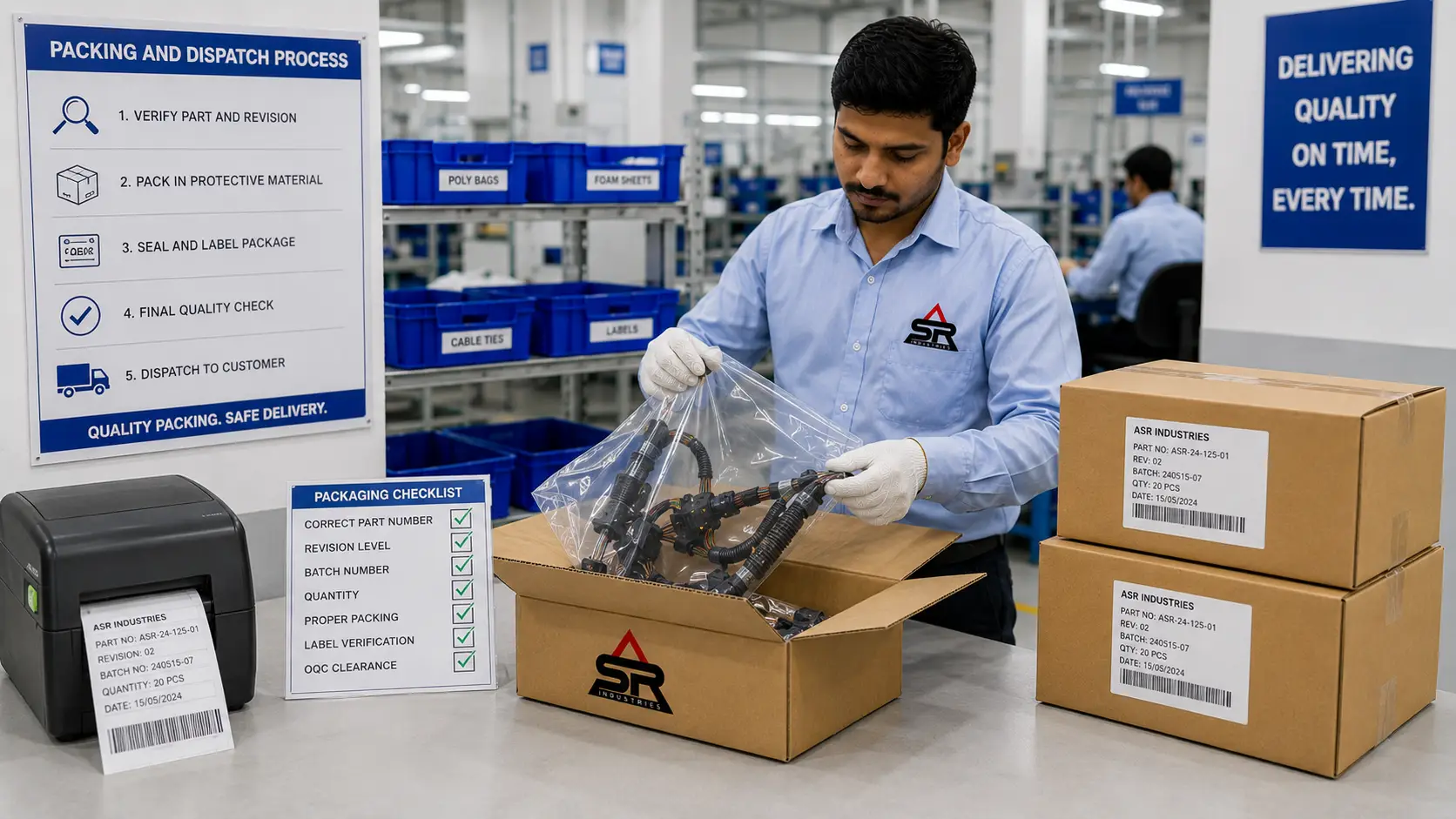
Harness geometry determines the packing method. Flat, simple harnesses go into poly bags with appropriate foam or layer protection. Complex three-dimensional harnesses that cannot be folded without stressing branch points require custom thermoformed trays or specially engineered carton inserts that hold the harness in its natural form throughout transit and storage.
Every package is labelled with the information the customer’s incoming goods process requires: part number, revision level, batch number, production date, quantity, and any customer-specific barcode or data matrix requirements for their production scanning systems. Label content and format are defined in the customer’s packaging specification, agreed during PPAP.
Before dispatch, Outgoing Quality Control samples each batch against the finished product specification. Batches that fall short of OQC acceptance criteria are quarantined for investigation, not shipped.
The geographic distribution of ASR’s five plants — covering Noida, Delhi NCR, Haryana, Uttarakhand, and Rajasthan — means that customers in northern and central India can be served with realistic lead times from a facility that is genuinely close to their operations, not one that is nominally present in a region through a distribution arrangement.
What ISO and IATF Certifications Mean in Practice
It is worth being direct about this, because certifications get listed so routinely on supplier qualification forms that they can start to feel meaningless.
ISO 9001:2015 establishes and requires a documented, third-party-audited quality management system. Not a quality promise — a system with documented processes, controlled documents, recorded data, structured nonconformance management, corrective action tracking, and formal management review. The certification means an accredited external auditor has verified that the system exists and functions. It has to be re-verified through annual surveillance audits and full recertification every three years.
IATF 16949:2016 is ISO 9001 plus automotive-specific requirements: Advanced Product Quality Planning (APQP), Production Part Approval Process (PPAP), Design and Process FMEA, Measurement System Analysis, Statistical Process Control, and customer-specific requirements that apply on top of all of the above. For automotive OEM suppliers, this certification is a qualification threshold, not a differentiator. A supplier without it is not in the conversation.
ISO 45001:2018 covers occupational health and safety management. The management discipline required to operate a genuinely safe production environment overlaps considerably with the discipline required to operate consistent product quality. Facilities that treat safety seriously tend to treat quality seriously for the same underlying reasons.
ZED Gold Certification — awarded under the Government of India’s Zero Defect Zero Effect programme — recognises manufacturing quality alongside environmental performance. For OEM customers with supply chain sustainability commitments, this is increasingly relevant beyond being simply an Indian government recognition.
Current certification to all of these standards at ASR Industries means the quality systems described in this article are not internal claims — they are verified by external auditors on a defined schedule.
Frequently Asked Questions
Q1. How long does wire harness manufacturing actually take?
It depends heavily on where the project is in its lifecycle. Volume production of an existing, approved design with available materials runs 2–4 weeks depending on order quantity and production scheduling. A brand-new design going through APQP, prototype build, customer approval, and PPAP can take 6–10 weeks from design sign-off to first production delivery. Attempting to compress that timeline at the engineering and approval stage creates risks that show up later at exactly the wrong moment.
Q2. What is the practical difference between a wire harness and a cable assembly?
A wire harness is engineered for a specific application — it has a defined routing geometry, specific branch points, and is designed to fit exactly one product configuration. A cable assembly is typically a point-to-point connection: one or more cables with connectors at each end, without the complex multi-branch routing architecture of a harness. The manufacturing process for a cable assembly is simpler; the process for a harness is considerably more involved.
Q3. What quality standards govern automotive wire harness manufacturing?
IATF 16949:2016 is the automotive quality management system standard. IPC/WHMA-A-620 sets the requirements and acceptance criteria for the physical assembly of cables and harnesses — crimp quality, insulation damage, connector assembly, marking, and so on. Individual OEMs typically publish their own customer-specific requirements that supplement these standards.
Q4. Why do wire harnesses fail in service?
The most common failure modes — based on field return analysis across the industry — are poor crimp quality (inadequate pull strength or elevated contact resistance), incorrect wire gauge for the current load, moisture ingress through inadequately sealed connectors or grommets, and vibration fatigue at inadequately supported harness segments. The testing protocol described above — continuity, dielectric, and pull force — is specifically designed to catch these failure modes before the harness reaches the customer.
Q5. Is EV wire harness manufacturing fundamentally different from conventional automotive?
The process steps are the same. The specifications are not. High-voltage harnesses in EV applications — connecting battery packs, inverters, and motors — require insulation systems rated for voltages an order of magnitude higher than conventional 12V automotive wiring. They require shielding for electromagnetic compatibility, connectors engineered specifically for high-voltage safety with secondary locking and interlock features, and dielectric testing at substantially higher voltages than conventional harnesses. The manufacturing discipline required is the same; the tolerance for deviation is considerably smaller.
Q6. Can custom specifications be accommodated, or only catalogue products?
Custom design and manufacturing is the core of what ASR Industries does. Most customers come with their own specifications — OEM drawings, circuit diagrams, connector call-outs — and the manufacturing process starts from those requirements. Customers who need design support can engage the engineering team from the schematic stage. Volume requirements vary by product complexity; the right starting point is a direct conversation with the technical team.
A Final Thought
There is no shortage of wire harness manufacturers in India. The factors that distinguish one from another — production discipline, material traceability, genuine certification, testing rigour — are not visible in a product photograph or a price quotation.
They show up in how a supplier handles a design review. In whether the DFMEA is a real document or a template that was filled in once and filed. In whether test records for a specific batch can be produced in an hour or a week. In whether the QC team has the authority to quarantine a shipment or whether production pressure always wins.
Two decades of building precision wiring assemblies for automotive, EV, and industrial customers across five manufacturing plants across India has been, above everything else, an exercise in getting those fundamentals right and keeping them right regardless of order volume or competitive pressure.
That is what certified manufacturing actually means in practice — not a framed certificate, but a process that runs the same way on a slow Tuesday as it does when a major customer is visiting.
To discuss a specific wire harness requirement, or to explore ASR Industries’ complete range of wire harness products, contact the team directly or visit the products page.