
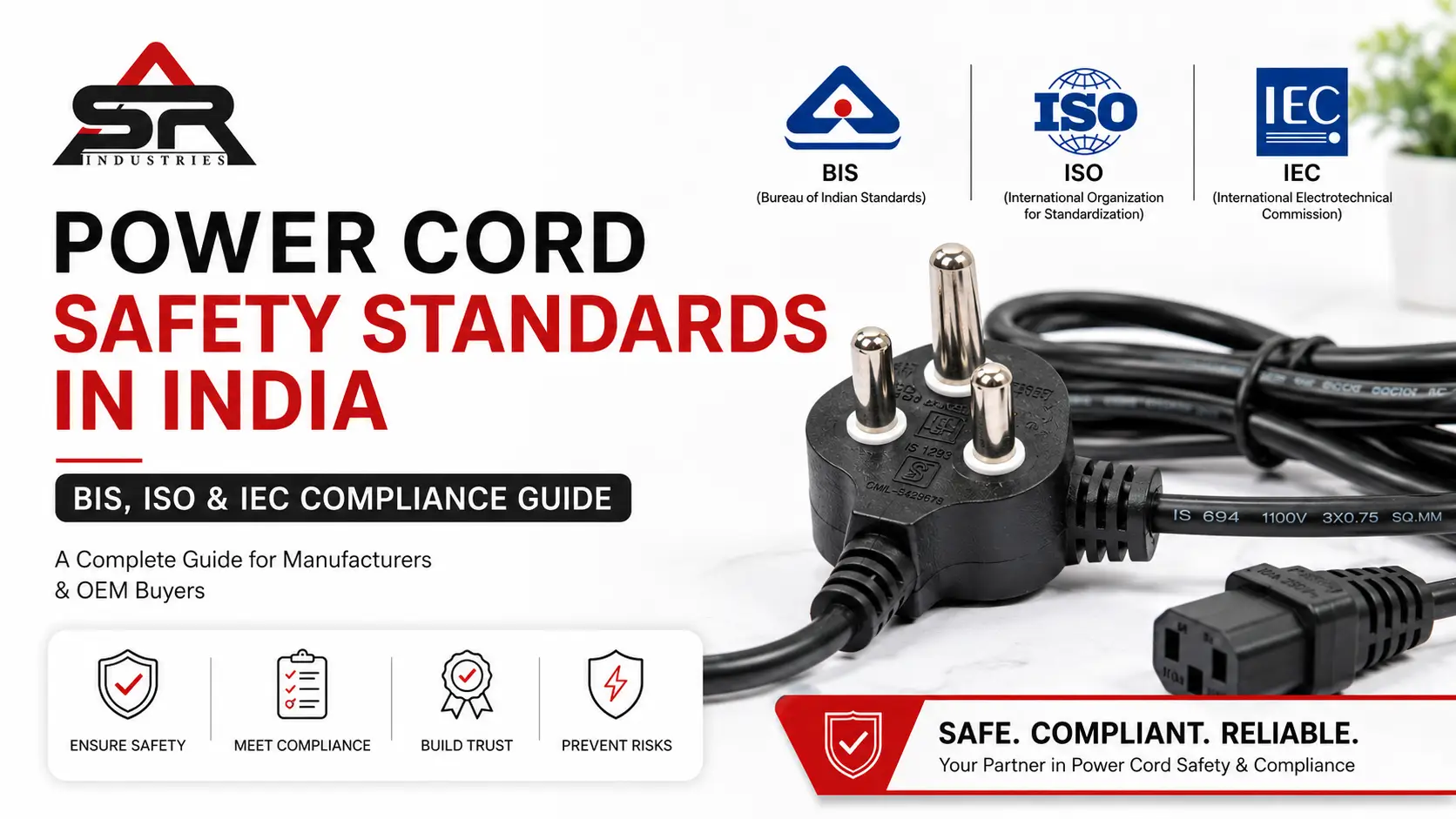
Power Cord Safety Standards in India: BIS, ISO & IEC Compliance Guide
A consignment of imported appliances was held at Nhava Sheva port a few years ago. The issue was not duty. It was not documentation. It was the power cord supplied with each unit — moulded plugs that visually resembled the Indian three-pin configuration, but without the ISI mark and without a verifiable BIS licence behind them. Tens of thousands of units sat in customs for weeks while the importer scrambled to source compliant power cords from a BIS-certified manufacturer in India.
That importer learned an expensive lesson. Power cords are not generic components.
In every other market, a power cord is a commodity — picked from a catalogue, ordered by the thousand, and quietly assembled into the final product without much regulatory scrutiny. In India, this is not how it works. Power cords destined for the Indian market sit under one of the most rigorously enforced product compliance regimes in the country. Both the plug and the cable that make up a moulded power cord require independent BIS certification under specific Indian Standards. Selling without it is not a procurement risk. It is a regulatory offence under the BIS Act, 2016.
This guide explains the standards that actually apply — BIS (Indian), IEC (international), and ISO (quality system) — what each one demands from a manufacturer, and what OEM procurement teams should verify before placing an order. It is written from the perspective of a power cord manufacturer that produces both BIS-certified product for the India market and IEC-compliant product for export, across five plants in northern and central India.
The Three Standards Frameworks That Apply to Power Cords
Before getting into specific standard numbers, it is worth being clear about which body issues which kind of standard, and what each one actually enforces. The three frameworks that matter for power cords in India work at different levels — and they are often confused with one another in supplier conversations.
BIS — Bureau of Indian Standards.
This is the statutory standards body of the Government of India, established under the BIS Act, 2016. BIS issues Indian Standards (denoted IS followed by a number), operates the ISI marking scheme, and enforces mandatory product certification for items on the Compulsory Registration Order list and the Mandatory Certification list. For power cords, three IS standards apply: IS 694 (PVC-insulated cables), IS 1293 (plugs and socket-outlets), and IS 9968 (elastomer-insulated cables). All three are under mandatory BIS certification.
IEC — International Electrotechnical Commission.
This is the international standards body for electrical and electronic technologies. IEC standards are not enforceable by Indian law directly — BIS is the regulatory authority in India. However, many Indian Standards are harmonised with their IEC equivalents (IS 1293:2019, for example, is equivalent to IEC 60884-1). IEC compliance also matters for products that will be exported from India to global markets, where IEC standards form the technical foundation of regional certifications like UL (USA), CE (Europe), CCC (China), and PSE (Japan).
ISO — International Organization for Standardization.
This is the international body responsible for quality management standards. ISO 9001 is the quality management system standard relevant to any manufacturer, including power cord producers. ISO does not certify the product itself — that is BIS’s role. ISO certifies the management system that produces the product. The two work together: BIS verifies that the cord meets the specification; ISO verifies that the system producing it is documented, controlled, and audited.
For a finished moulded power cord intended for the Indian market, all three layers matter. The cord itself must carry ISI marking under the relevant IS standard. The manufacturer should hold ISO 9001 certification for the quality system. And if the cord is intended for export as well, the design and testing should also satisfy the relevant IEC standards.
IS 694 — The Mandatory BIS Standard for PVC-Insulated Cables
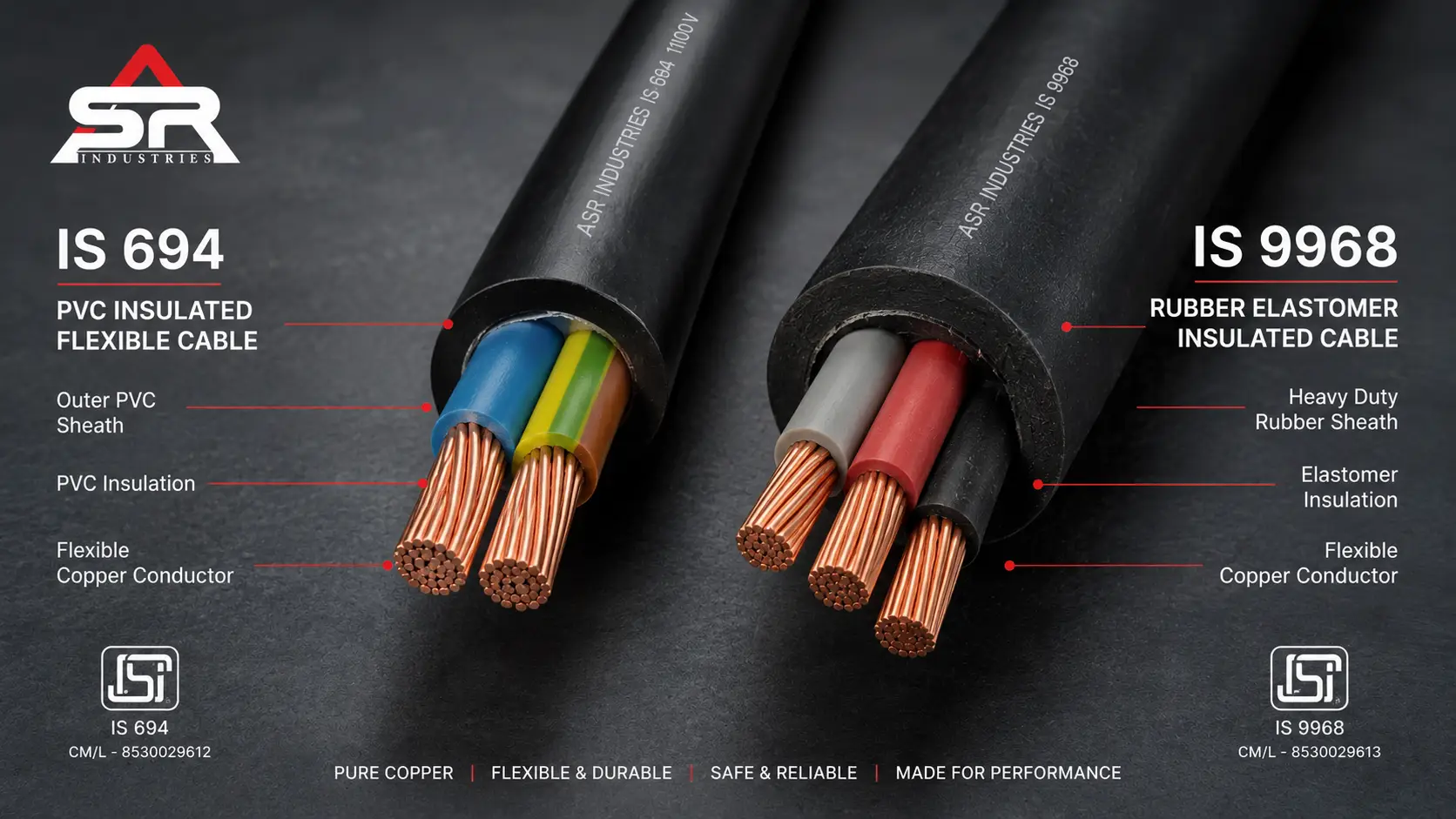
IS 694:2010 is the standard that governs PVC-insulated cables used in power cords sold in India. Any moulded power cord assembled with a PVC-insulated flexible cable must use cable that complies with IS 694 and carries the ISI mark.
The scope of IS 694 is wider than just power cords. The standard covers single-core and multicore cables — both rigid and flexible conductor types — with copper or aluminium conductors, PVC insulated, for rated voltages up to and including 1100 V. It also covers DC applications up to 1500 V to earth. Within that scope, the flexible multicore variants are the ones that end up in power cord assemblies.
Two important sub-categories of IS 694 are worth highlighting for OEM buyers:
FR cables — Flame retardant. The insulation is formulated to be self-extinguishing under specific test conditions. Required for many appliance and industrial applications where ignition risk needs to be controlled.
FR-LSH cables — Flame retardant, low smoke and halogen. In addition to flame retardance, these cables produce minimal smoke and no halogen gases under burning conditions. Increasingly specified for sensitive installations — public buildings, data centres, electric vehicles, and applications where evacuation routes need to remain visible during a fire event.
The certification status of IS 694 is unambiguous: it is on the BIS mandatory certification list. Manufacturers selling PVC-insulated cables in India without a current BIS licence and ISI marking are operating in violation of the BIS Act. This applies whether the cable is sold loose by the metre or built into a finished product like a moulded power cord.
For ASR Industries, every PVC-insulated cable used in BIS-marked power cord production is sourced and produced under IS 694:2010 compliance, with the ISI mark visible on the cable itself.
IS 1293 — The Mandatory BIS Standard for Plugs and Socket Outlets
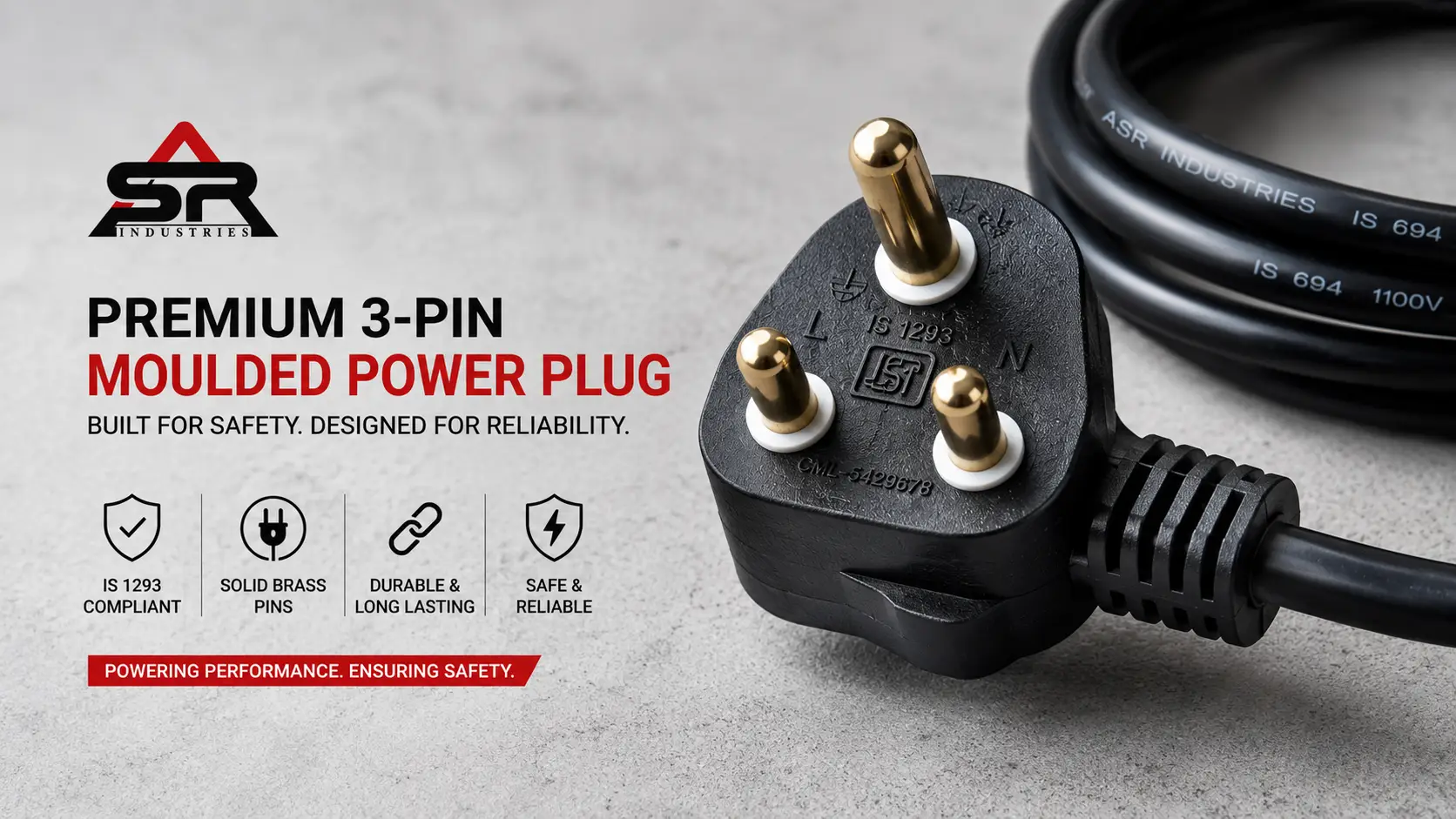
IS 1293 is the BIS standard that governs three-pin plugs and socket outlets used in India. The current edition — IS 1293:2019 — replaced the previous IS 1293:2005 and came into mandatory effect on 23 October 2020, after a brief postponement linked to the COVID-19 pandemic.
The scope of IS 1293:2019 covers plugs and portable socket-outlets for household and similar purposes, both indoor and outdoor use, with a rated voltage not exceeding 250 V and a rated current not exceeding 16 A. The standard is harmonised with IEC 60884-1, the international standard for the same product category.
One specific change in the 2019 revision is worth flagging carefully, because it is a real compliance issue that many product teams missed: the 10A plug rating was deleted from the standard. Plugs are now certified at either 6A or 16A — there is no longer a 10A configuration recognised under IS 1293. Manufacturers using older 10A plugs in moulded cord assemblies were required to transition their designs after the 2020 effective date. Power cords still using 10A plugs are operating against a standard that no longer recognises the configuration.
There is one other detail that catches a lot of OEM buyers off-guard. When a moulded plug under IS 1293 is permanently attached to a power cord, the cable component of that cord must independently comply with either IS 694 or IS 9968. The two certifications work together — a BIS-marked plug attached to a non-BIS-marked cable does not produce a compliant power cord. Both halves of the assembly require their own ISI marking and their own BIS licence trail.
For appliance, electronics, and equipment OEMs producing for the Indian market, this is not a recommendation. It is the regulatory baseline. Customs enforcement at port of entry and BIS market surveillance both check for compliance — and non-compliant product gets quarantined, withdrawn from sale, or destroyed at the importer’s or manufacturer’s cost.
IS 9968 — Elastomer-Insulated Cables for Specific Applications
Where PVC insulation falls short — flexibility-critical applications, oil and chemical exposure, higher temperature operation — elastomer (rubber) insulation takes over. IS 9968 is the BIS standard for elastomer-insulated cables.
The standard has two parts:
IS 9968 (Part 1) covers elastomer-insulated cables for working voltages up to and including 1100 V. This is the part most relevant to power cord applications — particularly for industrial power cords, certain appliance cords requiring high flex life, and outdoor or harsh-environment uses.
IS 9968 (Part 2) covers elastomer-insulated cables for rated voltages from 3.3 kV to 33 kV. This is industrial and utility-grade — outside the scope of typical consumer power cords, but relevant for industrial equipment cord-sets and certain medium-voltage applications.
The decision between IS 694 (PVC) and IS 9968 (elastomer) for a given power cord application comes down to the operating environment. PVC is economical, well-understood, and adequate for the majority of indoor consumer and commercial applications. Elastomer is specified where the cable will face repeated flexing, oil or chemical exposure, sustained higher temperatures, or outdoor weathering — and where the cost premium is justified by longer service life.
IS 9968 Part 1 is on the BIS mandatory certification list. ISI marking applies. The regulatory weight is the same as IS 694 — non-compliance carries the same consequences under the BIS Act.
IEC Standards — The International Reference Layer
For Indian manufacturers producing only for the domestic market, the IEC layer is informational. For Indian manufacturers exporting to global markets — and for global OEMs sourcing power cords from Indian suppliers for international product lines — IEC compliance is operationally critical.
Four IEC standards account for almost the entire power cord landscape internationally:
IEC 60227 covers PVC-insulated cables for rated voltages up to and including 450/750 V. It is the international equivalent of IS 694 for most practical applications. Cables produced to IS 694 with appropriate test certifications can typically be re-certified or cross-referenced for international markets.
IEC 60245 covers rubber (elastomer) insulated cables for rated voltages up to and including 450/750 V. International equivalent of IS 9968 Part 1.
IEC 60884-1 covers plugs and socket-outlets for household and similar purposes. As noted earlier, IS 1293:2019 is harmonised with this standard. The harmonisation means that a manufacturer producing IS 1293:2019 plugs is producing to a specification that aligns closely with the international reference.
IEC 60320 covers appliance couplers — the C13, C14, C19, C20, and related connector families that allow detachable power cords for IT equipment, monitors, servers, and industrial electronics. Almost every detachable power cord in the world terminates on the equipment side with an IEC 60320 connector. For products sold globally with detachable cords, IEC 60320 compliance on the appliance-side connector is essentially universal.
For ASR Industries, the practical implication is that production has to be capable of both regimes. India-market product carries ISI marking under IS 694, IS 1293, and IS 9968 as applicable. Export product is built to IEC 60227, IEC 60245, and IEC 60320 specifications, with test documentation aligned to the destination market’s certification requirement.
ISO 9001 — The Quality System Behind Product Certification
A common confusion in supplier evaluation is the relationship between product certification (BIS) and quality system certification (ISO 9001). The two are not interchangeable. They answer different questions.
BIS certifies the product against a defined technical specification. A power cord with the ISI mark has been produced under conditions where BIS has audited the manufacturing facility, tested samples, and granted a licence to use the mark on that specific product. The mark is evidence that the product meets the IS standard.
ISO 9001 certifies the management system that produces the product. It does not directly verify that any individual unit meets specification. What it verifies is that the manufacturer operates a documented, controlled, audited quality management system — with defined processes, recorded data, structured nonconformance management, and ongoing improvement.
For OEM buyers, the right question is not “do you have BIS or do you have ISO.” The right question is whether the supplier has both. A power cord manufacturer with BIS certification but no ISO 9001 is producing certified product without a verified system underneath it. A manufacturer with ISO 9001 but without BIS for products sold in India is operating illegally. Both certifications matter; they answer different parts of the same procurement question.
For automotive power cord applications — where the cord is sold to an automotive OEM as part of a charging system, EV onboard system, or accessory — the additional layer of IATF 16949 applies on top of ISO 9001. The IATF article on this site explains that framework in more detail.
ASR Industries holds current ISO 9001:2015 certification across all five plants — Noida, Delhi NCR, Haryana, Uttarakhand, and Rajasthan — alongside ISI marking on the relevant power cord products. Both certifications are independently audited and renewed on their respective cycles.
The Power Cord BIS Certification Process
For OEM buyers and for manufacturers entering the Indian market, the actual sequence of getting a power cord BIS-certified is worth understanding. The process is documented publicly by BIS, but the practical reality on the ground tends to be different from the documentary description.
Step 1 — Application. The manufacturer submits a formal application to BIS, identifying the specific product, the IS standard to be applied, the manufacturing location, and supporting documentation about the facility, the production process, and the testing capability.
Step 2 — Document review. BIS reviews the submitted documents against the requirements of the IS standard. Gaps are flagged and the applicant is required to address them before the process advances.
Step 3 — Factory inspection. BIS officials conduct a physical inspection of the manufacturing facility. This is not a paperwork audit. The inspectors verify production equipment, in-house testing capability, the presence and qualifications of quality control personnel, and the documentation that links daily production to the manufacturer’s quality management procedures.
Step 4 — Sample testing. Product samples are tested in a BIS-recognised testing laboratory against the complete test schedule defined in the IS standard. For power cords under IS 694, this includes dielectric, insulation resistance, conductor resistance, tensile, elongation, heat shock, ageing, and flame retardance tests. Sample testing for IS 1293 plugs covers a separate schedule including pin retention, temperature rise, mechanical durability, and IP rating where applicable.
Step 5 — Licence grant. On successful completion of inspection and testing, BIS grants the manufacturer a licence to use the ISI mark on the specific product covered. The licence carries a specific number, applies to a specific factory, and covers a specific product scope.
Step 6 — Ongoing surveillance. BIS certification is not a one-time event. Surveillance inspections are conducted on a defined schedule. BIS also conducts market surveillance — purchasing products from the market and testing them against the standard. Manufacturers whose products fail market surveillance can have their licences suspended or cancelled.
The realistic timeline for a new facility seeking first-time BIS certification on a power cord product runs 4 to 8 months. For an established manufacturer adding a new product or product variant under an existing facility licence, the timeline is shorter — typically 3 to 6 months. Anyone promising faster timelines is either misrepresenting the process or routing through a third-party arrangement that may not survive market surveillance.
Testing That a Power Cord Must Survive
The BIS test schedule for power cord certification is comprehensive. Reading through the IS 694 and IS 1293 test requirements is a useful exercise for any procurement engineer or product manager who has not previously seen what a certified power cord has to demonstrate.
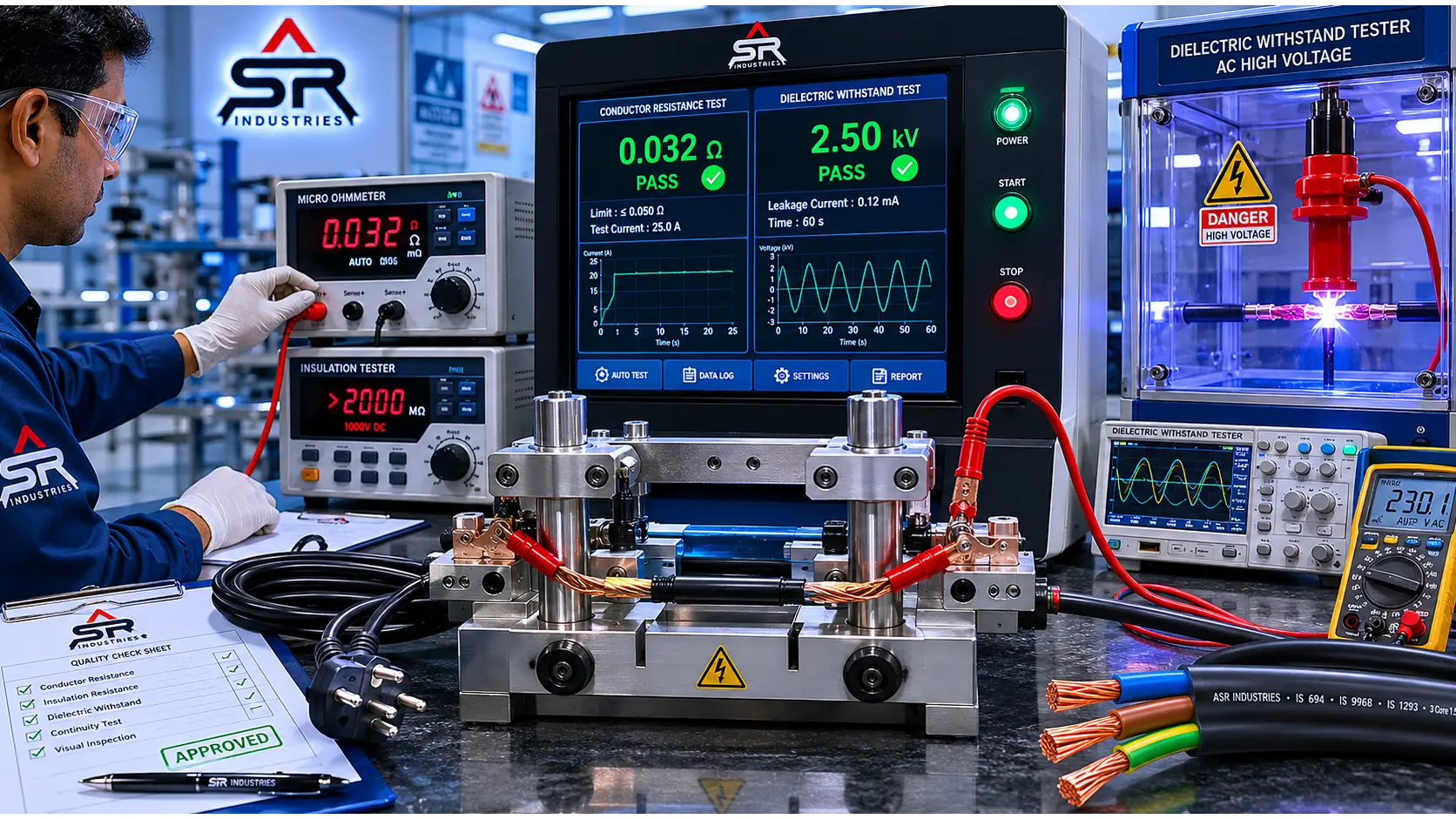
Dielectric (high voltage) test. The cable insulation is subjected to a voltage substantially higher than its rated operating voltage. Pass criterion: no breakdown within a defined time period.
Insulation resistance test. After immersion in water for a specified period, the cable insulation must still demonstrate a minimum insulation resistance value. This catches insulation defects that allow moisture ingress over time.
Conductor resistance test. The actual resistance of the copper conductor is measured and compared against the specification for that cable size. Under-gauge conductor is one of the most common counterfeit and quality issues in the power cord market — a cable nominally rated for 16A may actually have conductor cross-section adequate only for 10A, with predictable thermal consequences in service.
Tensile strength and elongation tests. The insulation must survive mechanical stretching without cracking or deforming permanently. The cable jacket undergoes the same testing.
Heat shock and ageing tests. The insulation is exposed to thermal stress for a specified duration, then re-tested for its mechanical and electrical properties. This catches insulation formulations that degrade prematurely at operating temperatures.
Flame retardance test (FR variants). Cables certified as FR must demonstrate self-extinguishing properties when subjected to flame under standardised test conditions per IS 10810.
Plug-specific tests under IS 1293. Pin retention force, temperature rise under load, dielectric withstand between live parts and accessible surfaces, mechanical durability across thousands of insertion cycles, IP rating verification for outdoor-rated plugs.
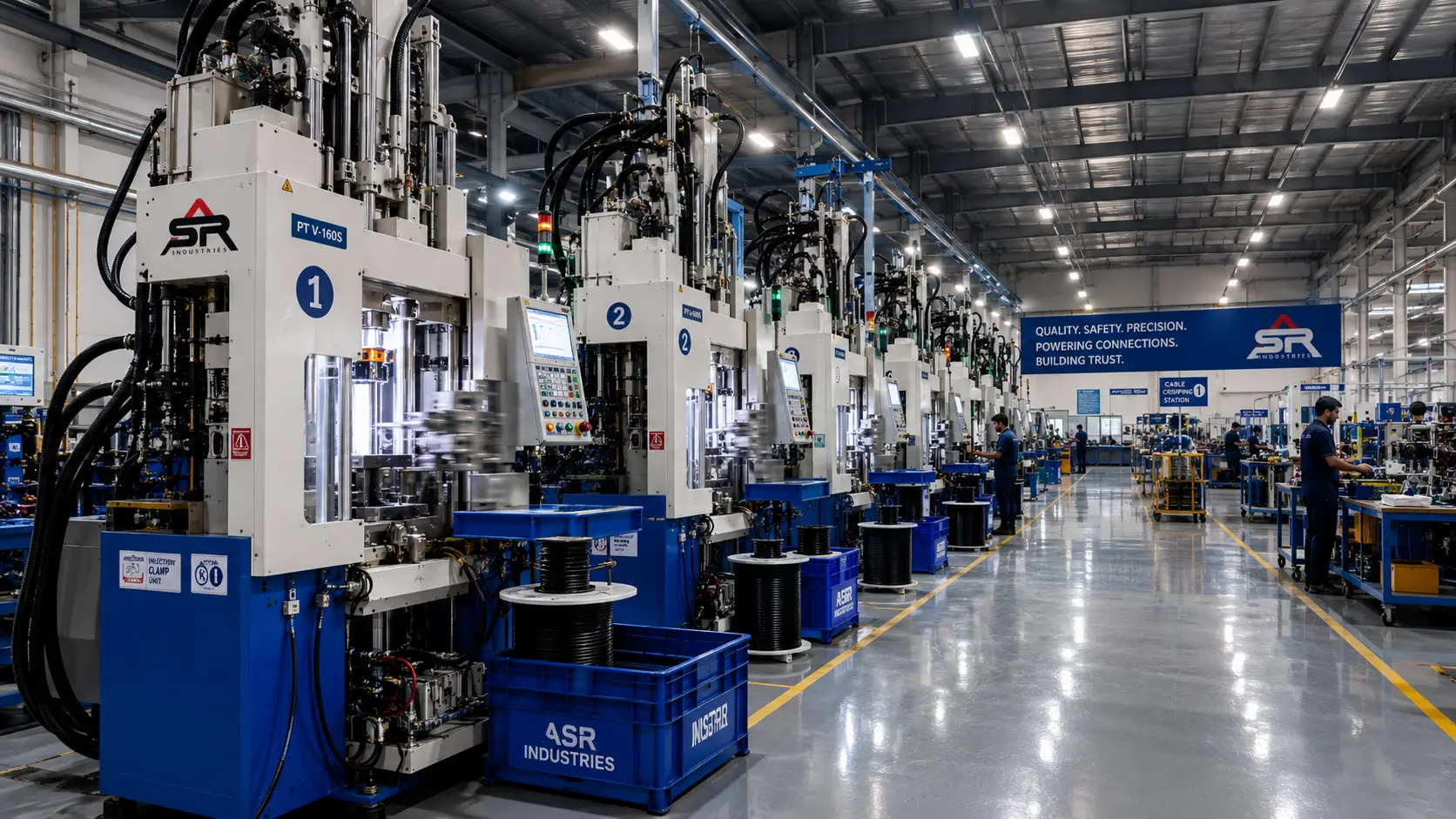
These tests are not conducted once at certification and never again. Manufacturers operating responsibly run subset versions of the test schedule on production samples throughout the manufacturing run. ASR Industries’ Complete Testing Lab includes the equipment for in-house dielectric, conductor resistance, mechanical, and flame retardance testing — allowing real-time verification of production output, not just periodic external testing for certification renewal.
What Counts as Non-Compliance — and the Consequences
The compliance regime around power cords in India is enforced. This is worth being direct about because the consequences are sometimes underestimated until they happen.
Selling unmarked product in the Indian market. A power cord without valid ISI marking, in any product, sold in India, violates the BIS Act. Penalties include fines, product seizure, and in repeat or aggravated cases, criminal proceedings against responsible persons.
Falsified ISI marking. Counterfeit ISI marks — applied to products from manufacturers without a valid BIS licence — are a criminal offence. BIS has prosecuted multiple cases involving falsified marking, and the enforcement record has become more aggressive in recent years.
Mixed compliance assemblies. Using BIS-marked cable in a moulded plug assembly where the plug itself is not BIS-certified — or the reverse — does not produce a compliant power cord. Both halves require their own ISI marking, with their own licence trail back to the manufacturer. This is one of the most common compliance gaps in low-cost power cord sourcing, and it does not survive market surveillance.
Expired or suspended licences. BIS publishes a public list of suspended and cancelled licences. Suppliers whose licences have lapsed cannot legally continue to apply the ISI mark, even if the physical mark is still printed on their inventory. OEM buyers should verify current licence status, not rely on historical certificates.
For OEM buyers conducting incoming inspection on power cord shipments, the practical verification involves three checks: the ISI mark must be physically visible with a clear licence number, the licence number must be verifiable on the public BIS registry, and the licence must be currently active and cover the specific product scope being supplied. These checks take minutes and prevent very expensive problems.
Standards Quick Reference Table
| Standard | Covers / Scope | Authority & Status |
|---|---|---|
| IS 694:2010 | PVC-insulated cables up to 1100 V (single and multicore flexible variants) | BIS — Mandatory |
| IS 1293:2019 | Plugs and socket outlets up to 250 V / 16 A (Equivalent to IEC 60884-1) | BIS — Mandatory |
| IS 9968 (Part 1) | Elastomer-insulated (rubber) cables up to 1100 V | BIS — Mandatory |
| IS 9968 (Part 2) | Elastomer-insulated cables 3.3 kV to 33 kV (Industrial/Utility grade) | BIS Compliant |
| IEC 60227 | PVC-insulated cables up to 450/750 V (International export reference) | IEC International |
| IEC 60245 | Rubber-insulated cables up to 450/750 V (International export reference) | IEC International |
| IEC 60884-1 | Plugs and socket-outlets (Global standard, IS 1293 base) | IEC International |
| IEC 60320 | Appliance couplers (Detachable C13, C14, C19, C20 server/IT connectors) | IEC International |
| ISO 9001:2015 | Quality Management System (Factory process & audit framework) | ISO Certified |
How ASR Industries Maintains Compliance Across Markets
Producing power cords for the Indian market and for export simultaneously requires running two compliance regimes in parallel — without compromising either. The approach at ASR Industries is built around the assumption that this is the normal operating state, not an exception.
For the India market, every power cord product covered by mandatory BIS certification is produced under a current BIS licence, with ISI marking applied to the cable (IS 694 or IS 9968) and to the plug (IS 1293) independently. Documentation traceability runs from incoming raw material certifications through to the finished cord, with licence numbers and batch records aligned for both BIS surveillance and customer verification.
For export, power cord production is aligned with IEC standards — IEC 60227 or IEC 60245 for the cable, IEC 60884-1 derivative plugs for the destination market (different countries use different plug configurations under the IEC framework), and IEC 60320 connectors for the appliance side of detachable cords. Test documentation is structured to support the destination market’s certification process, whether that is UL recognition in the United States, CE conformity in the European Union, or country-specific marks elsewhere.
The production infrastructure supporting both regimes is concentrated and substantial. ASR’s power cord manufacturing operations include 10 vertical injection moulding machines (from 25 to 55 tons), 10 dedicated assembly lines, 5 insert crimping machines for secure terminal connections, and 5 spot/pin welding stations for enhanced conductivity in high-current applications. The Complete Testing Lab provides in-house electrical, mechanical, and safety testing capability covering both BIS and IEC test schedules — meaning verification happens during production, not just at certification audit time.
Across all five plants in Noida, Delhi NCR, Haryana, Uttarakhand, and Rajasthan, the ISO 9001:2015 quality management system provides the underlying process discipline. The product certifications and the system certifications work together — neither is sufficient on its own.
Frequently Asked Questions
Q1. Is BIS certification mandatory for power cords sold in India?
Yes. Both the plug component (under IS 1293) and the cable component (under IS 694 for PVC, or IS 9968 for elastomer) require independent BIS certification. Selling a power cord in India without valid ISI marking on both components is a violation of the BIS Act, 2016, and exposes the seller to fines, product seizure, and in serious cases, criminal proceedings.
Q2. What is the difference between IS 694 and IS 9968?
IS 694 covers PVC-insulated cables — the standard for most general-purpose power cord applications. IS 9968 covers elastomer (rubber)-insulated cables — used where flexibility, oil resistance, higher temperature performance, or outdoor durability is required. Both are mandatory BIS standards for products in their respective categories. The choice between them depends entirely on the application environment.
Q3. What is IS 1293 and what did the 2019 update change?
IS 1293 is the BIS standard for plugs and socket outlets rated up to 250 V and up to 16 A, harmonised with IEC 60884-1. The 2019 revision, which came into force on 23 October 2020, removed the 10A plug rating from the standard. Manufacturers using 10A plug configurations had to transition designs to 6A or 16A. Power cords still using 10A plugs are non-compliant with the current standard.
Q4. Are IEC standards mandatory in India?
IEC standards are not directly enforced under Indian law — BIS is the regulatory authority for India. However, many IS standards are harmonised with their IEC equivalents (IS 1293:2019 with IEC 60884-1, for example). For products manufactured in India and exported to international markets, IEC compliance becomes operationally critical as the foundation for regional certifications like UL, CE, CCC, and others.
Q5. How long does BIS certification for a power cord take?
For a new facility seeking first-time BIS certification, the process — application, document review, factory inspection, sample testing, and licence grant — typically takes 4 to 8 months. For an established manufacturer adding a new product under an existing facility licence, the timeline is shorter, usually 3 to 6 months. Faster timelines than this should be treated with caution.
Q6. Can a moulded power cord use a BIS-certified plug with a non-BIS-certified cable?
No. When a moulded plug under IS 1293 is permanently attached to a cable, the cable must also independently comply with IS 694 or IS 9968 and carry its own ISI mark. The two certifications work together — one without the other does not produce a compliant power cord. This is a frequently missed compliance gap in lower-cost sourcing.
Q7. How can an OEM buyer verify a supplier’s BIS certification is genuine?
BIS publishes a public registry of licensed manufacturers at manakonline.in and bis.gov.in. The verification involves three checks: the ISI mark must be physically present with a visible licence number, the licence number must be traceable on the BIS registry, and the licence must be currently active with scope covering the specific product being supplied. The verification takes minutes and is worthwhile on every new supplier engagement.
A Closing Thought
The Indian power cord compliance regime is sometimes described as bureaucratic, slow, or excessive. From the inside, it does not look that way. BIS certification under IS 694, IS 1293, and IS 9968 is what stops the Indian market from being flooded with the kind of power cords that have caused house fires, equipment failures, and consumer injuries in less-regulated markets. The mandatory regime exists because the alternative produced real and visible harm.
For OEM buyers and procurement teams sourcing power cords in India, the practical takeaway is straightforward. Verify the supplier’s BIS licence before placing an order. Verify the ISI mark on incoming product against the licence registry. Treat ISO 9001 certification as a baseline expectation, not a competitive advantage. And for automotive, EV, or export applications, expect the supplier to demonstrate compliance beyond the India-mandatory minimum — IATF 16949, IEC compliance, regional certifications as applicable.
ASR Industries operates inside this regime by design. The licences are current, the testing capability is in-house, and the production discipline runs the same way regardless of which market the cord is bound for. The compliance is real, verifiable, and ongoing — which is what compliance is supposed to be.
To discuss power cord requirements for India-market or export applications, contact the ASR Industries technical team or explore the BIS-certified power cord product range.