
Wire Harness Supplier in India: 7-Point OEM Selection Checklist
How to Choose the Right Wire Harness Supplier in India: A 7-Point OEM Checklist
The lowest quote on the table is almost never the cheapest harness. Sourcing managers learn this the hard way — usually around the third month of production, when a 40-paise saving on a terminal turns into a sorting cell, an expedited air freight from a sister plant, and a line-down call from the OEM at 2 a.m. A stopped four-wheeler assembly line burns through several lakhs an hour. Set that against a piece-price gap of a few rupees across an annual volume, and the math stops being about unit cost and starts being about total cost of ownership.
That is the lens this checklist uses. Picking a wire harness supplier in India is a risk-transfer decision dressed up as a purchasing decision. Get it right and the harness disappears into the product, never to be thought about again. Get it wrong and it becomes the single most visible failure point in the field. The seven points below are how an auditor with two decades of plant walks — Manesar, Oragadam, Chakan, Sanand, and a hundred unglamorous industrial estates in between — separates a wire harness manufacturer in India that can actually carry a program from one that just photographs well.
Choosing the right wire harness supplier in India requires looking beyond basic certificates. True reliability depends on 100% in-house automated continuity testing, strict lot-level traceability, and a multi-plant footprint located near major automotive/industrial hubs (NCR, Pune, Chennai) to slash logistics costs and guarantee business continuity.
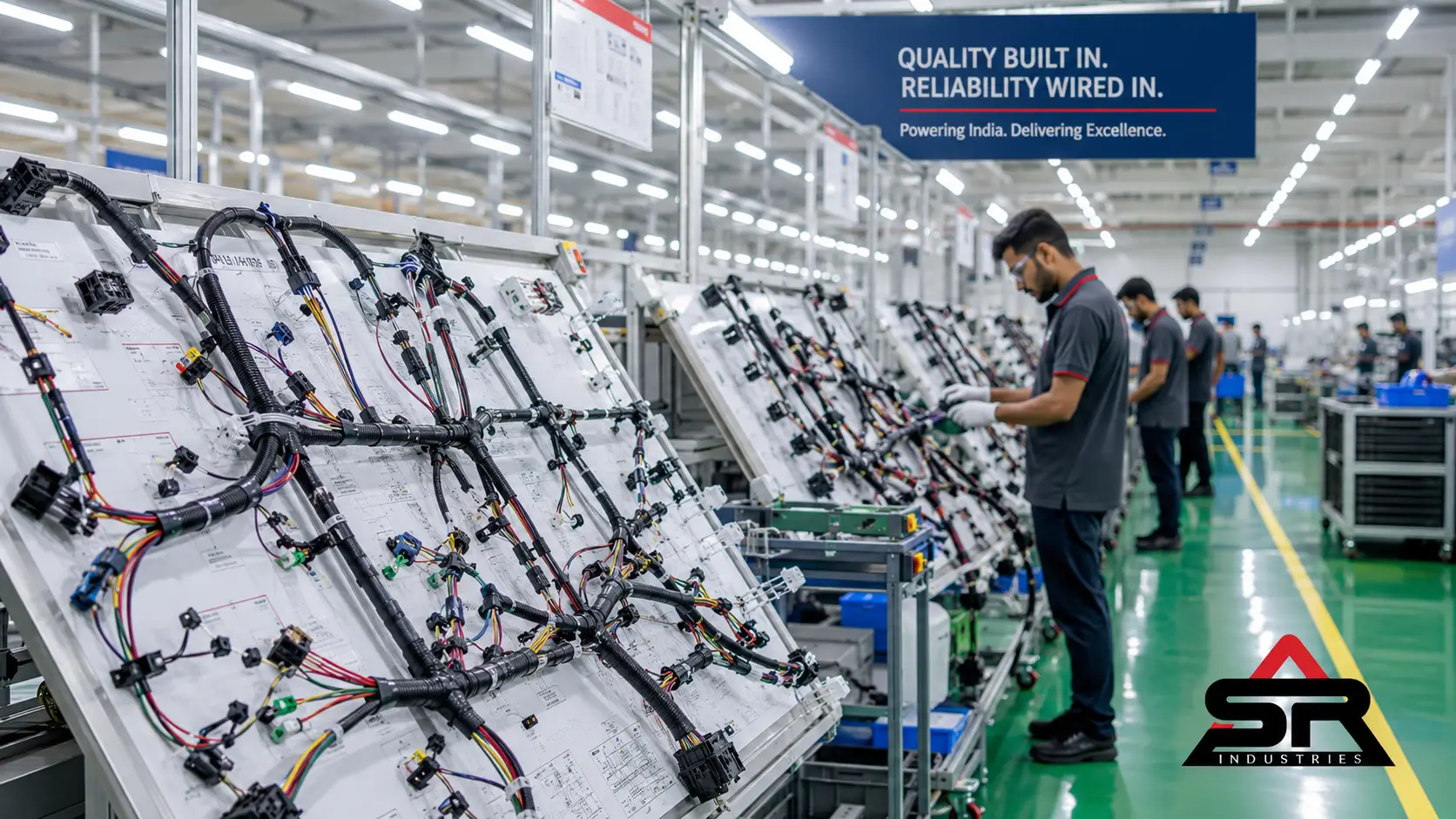
A quick orientation before the floor walk:
The reality of a harness audit: The framed certificates hang in the air-conditioned conference room. The truth sits in the reject bin next to the crimping station, in yesterday’s first-piece inspection sheet, and in whether the operators are using a pull-tester or eyeballing crimps. Always ask to see the second one.
Why Piece Price Lies and Process Discipline Pays
A wire harness fails in ways the eye cannot catch. A high-resistance crimp, an open circuit behind a sealed connector, an insulation nick under a piece of loom tape, a single swapped pin in a 60-circuit assembly — none of these show up in a glance at the finished part, and all of them show up in the field. That gap between “looks fine” and “is fine” is exactly where a weak supplier hides, and exactly where the cost lands on the buyer.
Total cost of ownership for a harness is the piece price plus everything the piece price does not tell you: the PPM defect rate at your incoming dock, the cost of sorting and rework, the freight you pay to recover schedule, the warranty exposure in the field, and the engineering hours your own team burns chasing a supplier’s root cause. A harness that arrives at 50 PPM and a harness that arrives at 5,000 PPM can carry the same unit price and a wildly different real cost. The supplier’s process discipline is what decides which one you are actually buying.
Everything that follows is a way to read that discipline before a purchase order locks it in.
1. Certifications — Verify the Scope, Not the Logo
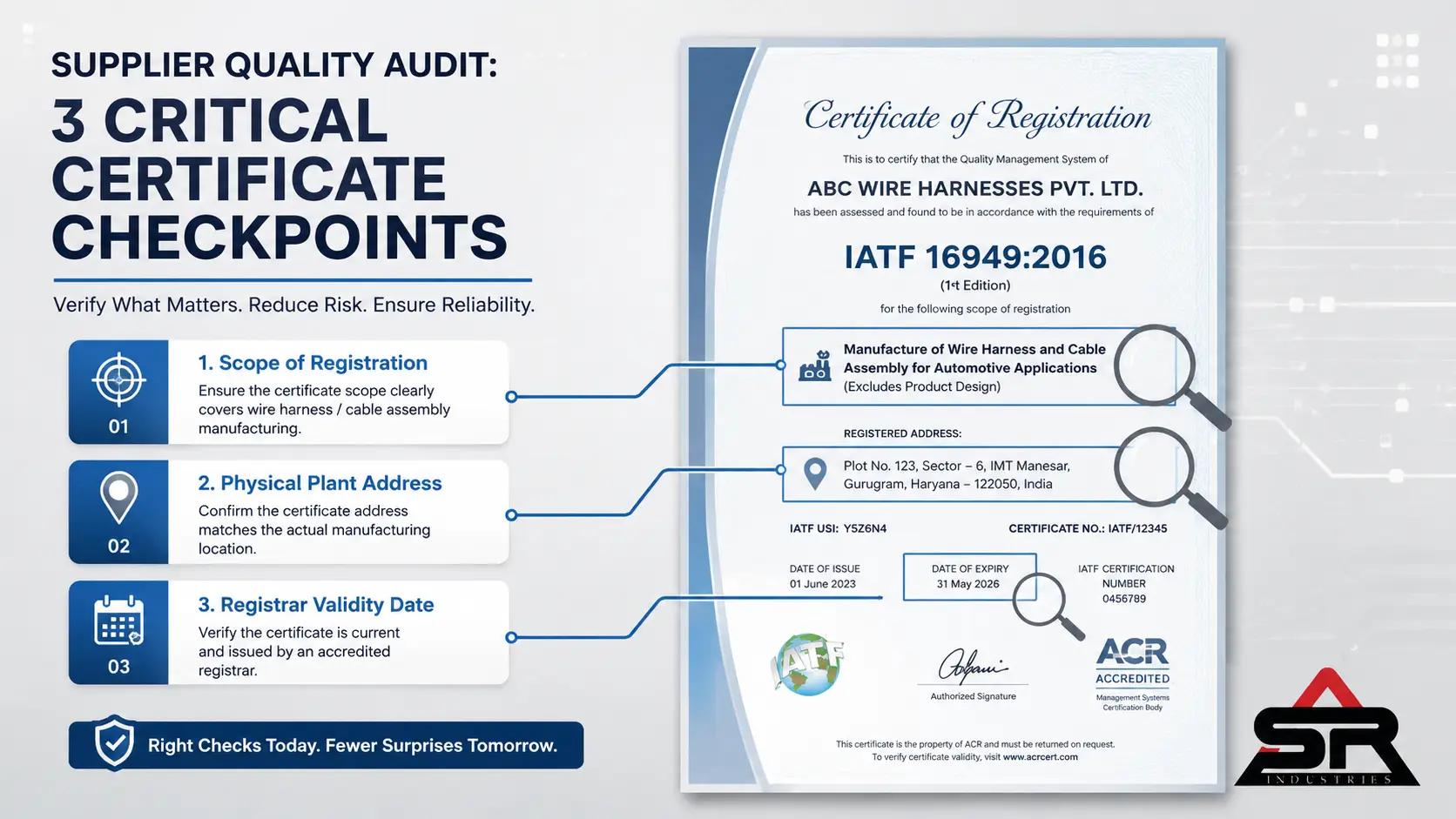
For automotive and EV programs, IATF 16949:2016 is the floor, not the ceiling; ISO 9001:2015 is the baseline for general industrial work. That part most buyers know. What separates a real OEM vendor qualification from a rubber stamp is how the certificate gets verified.
A certificate proves a quality system existed at one site, on one audit day, within a defined scope. Three checks turn it from decoration into evidence:
- Scope of Registration. Read the scope line on the certificate, not just the standard number. It must explicitly cover wire harness or cable assembly manufacturing. A scope that reads “moulded components” or a vague parent activity does not certify the line building your harness.
- Physical plant address. Match the address on the certificate to the address where your parts will actually be made. This is the check that catches the most expensive trick in the trade.
- Validity and registrar. Confirm the certificate is current and issued by an accredited registrar — not lapsed, not “renewal in progress,” not self-declared.
That address check matters more than it looks. A tier-1 with genuine IATF 16949 certification at its head plant can quietly subcontract overflow to an uncertified job shop in a nearby industrial area — the kind of unit running two crimping machines and no test bench. The certificate stays clean; your harness was never built under it. An IATF 16949 harness supplier worth qualifying will build your part at the certified site and will let you confirm it on the floor without flinching.
Supporting certifications fill in the picture. ISO 14001 and ISO 45001 signal an operation mature enough to run systems beyond the bare minimum, and increasingly feed an OEM’s own supplier-code and sustainability obligations. Treat them as positive signals, not substitutes for the two that matter.
2. In-House Testing — Where Most Suppliers Quietly Fall Short
A serious harness builder tests 100% of finished assemblies in-house, on its own equipment, with the data retained. Sample-based testing is the most common shortcut in the industry, and it is the one that costs OEMs the most in the field.
Walk the test area and look for four things specifically:
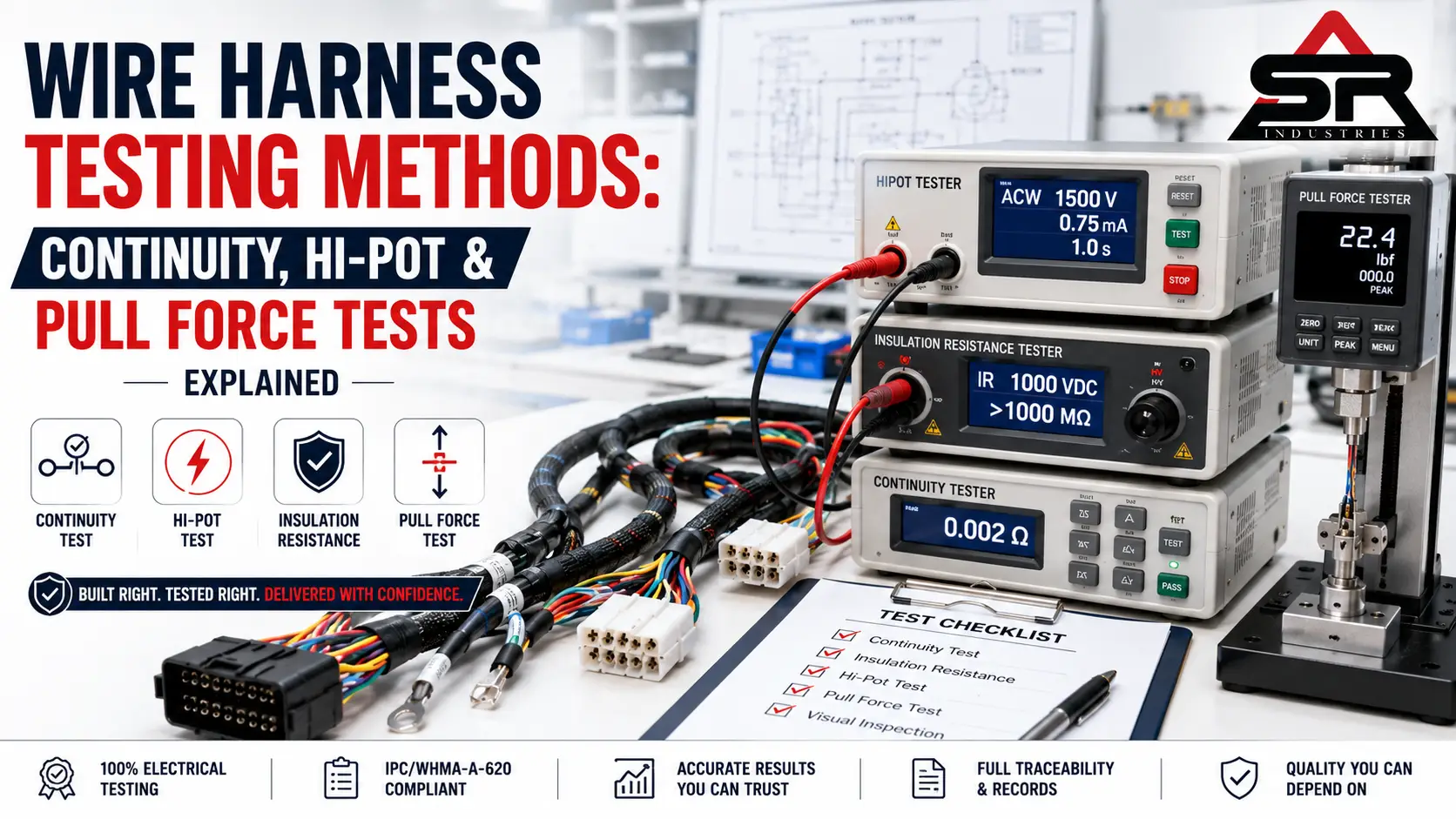
- Automatic continuity benches. Every harness should run on an automatic test bench that checks the full circuit map for opens, shorts, miswires, and wrong pin-outs against a master. On a complex multi-circuit harness, manual checking simply cannot catch a single transposed wire reliably. Ask what percentage of production passes through the bench — the only acceptable answer is all of it.
- Crimp validation by pull-force and micro-section. Crimp quality is the number-one harness failure mode, and a glossy sample tells you nothing about it. Strong plants run terminal pull-out (tensile) tests against the minimum hold force for the conductor size — roughly in the order of 60 N for a 0.5 mm² crimp and well past 200 N for 2.5 mm², with the exact floor set by the applicable standard (IEC 60352-2 / USCAR-21) for that gauge. They back it with periodic micro-section (cross-section) analysis under a microscope.
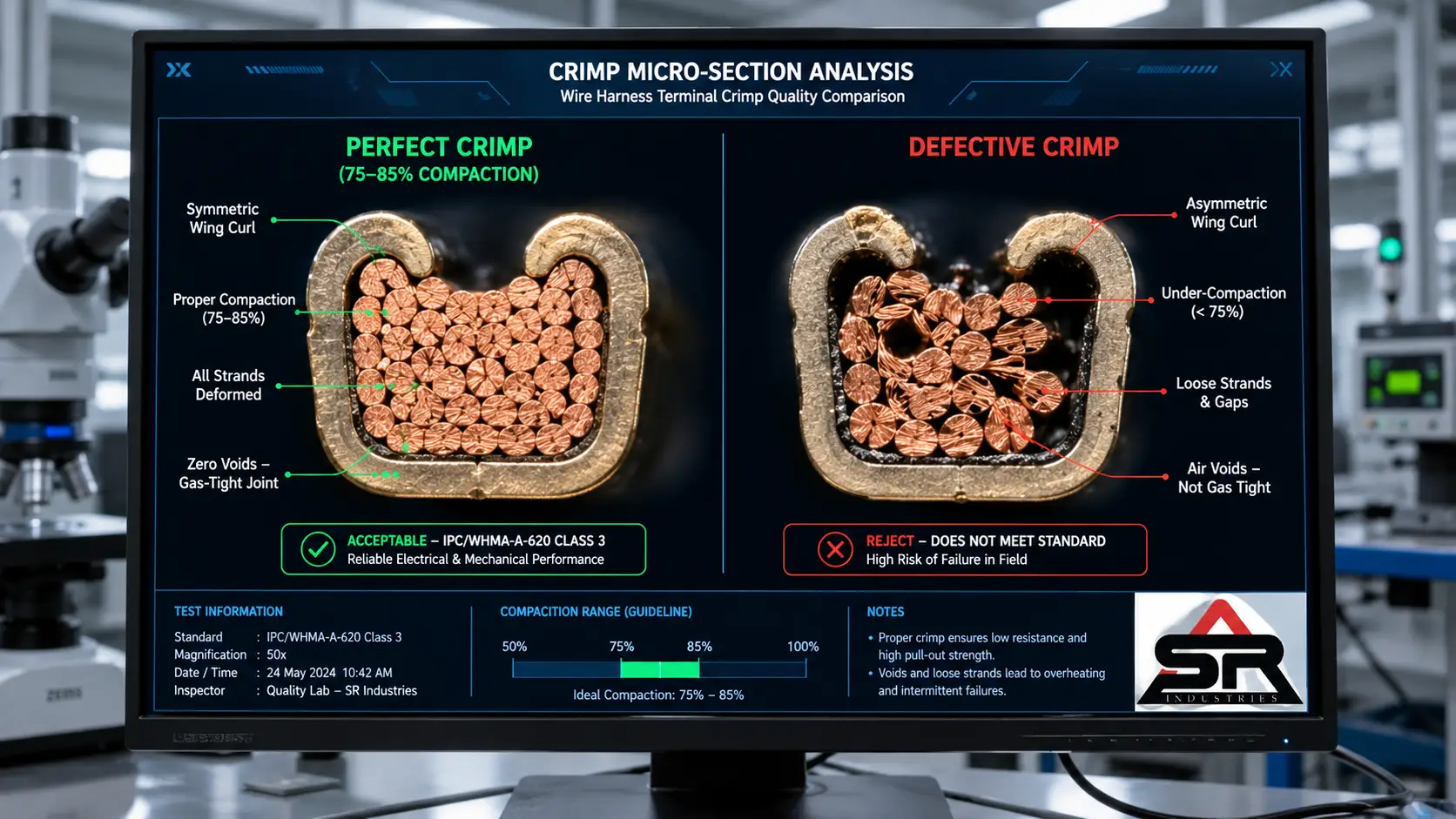
What a good micro-section actually shows: correct compaction with no voids between strands — a gas-tight joint, typically in the 75–85% compaction range — with every strand deformed, none cut, and symmetric wing curl. Loose strands, gaps, or strands sheared by an over-crimp are the tell-tales of a worn applicator or an untrained setter. If a supplier cannot produce a recent micro-section image on request, the crimp process is running blind.
- High-voltage and insulation testing for EV. For 800V EV architectures, hi-pot (dielectric withstand) and insulation resistance testing are not optional. Insulation resistance should read in the high MΩ-to-GΩ range, and hi-pot must be performed at a voltage appropriate to the working class. A supplier building HV harnesses without dedicated HV test capability is learning your safety case on your program. Look closely at how they handle safety protocols in high-voltage EV wire harness production before signing the contract.
- Workmanship standard and class. Ask which acceptance standard governs build and inspection. IPC/WHMA-A-620 is the recognised standard for cable and harness assemblies, and it has three classes. Most automotive and EV work belongs at Class 2 or Class 3 — Class 3 being the high-reliability tier where continued performance is critical. A supplier that cannot name the class it builds to has no shared definition of “good,” which means each operator is quietly inventing one.
The single most useful question in this section: is testing in-house or outsourced? Outsourced testing means slower containment, a broken chain of custody, and a supplier that finds out about its own defects from a third party. In-house testing is the difference between a problem caught at the bench and a problem caught at your dock.
3. Capacity & Multi-Plant Footprint — Built for the Indian Supply Map
Two questions decide whether a supplier can keep your line fed: how much real headroom it has, and what happens when one of its plants stops. In India, the second question is not hypothetical.
Start with real capacity utilization, not nameplate capacity. A plant running at 90% on the lines that would build your harness has nothing left to absorb your ramp-up or another customer’s emergency. Ask directly for current utilization on the relevant lines and the free capacity available for your growth curve. A vague answer is itself the answer.
Then weigh the multi-plant footprint against the Indian map. The harness industry clusters around the automotive and industrial hubs for a reason — proximity to the OEM line is proximity to recovery. A supplier with plants positioned near the major belts changes your risk profile:
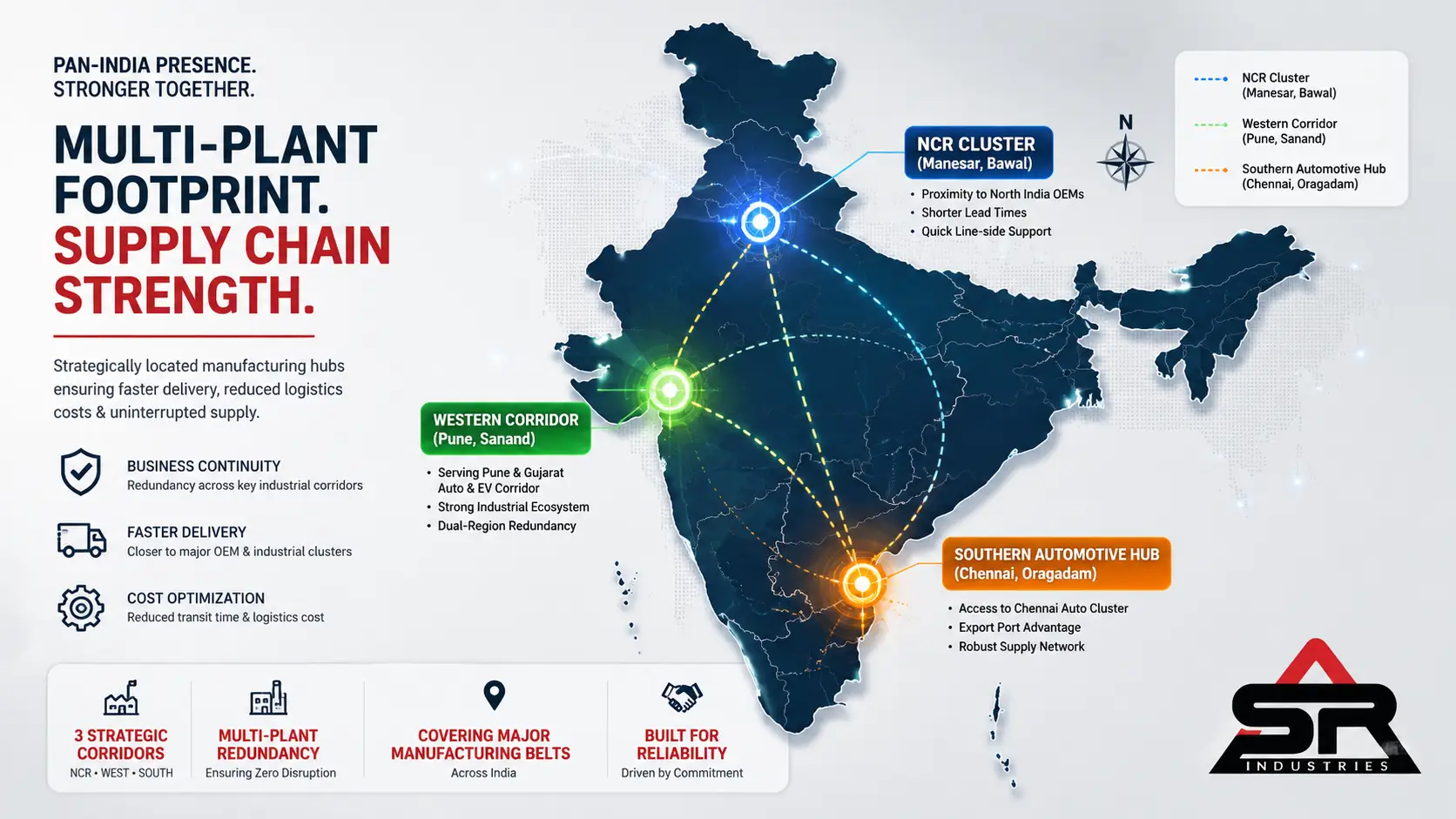
| Manufacturing Belt | Anchor Region | What Proximity Buys You |
|---|---|---|
| NCR / North | Manesar, Bawal, Noida | Line-side support for North automotive and appliance OEMs; short lead times |
| Western | Chakan & Talegaon (Pune), Sanand (Gujarat) | Coverage for the Pune and Gujarat auto-EV corridor; dual-region redundancy |
| Southern | Oragadam & Sriperumbudur (Chennai) | Access to the Chennai auto and EV cluster; export-port proximity |
The business-continuity case is sharper than logistics alone. A monsoon flooding a single estate, a regional labour dispute, a local shutdown, or a fire — any of these can idle a single-plant supplier for weeks, and that downtime becomes your downtime. A supplier with a sister facility able to build the same harness can shift work and keep your line running. Ask the question plainly during qualification: “If this plant goes down, which other plant builds this exact harness, and how fast?” A supplier with a real Business Continuity Plan answers in specifics. One without it changes the subject.
There is a freight dividend too. Sourcing from a plant inside your own manufacturing belt — rather than trucking harnesses across the country — typically trims inbound transit time and pulls freight cost down by a meaningful margin, often in the 12–15% range on landed cost for high-volume programs. On a large annual buy, that is not rounding error.
4. Design & Engineering Support — APQP/PPAP Without Hand-Holding
The suppliers that launch programs cleanly co-engineer the harness; the ones that cause launch fires only build to print. For NPD buyers running a high-stakes EV or industrial rollout, this is the point that decides whether your timeline holds.
A capable partner runs APQP properly and gives real Design for Manufacturability feedback early — while changes are still cheap. Expect them to flag a connector that is hard to seat under takt time, a routing path that will chafe against a bracket, an over-specified wire gauge inflating cost, or a splice location that complicates assembly. That input before tooling is committed is worth more than any number of post-launch corrective actions.
The proof of engineering maturity is PPAP. A supplier that can run the Production Part Approval Process and deliver a clean Part Submission Warrant — supported by the elements behind it: process flow, PFMEA, control plan, dimensional results, and material and performance test data — without your team writing it for them is operating in a different tier from a job shop. For custom wire harness manufacturer work, this is the line between a vendor who needs supervision and a partner who shortens your validation cycle.
A fast NPD filter: Ask to see a real, recent PPAP package from another program (redacted as needed). A supplier that produces one in minutes has the system running. A supplier that needs a week to assemble one is building PPAP for the audit, not running it in production.
5. Traceability & Quality Documentation — The First Hour of a Recall
When a defect ships, the only question that matters is how fast the supplier can tell you exactly which harnesses are affected — and “within hours” is the only acceptable answer. Traceability is the capability that decides whether a problem stays contained or swallows your entire received inventory.
Strong suppliers run lot-level traceability that links each finished harness to its production batch, and from there to the date and lot codes of the terminals, connectors, and wire that went into it. When a connector batch is later found suspect, that supplier isolates the exact affected harnesses instead of quarantining six weeks of supply on suspicion.
During a wire harness supplier audit, the documentation that proves this is concrete and checkable:
- Control plans and process flow diagrams that match what the floor actually does — not an idealised version filed for the auditor
- PFMEA records that show revision history, meaning they are used and updated rather than written once
- Retained electrical test results and crimp validation data, traceable to specific lots
- Incoming inspection records for purchased components, with supplier lot codes captured
- A stated records-retention policy — how long test data, inspection reports, and certificates of conformance are held
How a supplier keeps records predicts how it behaves under pressure. The plant that can pull a specific lot’s test data in front of you is the plant that contains a field issue in an afternoon. The one that hunts through unlabelled folders is the one that turns a 200-piece problem into a 20,000-piece quarantine.
6. Industry Experience & References — Relevant Beats Impressive
Experience in your specific application beats a long general track record every time. A supplier that has already shipped your kind of harness has already paid for the failure-mode education that a first-timer will charge to your program.
The requirements diverge sharply by application. An 800V EV high-voltage harness, a solar DC string harness, an engine-bay harness rated for under-hood heat and vibration, a battery-pack interconnect, and an appliance harness each carry different voltage classes, temperature ratings, sealing demands, and regulatory expectations. A supplier fluent in your domain anticipates these; one new to it discovers them mid-program.
Verify the experience rather than accepting the brochure:
- Ask for references in your own sector, ideally OEMs at comparable volume and quality expectation
- Probe the tenure of key customer relationships — accounts held for five-plus years survived scrutiny that a first-order honeymoon never tests
- Request a comparable program by complexity and an honest account of how its launch and ramp went
- Listen for whether the supplier can discuss your application’s specific failure modes unprompted — that fluency cannot be faked in a sales meeting
A supplier that has earned and kept demanding customers in your field is offering a track record that has already been stress-tested by someone with your standards.
7. Corrective Action & Responsiveness — Judge the Containment Clock
Every supplier eventually ships a defect. The ones worth keeping are defined by how fast they contain it and how honestly they chase the cause. The clock that matters is the containment clock: the hours between a problem surfacing and the supplier protecting your assembly line.
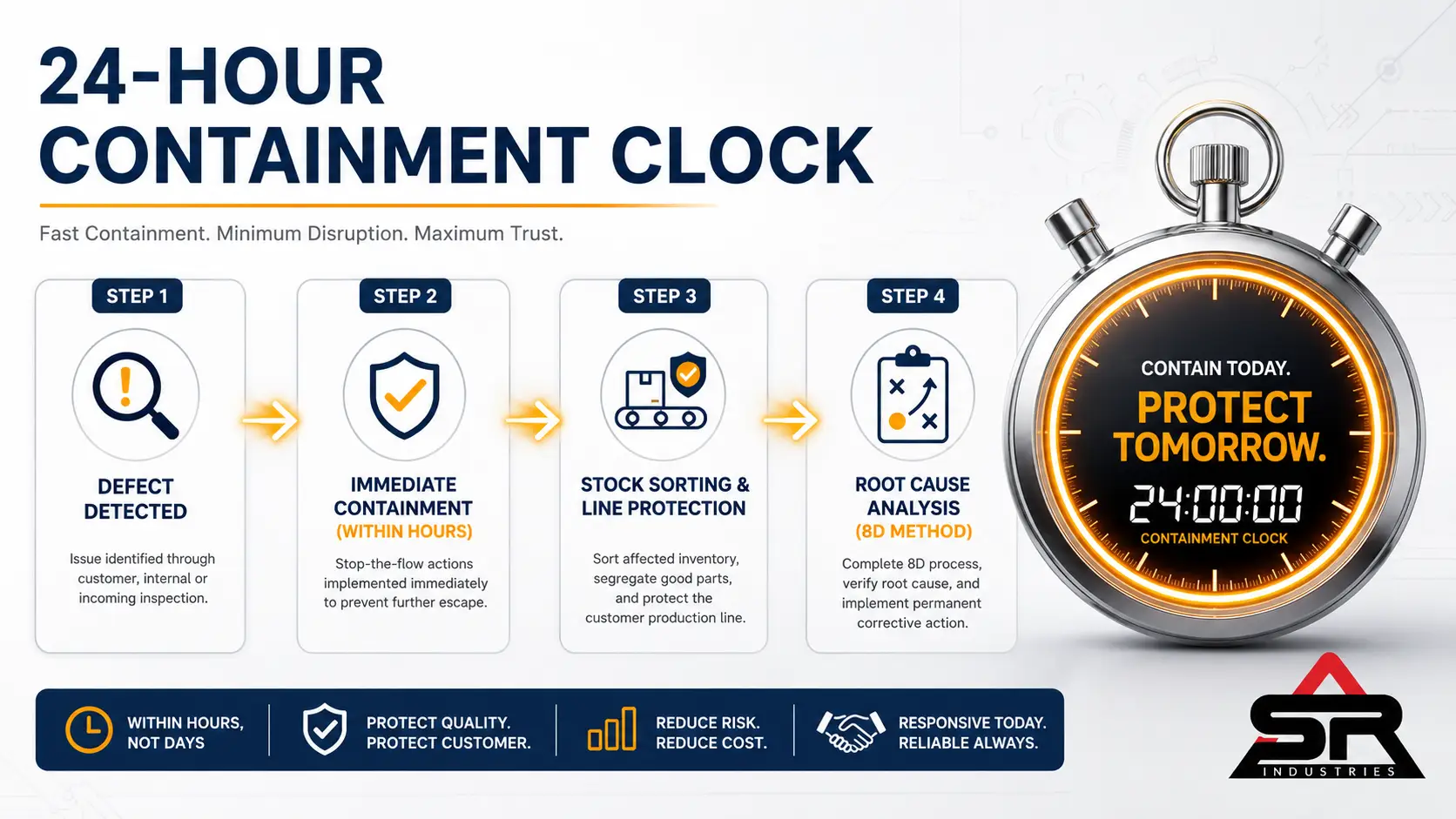
A mature supplier runs structured 8D problem-solving and moves through it in order — immediate containment first (sorting stock, certifying clean inventory, protecting your line within hours, not days), then genuine root-cause analysis, then a verified permanent corrective action, then a read-across to confirm the same failure mode is closed on similar parts. Containment speed is the first signal of competence; root-cause depth is the second.
Responsiveness reveals the culture behind the process. Look for a single named point of contact, early and honest communication when something slips, and a willingness to own a problem instead of deflecting it. A supplier that closes an 8D properly — and tells you the uncomfortable truth before your incoming inspection finds it — is worth far more than one that has simply never been tested.
The audit move that exposes everyone: Describe a realistic failure — say, a batch of harnesses with intermittent continuity traced to a crimp issue — and ask the supplier to walk through the first 24 hours. The ones who lead with containment and a clear escalation path have done it before. The ones who lead with explanations have not.
Red Flags to Watch For
Most warning signs surface before a single part is built. This table maps the common ones to what they actually signal — and the question that cuts through.
| Red Flag | What It Signals | What to Verify Instead |
|---|---|---|
| Sample testing only, no 100% bench | Defects ship undetected; quality relies on luck | "Does every harness pass an automatic continuity bench?" |
| Certificate scope or address ≠ build site | Your parts may be made outside the certified system | Match scope and physical address to the actual line |
| Quote sits well below the market | Corners cut on testing, copper, or terminals | Demand a cost breakdown; confirm testing and material are in it |
| No micro-section or pull-force data on request | The crimp process is running blind | Ask to see a recent cross-section image and pull-test log |
| Single plant, no BCP | One monsoon or strike idles your line | "Which sister plant builds this exact harness, and how fast?" |
| No PPAP package readily available | Builds to print; cannot support a launch | Request a recent redacted PPAP and control plan |
| Defensive or slow on a complaint | Containment will fail when it matters most | Walk through a hypothetical 8D; judge the first 24 hours |
| Hesitates on a floor audit | The floor does not match the brochure | Treat open-door audits as a baseline, non-negotiable |
One red flag warrants harder questions. Three together warrant moving on.
What certifications are essential for a wire harness supplier?
ISO 9001:2015 is the minimum for any serious supplier, and IATF 16949:2016 is essential for automotive, EV, and high-reliability programs. Verify three things on the certificate: that the scope explicitly covers harness or cable assembly manufacturing, that the physical plant address matches where your parts will be built, and that the certificate is current and from an accredited registrar. IPC/WHMA-A-620 (Class 2 or Class 3) is the workmanship standard a quality-focused builder should name without hesitation. ISO 14001 and ISO 45001 are strong supporting signals.
How do you verify a supplier's real capability beyond the website?
Run a plant audit and demand evidence, not claims. Confirm 100% continuity testing happens in-house, ask for a recent crimp micro-section image and pull-force log, and have the supplier trace one finished harness back to its component lot codes in front of you. Review a redacted PPAP package and control plan, check references in your own sector, and weigh the tenure of long-standing customers. Skip the conference room and the framed certificates — the reject bin, the test logs, and the floor tell the real story.
What is a reasonable MOQ for a custom wire harness?
There is no universal number — minimum order quantity depends on harness complexity, any application or fixture tooling cost, and the changeover time each build needs. A simple high-volume harness can carry a low MOQ; a complex custom assembly with dedicated tooling will carry a higher one to make setup viable. The sharper question is whether the supplier's MOQ, tooling cost, and lead time fit your volume curve from prototype through full production. A strong partner explains the logic behind its MOQ instead of just quoting a figure.
Start a Supplier Qualification Conversation
The right wire harness supplier in India is a risk you have priced and controlled, not a quote you accepted. Score every shortlisted candidate against these seven points, weight them by what your program genuinely demands — HV testing depth for EV, BCP and footprint for high volume, APQP maturity for a tight NPD timeline — and the strongest partner separates itself from the look-alikes within one floor walk.
If a qualification is already in motion, the fastest pressure test is a direct conversation about four things: certification scope, in-house testing, real capacity, and the containment clock. Those are where weak suppliers reveal themselves first. Start that conversation, ask for the evidence on the floor, and let the answers do the shortlisting.