
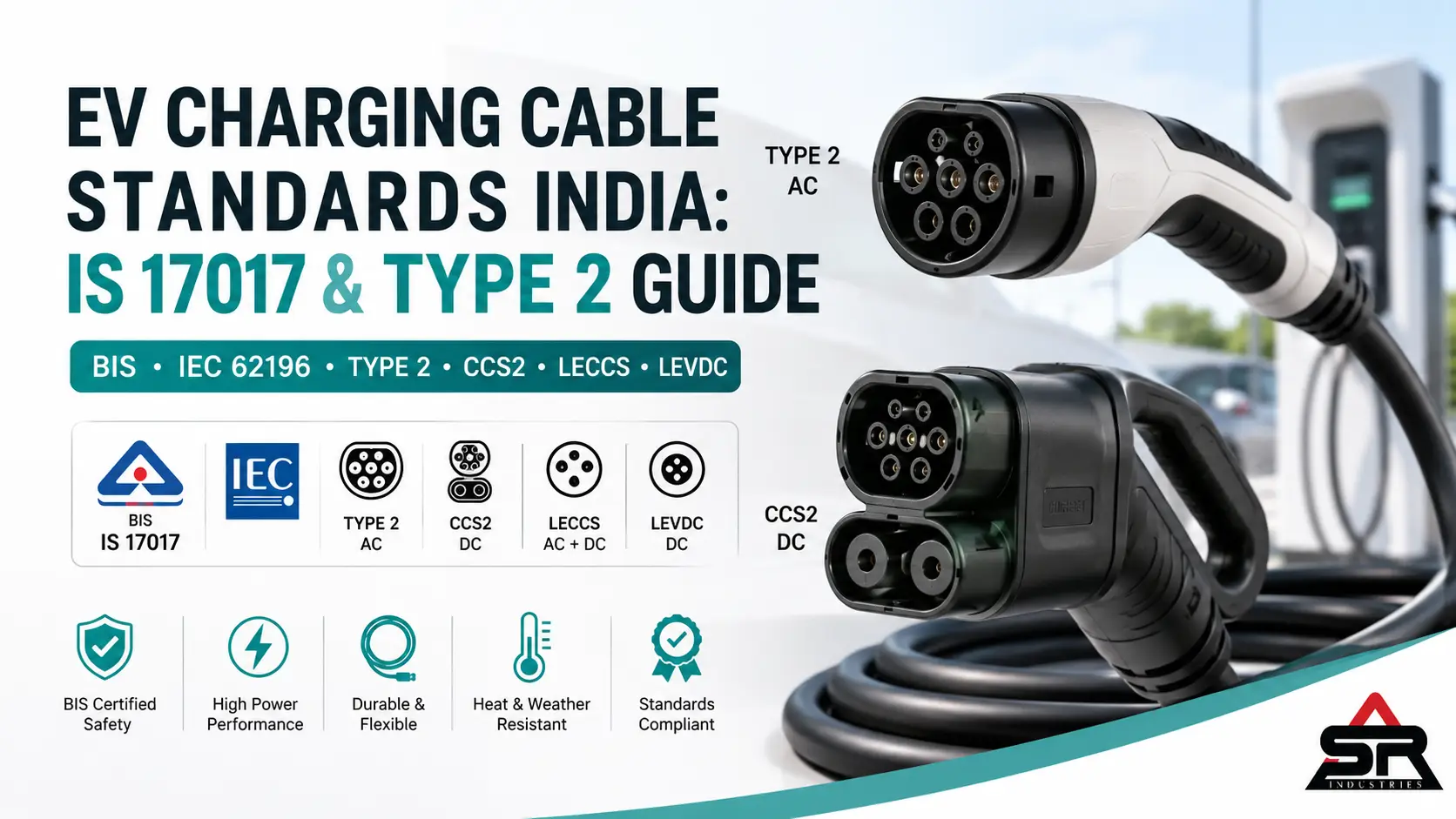
EV Charging Cable Standards India: IS 17017 & Type 2 Guide
EV Charging Cable Standards in India: BIS, IEC 62196 & Type 2 Explained (2026)
A rejected type-test report is the most expensive document an EVSE company can receive. By the time a charging cable assembly fails at ARAI or iCAT — a sheath that deforms under load, a conductor that overheats at rated current, a connector whose rating does not match the lead — the tooling is committed, the launch date is locked, and the requalification cycle burns weeks no project plan accounted for. Compliance is not decided on that test bench. It is decided at the drawing stage, against IS 17017 and the IEC standards it harmonises with.
For an EVSE manufacturer, a procurement head, or an EV startup founder building hardware for the Indian market, the EV charging cable standards India enforces are the difference between a product that ships and one that sits in a holding pattern. This briefing covers what actually governs the cable: the IEC 62196 connector family, the Type 2 charging cable that carries the AC market, the CCS2 system behind DC fast charging, the light-EV connectors that replaced the Bharat era, and the BIS regime that decides whether any of it can be sold.
India's EV charging infrastructure mandates strict compliance with the IS 17017 framework. Commercial viability and type-test approval at ARAI or iCAT depend on matching Type 2 connectors for AC charging (up to 22 kW) and CCS2 for DC fast charging (50 kW to 350 kW+). For fleet and light EVs (2W/3W), the ecosystem has shifted entirely to dedicated Type 6 (LEVDC) and Type 7 (LECCS) standards, requiring high-ambient XLPO insulation and heavy-duty TPU/TPE sheathing to survive localized thermal deformation exceeding 50°C.
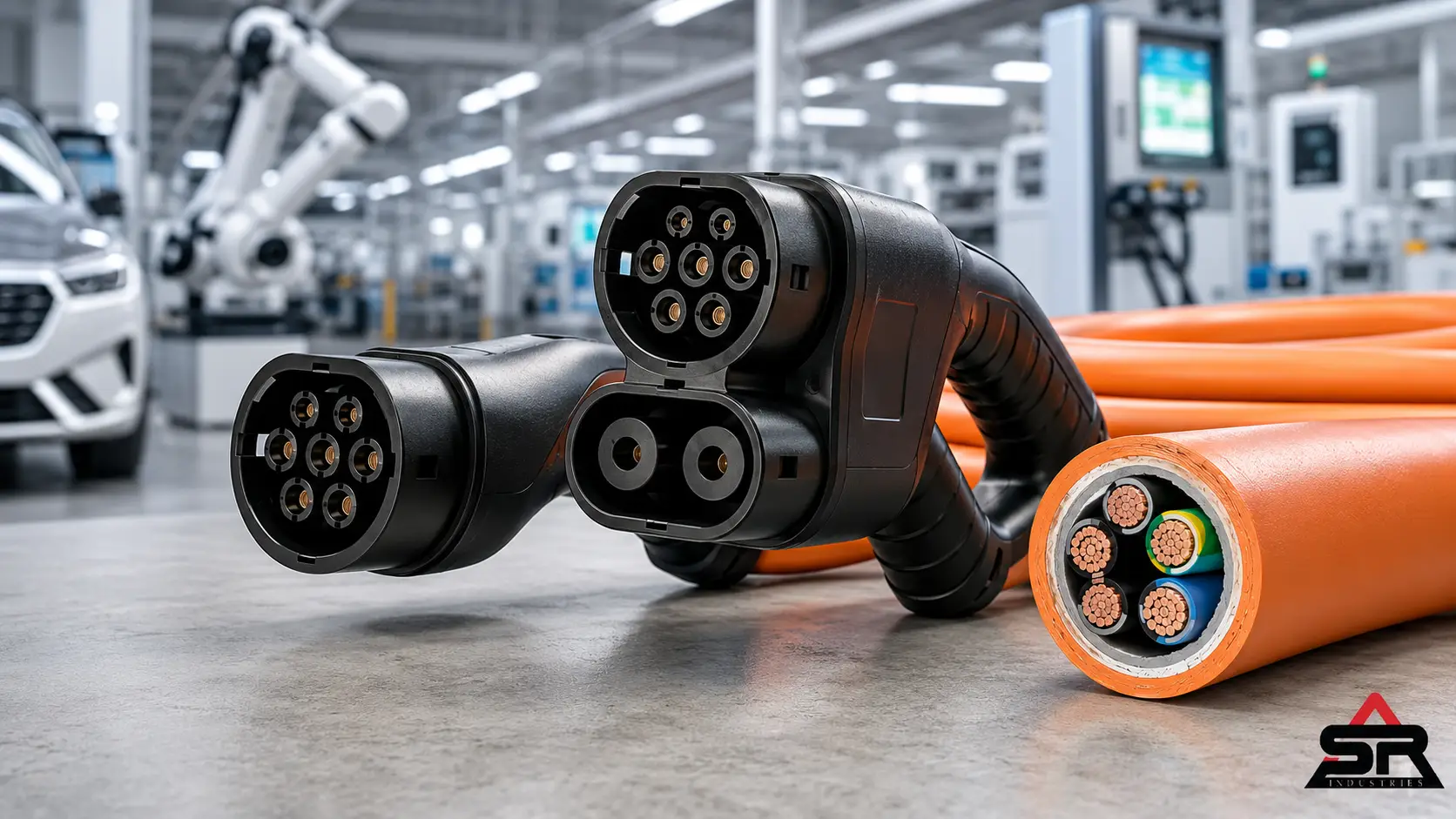
The EV Charging Cable Landscape in India
Every legitimate charging product in the country answers to IS 17017, the Bureau of Indian Standards series for electric vehicle conductive charging systems. It is harmonised with IEC 61851 (the charging system and supply-equipment rules) and IEC 62196 (the plugs, connectors, and vehicle inlets), then adapted for Indian grid behaviour, ambient extremes, and a vehicle mix no European standard ever anticipated — from a 2 kWh scooter to a 350 kWh electric bus.
IS 17017 is a family, not a single document, and engineers need to cite the right member for a given product:
- Part 1 (2018) sets the general requirements, covering supply up to 1,000 V AC or 1,500 V DC across all electric road vehicles, including plug-in hybrids.
- Part 2 defines the plugs, sockets, connectors, and vehicle inlets — aligned with IEC 62196, and the home of Type 2 and the Indian light-EV connectors.
- Part 21 handles electromagnetic compatibility, mirroring IEC 61851-21-2.
- Part 22, Section 1 (2021) governs AC charging for light EVs.
- Part 23 covers DC supply equipment for Mode 4 fast charging.
- Part 24 (2021) specifies the digital communication between the vehicle and DC supply equipment.
- Part 2, Sections 6 and 7 (2023) define the LEVDC (Type 6) and LECCS (Type 7) connectors purpose-built for Indian two- and three-wheelers.
Layered on top is the IEC 61851 charging-mode framework that engineers reference in daily conversation. Mode 2 is a portable lead with an in-cable control box running off a domestic socket. Mode 3 is the dedicated AC point with a Type 2 interface and full pilot communication. Mode 4 is off-board DC fast charging. Nearly every public AC charger in India is a Mode 3 product; nearly every DC fast charger is Mode 4.
In the field, this translates to a simple discipline: a cable is never “EV-rated” in isolation. It is rated against a mode, a connector, a current, and a voltage class — and the certification only holds when the finished assembly matches the standard it claims on paper.
AC vs DC Charging Cables
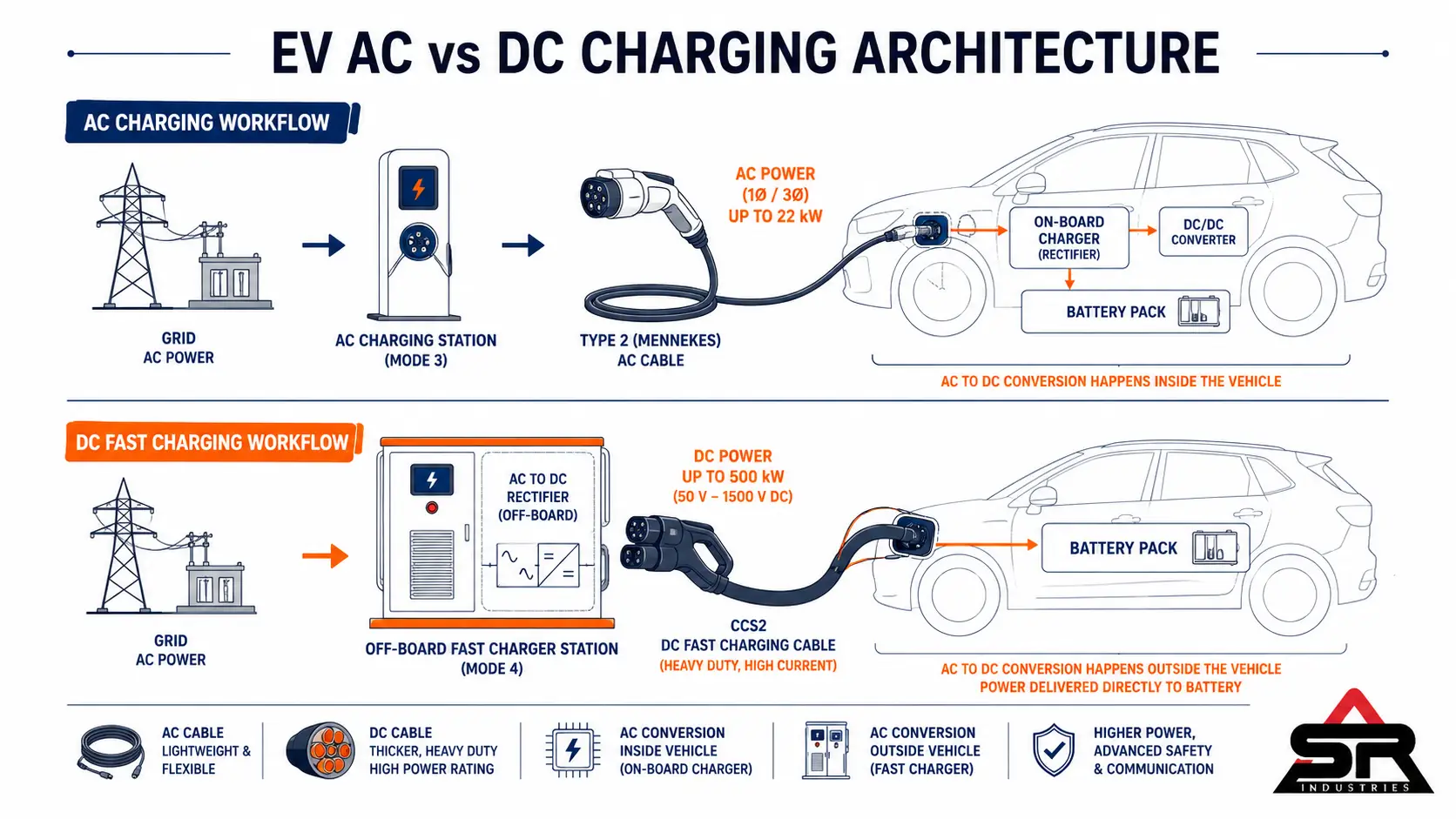
The split between alternating and direct current is the most consequential decision in cable design, because it dictates physics, not paperwork. What determines everything downstream is one question: where does the AC-to-DC conversion happen?
In an AC charging cable, conversion happens inside the vehicle. The cable simply ferries grid power to the car’s on-board charger — live conductors, neutral where present, protective earth, and two thin signal lines for the control pilot and proximity pilot. Power stays modest, from 3.3 kW at the entry level up to 22 kW on a three-phase park-bay unit. The conductors stay light, the lead stays flexible, and the cost stays contained. The Type 2 charging cable carries this entire segment.
A DC charging cable is a different engineering problem, because the rectifier sits in the charger and the cable delivers battery-level DC straight to the pack. Three things change at once. Copper cross-sections climb sharply to carry the current. Thermal management becomes a design constraint rather than an afterthought — the conductor heats under sustained high load, and that heat has to go somewhere. And at the top of the range, the only way to keep the gun light enough for a human hand is to run liquid-cooled conductors through the cable. That is the commercial cliff edge: a 60 kW DC lead is a heavy passive cable, but a 350 kW ultra-fast corridor charger needs active cooling, sealed coolant circuits, and a build cost that bears no relation to an AC lead. DC fast cables are almost always tethered permanently to the charger, precisely because of the current and the interlocks involved.
The discipline for a buyer is blunt. If the rectifier is in the car, it is an AC cable, and Type 2 is the format. If the rectifier is in the charger, it is a DC cable, the copper and cooling cost jumps, and CCS2 is the format. Specifying one when the architecture calls for the other is not a tolerance error — it is a different product.
IEC 62196 & Connector Types (Type 2, CCS2)
IEC 62196 defines the plug, socket, vehicle connector, and inlet for conductive charging worldwide, and India adopts it through IS 17017 Part 2. Two members of the family own the four-wheeler market.
Type 2 — India’s AC default
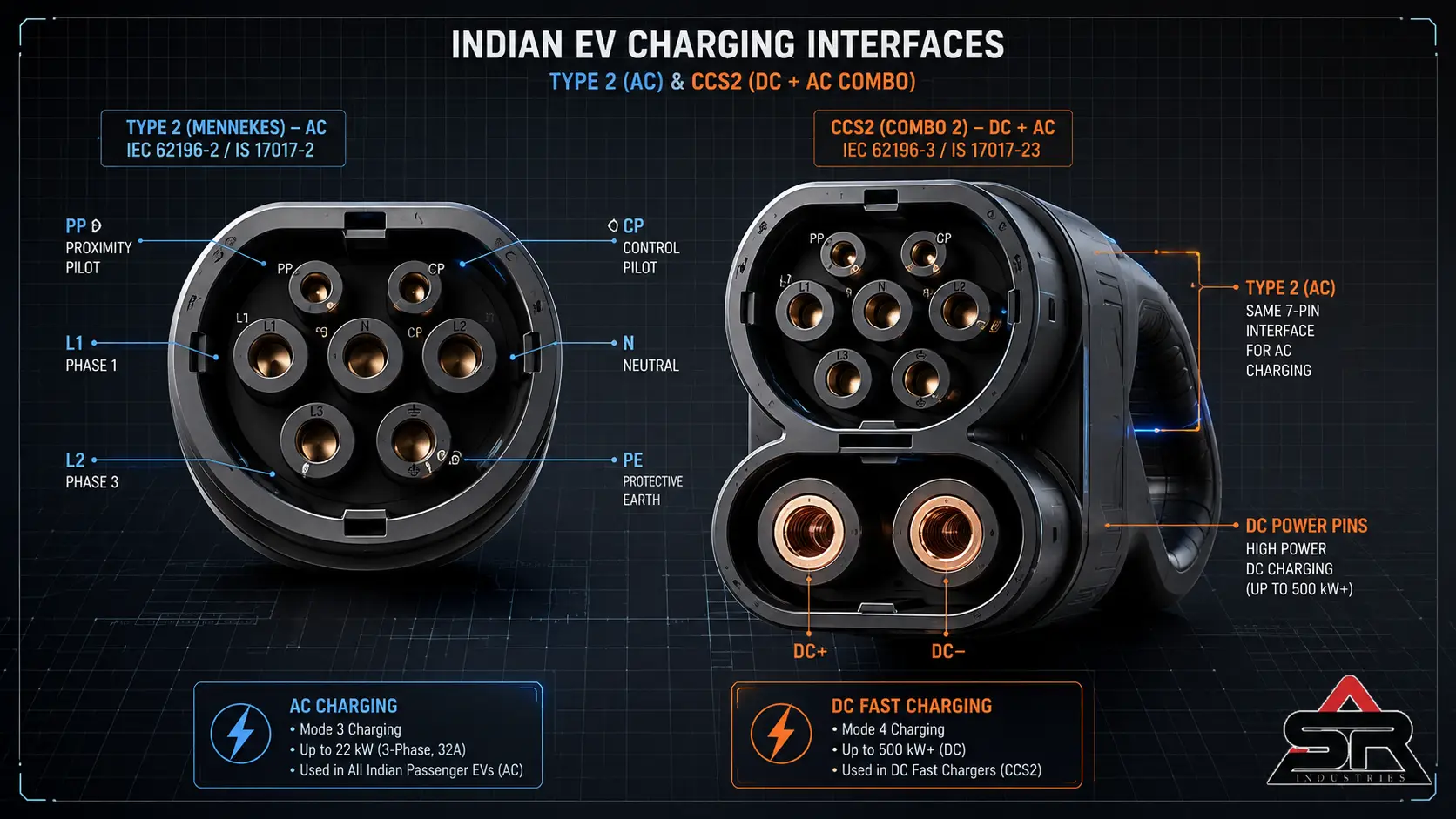
The Type 2 connector India standardised on, often called the Mennekes, is a round seven-pin interface: three power phases (L1, L2, L3), neutral, protective earth, plus the control pilot and proximity pilot signal pins. That layout lets one connector serve both single-phase and three-phase AC — up to roughly 7.4 kW single-phase and 22 kW three-phase at 32 A. It is the AC inlet on virtually every passenger EV sold here, from the Tata Nexon EV and MG ZS EV to imported premium models, and the interface on nearly every public AC point and home wallbox.
For a cable manufacturer, the Type 2 charging cable is the highest-volume EV product in the country. The standard Mode 3 assembly is Type 2 to Type 2, rated 16 A or 32 A, single or three phase, in 5-to-10-metre lengths.
CCS2 — India’s DC fast-charge consensus
CCS2 — Combined Charging System Type 2, under IEC 62196-3 — is the DC standard for cars. Its strength is the combo geometry: it reuses the Type 2 AC inlet and adds two large DC pins beneath it, so a single vehicle port accepts both an AC Type 2 cable and a DC CCS2 charging cable. That is why CCS2 dominates commercially — every new four-wheeler DC charger is built around it, from 50 kW units to 350 kW-plus corridor chargers with liquid-cooled leads.
India effectively closed the four-wheeler argument here: Type 2 for AC, CCS2 for DC. Legacy CHAdeMO and GB/T hardware survives at older sites, but no serious new car deployment is built on anything other than the IEC 62196 connector standard.
Bharat EV Charging Standards
Before that consensus existed, the Ministry of Power’s Bharat standards seeded India’s first public infrastructure — and a large amount of that hardware is still energised in the field. Anyone servicing existing sites or supplying replacement leads has to understand it.
Bharat AC-001 was the entry-level AC standard. It used the IEC 60309 industrial connector — the blue three-pin type — delivered up to 3.3 kW per socket at 15 A, 230 V single phase, and typically clustered three sockets per unit so several two-, three-, and four-wheelers could draw at once. There was no direct handshake between vehicle and charger; billing and control ran through the backend on OCPP. It was built for affordability and for the tiny batteries of early Indian EVs.
Bharat DC-001 was the matching fast-charge standard, built on a GB/T 20234.3 connector with CAN communication, delivering low DC output voltage (around 48 V or 72 V) at up to 200 A for roughly 10–15 kW. Government and PSU programmes rolled these out expecting automakers to follow, and early fleet cars like the Tata Tigor EV and Mahindra e-Verito did.
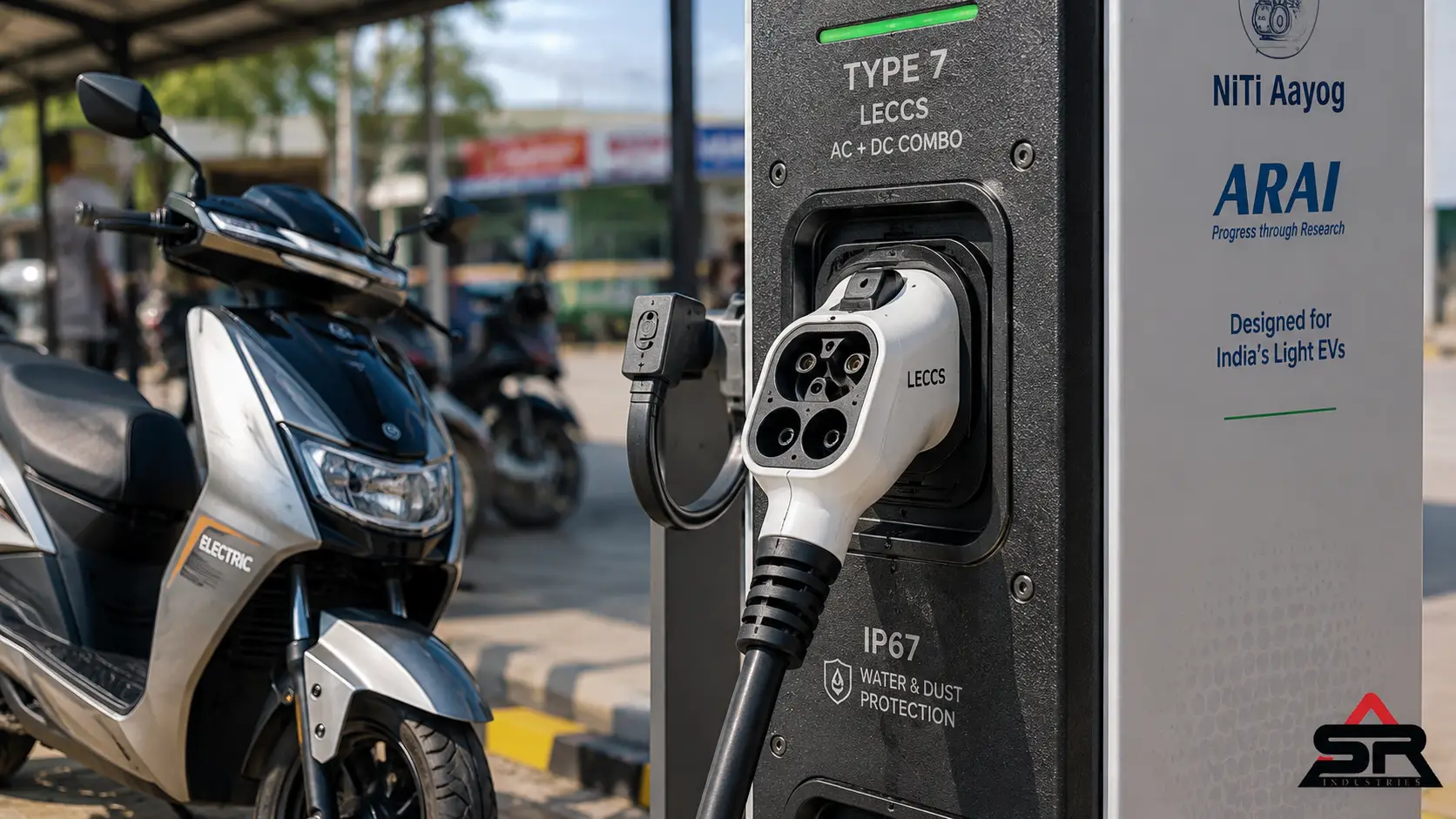
The structural bottleneck here was voltage headroom. As batteries grew and pack voltages climbed, the Bharat DC-001 architecture simply could not keep pace, and four-wheeler deployments migrated to CCS2. Rather than abandon low-voltage DC, the framework evolved into something better suited to the segment that actually needed it: the Type 6 (LEVDC) DC-only connector for light vehicles, and the Type 7 (LECCS) combined AC-and-DC port — roughly 7 kW AC and 10–12 kW DC in one interface — developed with NITI Aayog, ARAI, and industry players including Ather. For two- and three-wheelers, this was a necessary evolution: a standardised, durable, low-cost connector designed for fleet duty cycles instead of a four-wheeler standard awkwardly scaled down. For a cable supplier, the practical upshot is that the 2W/3W segment now has its own connector ecosystem, entirely separate from the Type 2 / CCS2 world.
Cable Current & Voltage Ratings
The EV charging cable rating is what protects the installation — and what carries the manufacturer’s liability when something melts. Two numbers govern the build.
Current rating sets the conductor cross-section, and procurement teams frequently overlook how unforgiving this relationship is. A 16 A single-phase AC cable is built on roughly 2.5 mm² copper. A 32 A lead steps up to about 6 mm², and a three-phase 32 A assembly is typically a six-core construction — three phases, neutral, earth, and the signal pair. Shaving cost by terminating 16 A copper into a 32 A connector is the classic failure: the lead runs hot, the insulation ages prematurely, and the assembly becomes a fire risk well inside its rated life. Oversizing wastes expensive copper and stiffens the cable until it is unpleasant to handle. The cross-section has to match the rated current honestly, both ways.
Voltage class splits along the AC/DC line again. Flexible AC charging cables sit in the 450/750 V class, which covers single- and three-phase grid voltages with margin. DC fast-charging cables move into a higher class — 1,000 V, rising toward 1,500 V on the newest high-voltage architectures — because the conductor carries battery-level DC directly.
A handful of IS 17017 power ceilings are worth committing to memory when matching a cable to a charger:
- Light-EV AC charging: up to 7 kW (Level 1).
- Light-EV DC charging: up to 12 kW (Level 1).
- Park-bay AC charging for cars: up to 22 kW (Level 2, three-phase, 32 A).
- DC fast charging for buses, trucks, and corridors: 50 kW to 500 kW (Levels 3 and 4).
One rule overrides all of them: the connector caps the assembly. A 32 A cable terminated in a 16 A connector is a 16 A product, whatever the copper could otherwise carry. Rated current, voltage class, and phase count must agree across cable, connector, and charger before anything goes to test.
Insulation, Flexibility & Durability Requirements
An EV charging lead lives a far harder life than building wire, and this is where cheap bills of material quietly destroy field reliability. The cable is coiled and uncoiled thousands of times, dragged across kerbs and gravel, run over by fleet vehicles, soaked in monsoon water, splashed with diesel and oil at forecourt sites, and left baking in direct sun. The material stack exists to survive exactly that.
Start with the failure that catches the most importers: ordinary PVC sheathing has no place on an Indian EV cable. PVC softens and deforms as ambient temperatures push past 50 °C — routine on an open forecourt or rooftop charger through a North Indian summer — and once the sheath deforms, the mechanical and electrical protection it was supposed to provide is gone. The non-negotiable field specification is cross-linked polyolefin (XLPO) insulation on the conductors, sheathed in thermoplastic polyurethane (TPU/PUR) or thermoplastic elastomer (TPE). TPU and TPE deliver the bending life, abrasion resistance, and crush resistance the application demands; serious assemblies also use low-smoke, halogen-free flame-retardant (LSZH) compounds so a fault does not fill an enclosed parking structure with dense, corrosive smoke.
The abuse this stack has to absorb is specific, and each mode maps to a real design requirement:
- Crush and conductor fatigue from fleet vehicles rolling over leads dropped on depot floors. Without high-grade sheathing and proper strand construction, the copper work-hardens and fractures internally — a fault that no visual inspection catches until the cable fails.
- Thermal ageing where undersized or poorly insulated conductors run hot under sustained load, embrittling the insulation from the inside out.
- Chemical attack at fuel forecourts and depots, where oil and solvent exposure swells and cracks a PVC sheath but is shrugged off by a correctly chosen TPU/PUR compound.
- UV and weather degradation on outdoor public installations, demanding UV-stable sheathing and an ingress rating — typically IP54 to IP67 at the connector depending on whether it is plugged, mated, or stowed.
- Mechanical endurance across tens of thousands of flex and bend cycles, plus tensile and crush performance, so the lead survives daily handling rather than just a one-time bench pass.
The construction benchmark behind this is IEC 62893, the international standard written specifically for EV charging cables — conductors, insulation, sheath, and flex performance. A cable that satisfies the connector standard but uses a low-grade sheath will clear a bench test and fail in service within a year. On an EV lead, flexibility and durability are not premium upgrades. They are the specification.
BIS & Safety Certification for EV Cables
A compliant design only earns half the prize. To be sold or installed in India, EV charging equipment must carry the correct certification, and BIS certification under IS 17017 is mandatory for AC and DC chargers — wall units, portable chargers, and DC fast chargers alike. For manufacturers, importers, and infrastructure providers, this is not negotiable.
What trips up project timelines is the texture of the process, not its existence:
- Certification is per model. A BIS grant attaches to a specific charger model or variant, not to a product family. A new variant generally needs its own grant, which means change management on the cable or connector can reopen a certification that was thought closed.
- The FMCS route governs imports. A foreign manufacturer of a charger or a critical component obtains BIS approval through the Foreign Manufacturers Certification Scheme, operating through an Indian Authorised Representative who carries the legal and procedural responsibility inside the country. Domestic makers route through the standard BIS scheme.
- ARAI and iCAT run the bench. These are the recognised agencies that built and operate the test capability for Indian charging standards, including the newer LECCS and LEVDC connectors. Type testing covers temperature-rise under rated current, dielectric withstand, insulation resistance, ingress protection, and flex-and-bend endurance — the same failure modes the material stack is designed to survive. A weak cable does not fail quietly here; it fails on a documented report that has to be answered before resubmission.
- The standards web keeps widening. Alongside IS 17017 sit vehicle- and battery-safety standards such as IS 18590:2024 and IS 18606:2024, plus the AIS-138 automotive-industry family for charging. Each tightens scrutiny on the electrical interface — exactly where the cable and connector live.
Treating BIS as a post-launch formality is one of the more expensive mistakes in this industry. Per-model grants, sample submission, and lab queues mean certification has a real calendar cost, and discovering a cable non-conformance after tooling is committed converts a design fix into a schedule crisis. For products bound for export as well, the same lead usually needs a parallel set — TUV or equivalent marks against IEC 62196 and IEC 62893, CE for Europe, and RoHS/REACH for materials. A manufacturer that builds to BIS and IEC together from the first drawing serves both markets without re-engineering, and walks into the test bench expecting to pass.
| Connector | Current Type | Standard | Typical Max Power | Primary Use in India |
|---|---|---|---|---|
| Type 2 (Mennekes) | AC | IEC 62196-2 / IS 17017-2 | 22 kW (32 A, 3-phase) | Default AC inlet for cars; wallboxes and public AC points |
| CCS2 (Combo 2) | DC | IEC 62196-3 / IS 17017-23 | 50–350+ kW | DC fast-charging standard for four-wheelers |
| Bharat AC-001 | AC | IEC 60309 | 3.3 kW per socket | Legacy/entry AC charging; multi-socket community units |
| Bharat DC-001 | DC | GB/T 20234.3 | 10–15 kW | Legacy DC fast charging for early fleet cars |
| Type 7 (LECCS) | AC + DC | IS 17017-2-7:2023 | ~7 kW AC / 10–12 kW DC | Standardised two- and three-wheeler combined charging |
| Type 6 (LEVDC) | DC | IS 17017-2-6:2023 | 3–12 kW | DC-only charging for light EVs (scooters, e-rickshaws) |
| CHAdeMO | DC | IEC 62196-3 | 50 kW+ | Legacy DC at older sites; not used in new car deployments |
FAQ: EV Charging Cable Standards
What is Type 2 charging?
Type 2 charging is AC charging through the IEC 62196-2 connector — a round seven-pin interface handling both single-phase and three-phase power. It is the default AC standard in India, used on passenger EV inlets, home wallboxes, and public AC points. A Type 2 charging cable typically carries 16 A or 32 A and reaches 22 kW in three-phase form. Because the vehicle's on-board charger does the AC-to-DC conversion, Type 2 leads are lighter and cheaper than DC fast-charge cables.
Is CCS2 the standard in India?
For DC fast charging of four-wheelers, yes. CCS2 (Combined Charging System Type 2) is the DC standard for cars. It extends the Type 2 AC inlet by adding two DC pins below it, so one vehicle port accepts both an AC Type 2 cable and a DC CCS2 cable. Every new public DC charger for cars is built around CCS2. Legacy CHAdeMO and Bharat DC-001 hardware remains at older sites, and two- and three-wheelers use the separate LECCS and LEVDC connectors, but CCS2 is the settled four-wheeler DC format.
What rating is needed for AC charging?
It depends on the segment. Home and light AC charging usually runs 16 A single-phase at around 3.3–3.7 kW. A faster home or workplace point uses 32 A single-phase near 7 kW. Public park-bay AC charging for cars uses 32 A three-phase for up to 22 kW. The cable's rated current must match the charger and connector — 16 A needs roughly 2.5 mm² copper, 32 A needs about 6 mm². The connector rating caps the whole assembly, so both ends must carry the same number.
Which standard covers the EV charging cable itself?
IS 17017 — with IEC 61851 and IEC 62196 — governs the connectors and the charging system, while IEC 62893 is the dedicated construction standard for the cable body: conductors, insulation, sheath, and flex performance. A complete EV charging cable specification references both, the connector standard for the interface and IEC 62893 for the cable.
Why does PVC fail on Indian EV cables?
PVC sheathing softens and deforms as ambient temperatures push past 50 °C, which is routine on open forecourts and rooftop chargers through an Indian summer. It also swells and cracks under the oil and solvent exposure common at fuel-station and depot sites. The field-grade alternative is XLPO insulation with a TPU/PUR or TPE sheath, which holds its mechanical and electrical properties across the temperature, abrasion, crush, and chemical loads an Indian EV cable actually sees.
Do EV charging cables need BIS certification in India?
Charging equipment placed on the Indian market must comply with IS 17017 and carry BIS certification — covering AC and DC chargers, portable units, and the connectors and cables in the assembly. Certification is granted per model, testing runs through ARAI or iCAT, and importers operate via the FMCS route through an Indian Authorised Representative. Building to BIS and IEC together is the cleanest path to both domestic and export approval.
Specifying EV Cable That Clears the Bench
Standards are not abstract on this product — they are the gap between a cable that passes type testing first time and one that comes back on a rejection report. A correct EV charging cable is matched on five fronts at once: connector type (Type 2, CCS2, LECCS, or legacy), current and voltage rating, conductor cross-section, sheath and insulation grade, and the certification it will be tested against.
For OEMs, EVSE builders, and charging-infrastructure operators sourcing in volume, the lowest-risk route is a manufacturing partner that designs to IS 17017 and IEC 62196/62893 from the first drawing, sizes the copper to the real rated current, and specifies XLPO insulation with TPU or TPE sheathing built for Indian heat, abrasion, and chemical exposure — not the cheapest compound on the shelf.
Discuss your EV charging cable requirements — connector type, current rating, length, and certification target — with an engineering and manufacturing team that builds to the Indian and international standards, so the assembly is right long before it reaches a test bench at ARAI or iCAT.