
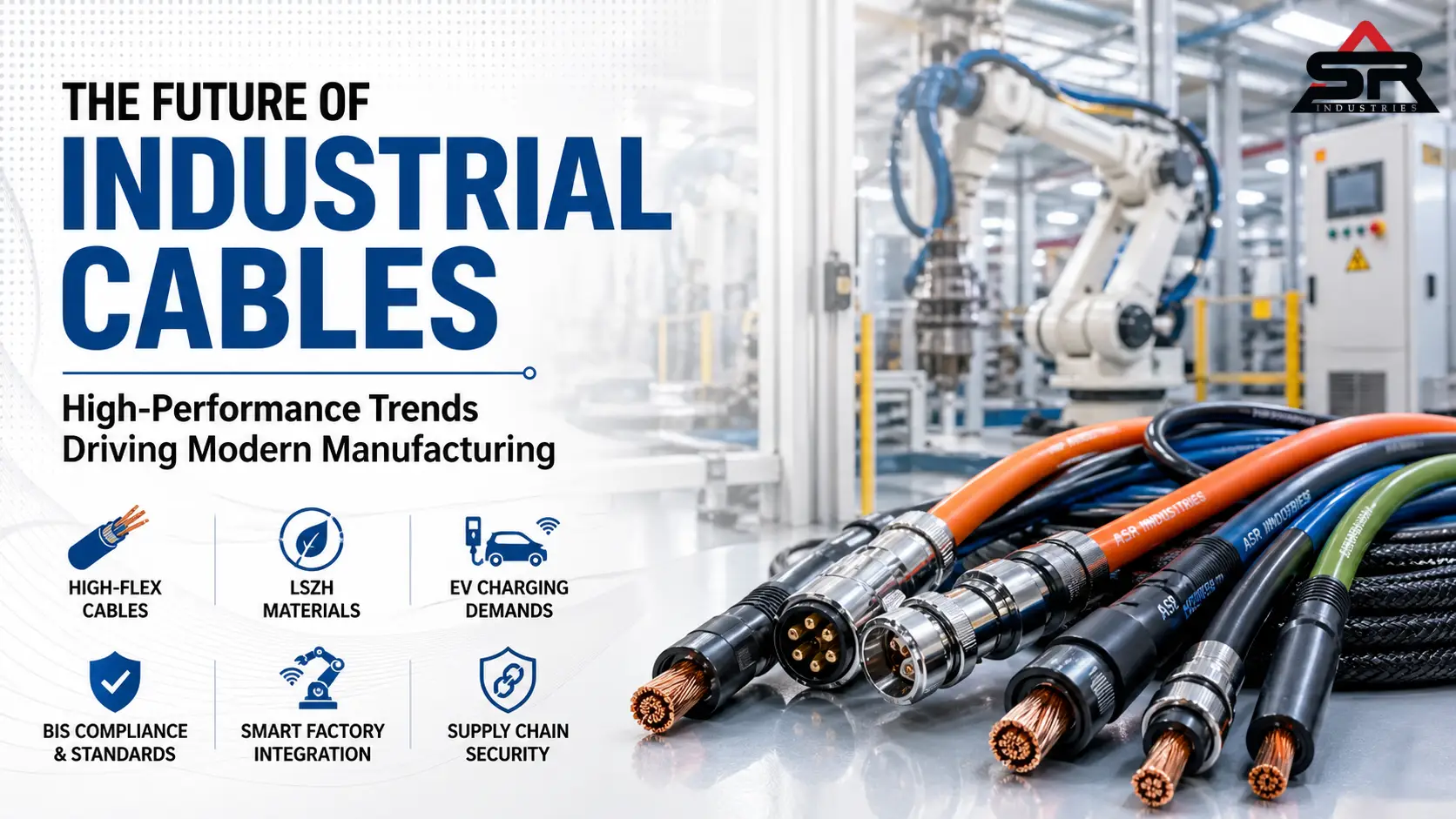
The Future of Industrial Cables: High-Flex & LSZH Trends
The Future of Industrial Cables: High-Performance Trends Driving Modern Manufacturing
Wiring a modern factory, an automated assembly line, or a high-voltage EV infrastructure grid, using legacy procurement habits, you are engineering your own failure. The industrial cable sector has completely shifted. Today’s manufacturing demands cables that survive millions of high-speed flexing cycles, resist highly caustic chemical cutting fluids, and handle extreme thermal loads without catastrophic insulation breakdown. It’s no longer just about copper and plastic. It is about advanced material science, stringent regulatory compliance like BIS, and bulletproof supply chain redundancy.
Cable failures in continuous motion environments cause immediate, catastrophic downtime, freezing automated assets and halting entire production shifts. An entire production shift grinds to a halt while maintenance technicians scramble to trace a single fault across hundreds of meters of cable trays. The financial bleed during these downtime events is massive.
This guide examines why legacy cable architectures fail under modern loads, analyzes current BIS/IATF standards, and outlines procurement strategies for high-stress environments.
The Real Cost of Bad Wiring on the Factory Floor
Most engineers focus heavily on the mechanical components of a new build—the motors, the pneumatics, the PLCs. The wiring harness often gets treated as an afterthought.
In continuous motion applications like gantry robots, CNC centers, and automated packaging lines, standard cables inside a moving drag chain degrade rapidly. The internal copper strands suffer from metal fatigue. As the cable bends back and forth thousands of times a day, the outer strands in the copper bundle stretch, while the inner strands compress. Eventually, they snap. This creates a “bird-caging” effect inside the jacket. The broken strands puncture the insulation, hit another conductor, and you get a dead short.
Engineering Insight: Never specify your cable based purely on static ampacity charts if the application moves. A cable rated for 50 amps resting in a tray might only safely carry 35 amps when tightly bundled inside a high-temperature, continuously flexing robotic track. Heat dissipation changes entirely when you stack cables together in motion.
To combat this, the industry has entirely re-engineered how high-flex cables are built. We aren’t just using thinner copper strands. We are changing the geometry of the bundle. Advanced industrial cables use incredibly precise “lay lengths”—the twist rate of the copper. A shorter lay length allows the cable to bend tighter without stressing the metal. Furthermore, top-tier manufacturers are wrapping these bundles in specialized PTFE tapes. This acts as a dry lubricant. When the cable bends, the internal components literally slide past each other instead of grinding together.
Suppliers unable to provide precise stranding geometry data are likely supplying commodity wiring unsuitable for dynamic mechanical loads.
The Automotive Shift: EV Charging and Heavy-Duty Demands
The explosion of electric vehicle manufacturing has forced the cable industry to evolve overnight. You cannot wire a 400-volt or 800-volt EV architecture with standard low-tension wire.
Automotive OEMs are incredibly specific about what goes into their vehicles. The industry standard has heavily shifted toward highly engineered AV, AVS, and AVSS cables. These are specialized low-tension cables designed with ultra-thin wall insulation. Why thin? Because space and weight inside a modern vehicle are at a premium. Every gram matters. But reducing the insulation thickness means the material itself has to be vastly superior. It has to resist abrasion, extreme engine heat, and automotive fluids without breaking down.
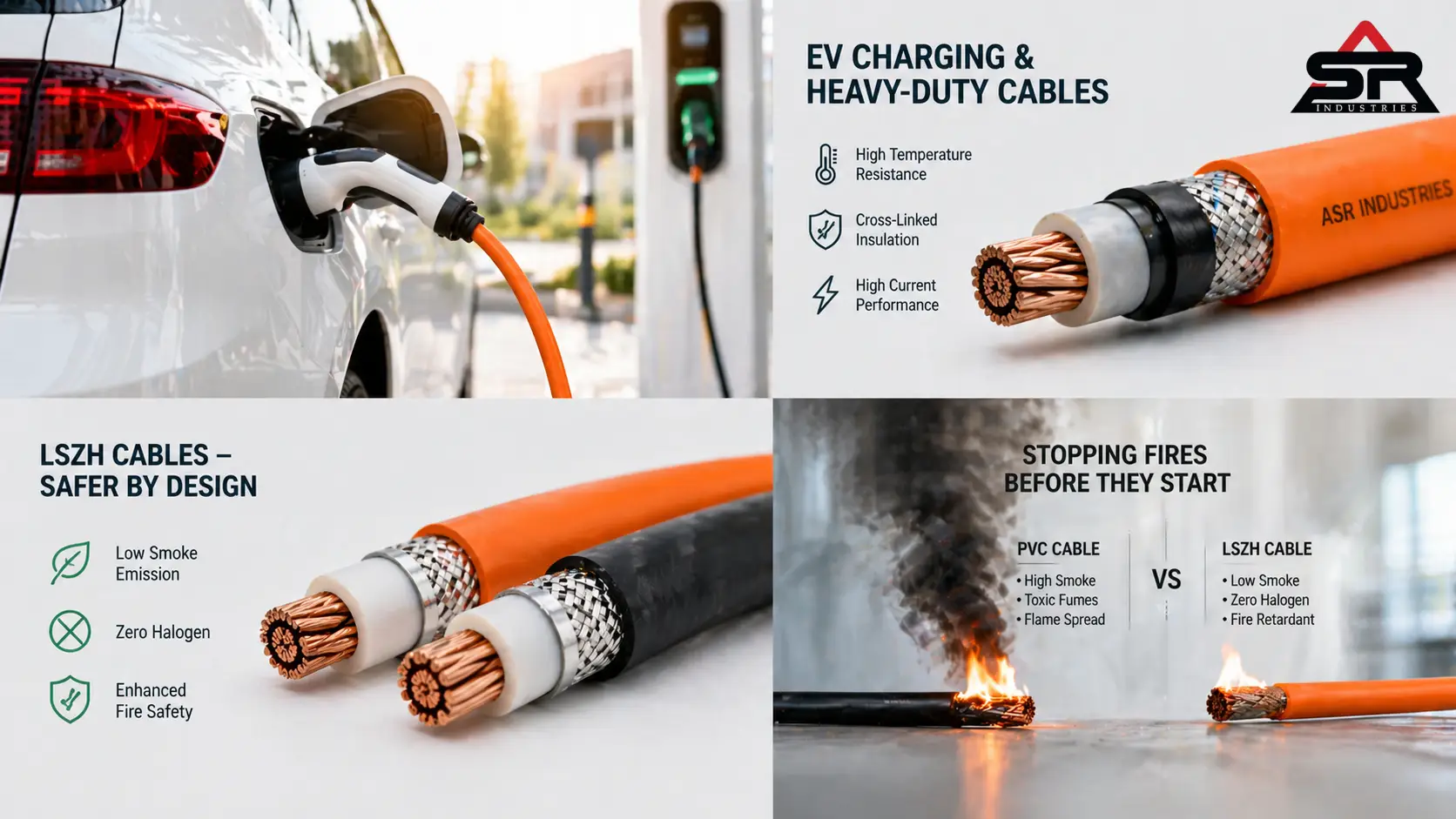
Then you have the high-voltage side. Heavy-duty battery cables and EV charging cables live a brutal life. When you fast-charge an electric vehicle, you are dumping a massive amount of direct current (DC) through that line. That creates intense heat.
Standard PVC insulation will literally melt off the copper under these thermal loads.
This is why modern EV cables utilize cross-linked elastomers and highly advanced polymers. Cross-linking is a chemical process that changes the molecular structure of the plastic. It stops it from acting like a thermoplastic (which melts when hot) and makes it act like a thermoset (which holds its shape). You can bake a cross-linked cable at 150°C, and it will remain structurally sound.
But it isn’t just about the heat. EV charging cables sit outside in the freezing rain, the blistering sun, and get dragged across abrasive concrete by consumers daily. The outer jacket has to remain highly flexible at -40°C while resisting heavy UV degradation. It is a masterclass in chemical engineering.
Material Science: Stopping Fires Before They Start
Electrical faults remain a primary ignition source in industrial settings. While Polyvinyl Chloride (PVC) has historically been the standard due to its cost-effectiveness and extrusion properties, it has a fatal flaw. When it burns, it releases dense, black smoke and highly toxic halogen gases, specifically hydrogen chloride. These hydrogen chloride emissions pose severe, immediate respiratory risks in enclosed spaces. In an enclosed factory, a warehouse, or a commercial high-rise, burning PVC is often deadlier than the actual flames.
Building codes and industrial insurance policies are cracking down hard. The trend is moving rapidly toward Low Smoke Zero Halogen (LSZH) compounds.
LSZH cables are engineered using different base polymers. If exposed to a flame, they do not release halogen gases. The smoke emission is incredibly low, meaning workers can actually see the emergency exit signs during an evacuation.
Transitioning from PVC to LSZH is not a simple swap for a manufacturer. The extrusion process is vastly different. LSZH compounds are highly sensitive to temperature variations during manufacturing. If the extrusion head is off by just a few degrees, the jacket will tear or fail to cure properly. This requires state-of-the-art machinery and relentless quality control on the production floor.
Understanding the Certifications That Actually Matter
Quality claims in industrial procurement require stringent, verifiable documentation.
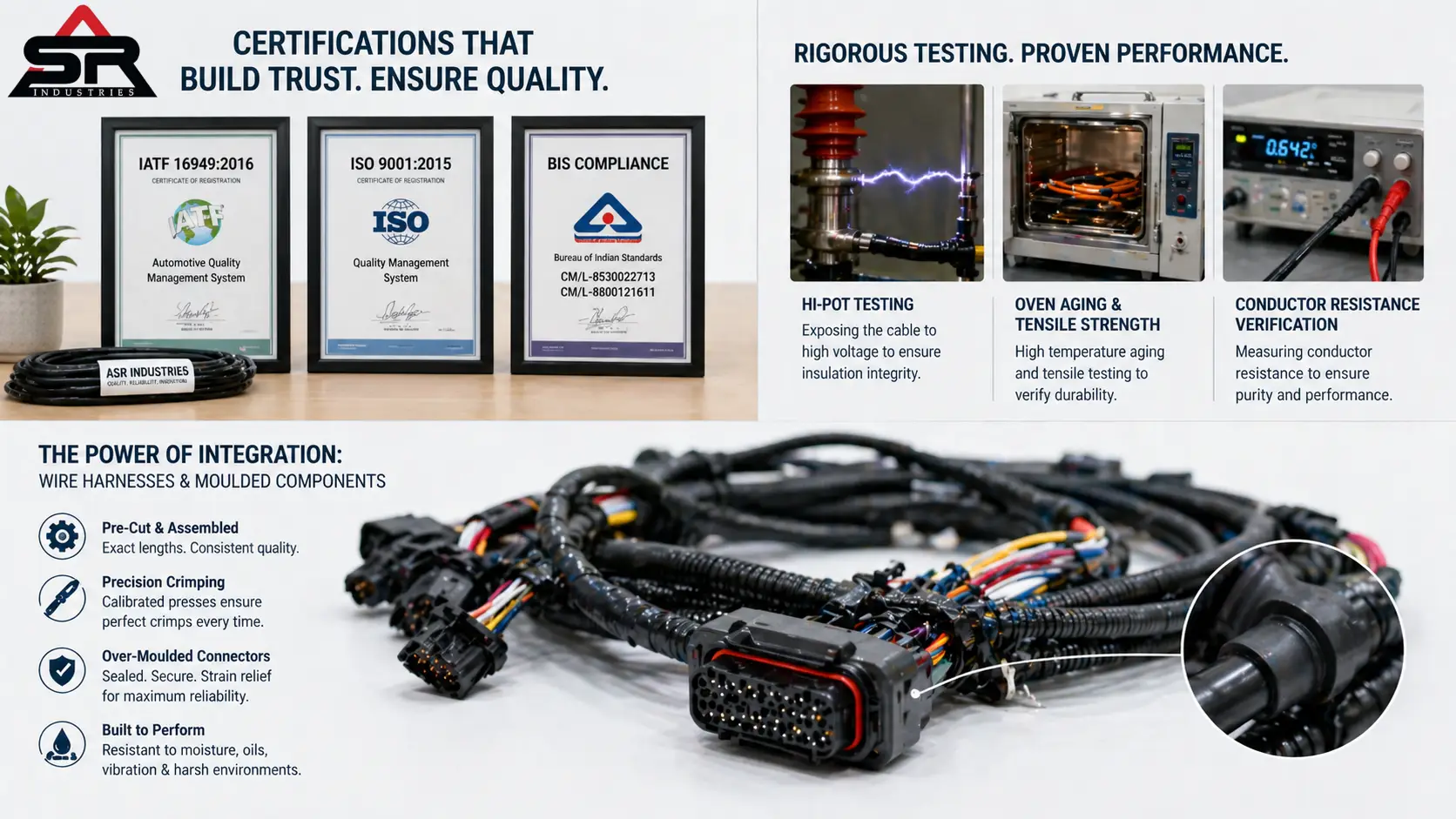
IATF 16949:2016 If you are buying anything related to automotive—especially wiring harnesses or EV components—this is the gold standard. It goes way beyond basic quality control. IATF 16949 is about defect prevention. It is about statistical process control and continuous improvement within the automotive supply chain. A manufacturer holding this certification has proven that their entire facility is wired to eliminate variation. Every single batch of wire is exactly identical to the last.
ISO 9001:2015 This is your baseline. It proves the manufacturer has a documented, functioning Quality Management System. It means they track their raw materials, they document their testing procedures, and they have a system in place to handle non-conformance.
BIS Compliance (Bureau of Indian Standards) > For the Indian market and export markets relying on Indian manufacturing, BIS is non-negotiable. Cables must meet strict IS standards, verifiable by specific CM/L numbers (for instance, CM/L-8530022713 for specialized cables, or CM/L-8800121611 for power cords).
This certification is not a rubber stamp; it guarantees the product has survived brutal third-party testing protocols, including:
- High-Voltage “Hi-Pot” Testing: Exposing the cable to massive electrical stress to ensure the insulation does not break down or arc.
- Oven Aging & Tensile Strength: Baking the plastic jackets at extreme temperatures and physically stretching them to verify structural integrity under thermal load.
- Conductor Resistance Verification: Scientifically measuring the copper’s resistance to prove absolute metallurgical purity.
Do not install uncertified wire in a commercial project. If an electrical fire occurs, insurance investigators will immediately look for BIS compliance, and uncertified installations will result in instant claim denial.
The Power of Integration: Wire Harnesses and Moulded Components
A raw spool of high-performance cable is useless until it is terminated correctly.
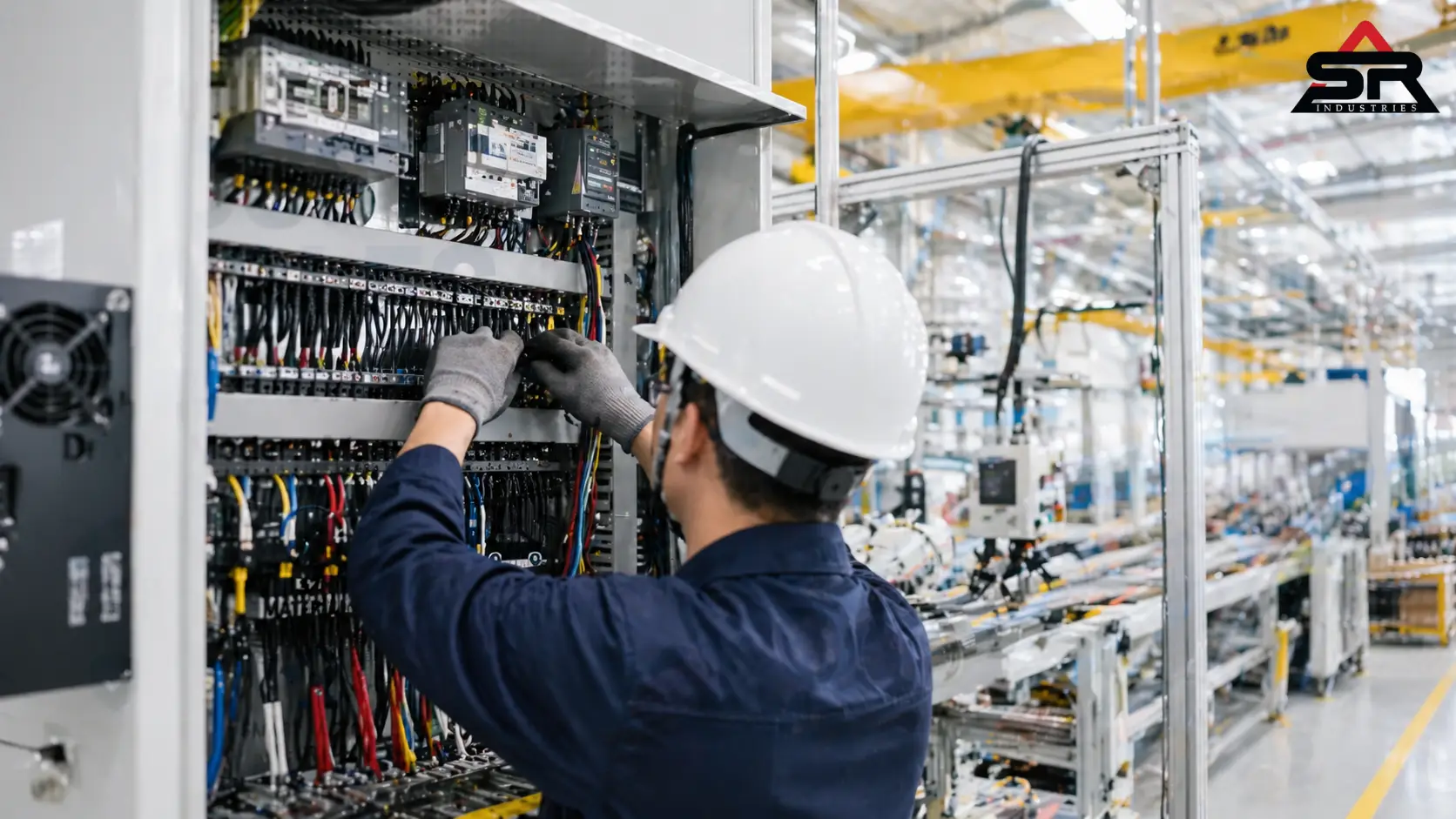
The industry trend is heavily shifting away from on-site termination. Having an electrician standing in a factory, stripping wires and crimping lugs by hand, introduces massive human error. A single bad crimp causes micro-arcing, which generates heat, which eventually causes a fire.
Smart procurement teams are buying fully assembled wiring harness solutions directly from the manufacturer.
When a harness is built in a controlled factory environment, the quality is locked in. Wires are cut to exact lengths using automated machinery. Terminals are crimped using calibrated pneumatic presses that apply the exact correct tonnage every single time.
The critical failure point is often the junction between the flexible cable and rigid connector, making over-molded components essential.
Look at a heavy-duty power cord or a complex automotive harness. The point where the flexible cable meets the rigid connector is the weakest point in the entire assembly. This is where strain relief is critical. Top-tier manufacturers don’t just attach a connector; they over-mold it. They inject hot plastic or rubber directly over the termination point, bonding the jacket and the connector into a single solid piece.
This seals out moisture, blocks industrial oils, and mechanically locks the internal wires in place so they cannot be pulled out under tension. If you are operating in a wet environment or an area with heavy vibration, over-molded connectors are the only reliable option.
Supply Chain Security: Why ‘Made in India’ is the Strategic Play
The global supply chain shocks of the past few years forced a massive reckoning in B2B procurement. Over-reliance on single-source overseas suppliers creates unacceptable vulnerabilities during logistical disruptions.
Procurement managers are now prioritizing redundancy and scale. They want suppliers who cannot be knocked offline by a localized issue.
This is why the manufacturing hub in India—specifically regions like Noida, Uttar Pradesh—has become incredibly strategic for global buyers. India offers a rare combination of highly technical engineering talent, vast raw material access, and massive production capacity.
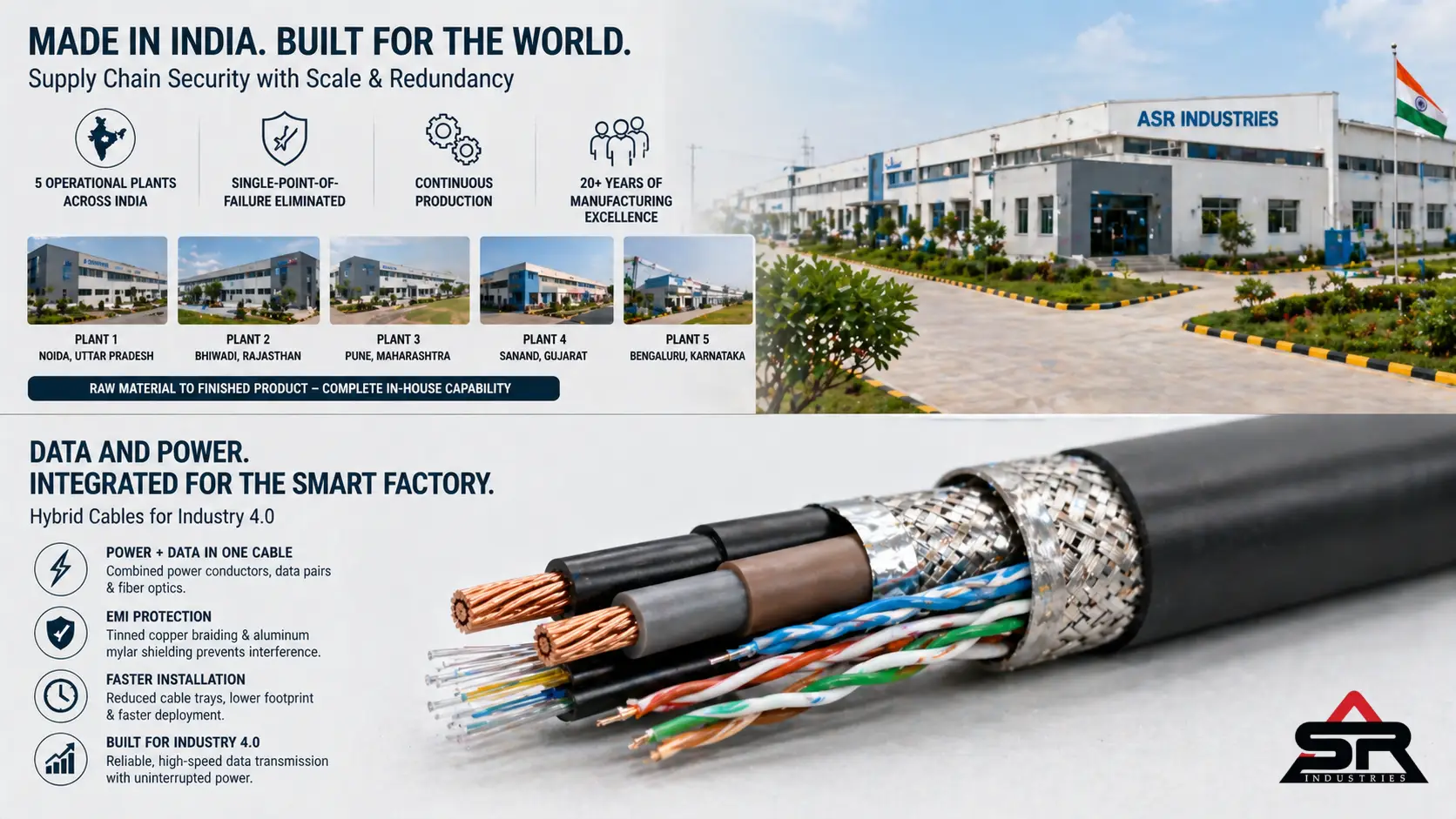
Consider a manufacturer like ASR Industries. They aren’t just operating a single shed. They have built an infrastructure featuring 5 operational plants across India.
Why does that matter to an OEM? Because it eliminates single-point-of-failure risk. If a localized storm knocks out power to one facility, or a regional transport strike happens, production instantly shifts to one of the other four plants. The wiring harnesses, the power cords, and the industrial cables keep flowing.
With almost two decades of manufacturing excellence, facilities operating at this scale are capable of handling high-volume, highly complex orders that smaller boutique shops simply cannot touch. They control the entire process from the copper drawing to the final plastic over-molding.
Data and Power Integration: The Smart Factory Future
As we push deeper into Industry 4.0, the definition of an industrial cable is blurring.
A modern CNC machine doesn’t just need 3-phase power. It has dozens of high-precision sensors—like a WIKA pressure transmitter or a high-speed optical scanner. These sensors need to talk to the PLC instantly.
Historically, you ran heavy power cables in one tray and delicate data cables in another to prevent Electromagnetic Interference (EMI). Heavy power lines throw off magnetic fields that can corrupt digital data.
The latest trend is the hybrid cable. Manufacturers are engineering single, highly shielded cables that carry heavy copper power conductors right alongside twisted-pair data lines or even fiber optics.
This requires intense engineering. The data lines must be wrapped in specialized tinned-copper braiding or aluminum mylar foil to completely block the EMI generated by the power conductors right next to them.
The benefit? You cut your installation time in half. You reduce the physical footprint of your wiring runs. You eliminate the need for secondary cable trays. It is a leaner, faster, and highly efficient way to wire a smart facility.
Strategic Procurement for Future Infrastructure
The cables carrying power and data through your facility are the literal nervous system of your operation. Treating them as a cheap commodity is a dangerous game that ends in massive downtime and severe safety risks.
The demands on these systems will only intensify. Electric vehicles will charge faster, requiring higher voltages. Factory automation will become faster and more complex, demanding cables that can survive relentless motion. Environmental regulations will force a complete abandonment of toxic legacy plastics.
You need to partner with manufacturers who operate at scale, hold the hard certifications, and deeply understand the brutal chemical and mechanical realities of modern industry. Look at the data, audit the testing protocols, and build your infrastructure to survive the future.
Frequently Asked Questions (FAQs)
Why do continuous flexing applications destroy standard cables?
Standard cables use thick copper strands and basic stranding geometries. When forced to bend repeatedly in a drag chain or robotic arm, the copper suffers metal fatigue and snaps, while the friction between internal components causes the jacket to tear from the inside out. High-flex cables use ultra-fine stranding, tight lay lengths, and dry lubricants to survive millions of cycles.
What is the functional difference between AV, AVS, and AVSS automotive cables?
These are low-tension cables used in vehicle wiring harnesses. AV is the standard thickness. AVS features a thinner insulation wall to save weight and space. AVSS takes this a step further with an ultra-thin wall, used in high-density modern automotive electronics where space is extremely restricted. All three require highly durable polymer insulation to survive engine heat and abrasion.
How does over-molding improve a wiring harness?
Over-molding means injecting hot plastic or rubber straight over the exact point where the wire meets the terminal. This seals out moisture and oil completely. But more importantly, it acts like a physical anchor. If a technician yanks that cord hard on the factory floor, the internal wires won’t tear away from the pins. It stops accidental pull-outs dead in their tracks.
Why is LSZH cable becoming mandatory in many industrial builds?
Standard PVC turns into a nightmare during a factory fire. It pumps out thick, black smoke and acid gas. LSZH (Low Smoke Zero Halogen) materials fix this exact problem. If an LSZH jacket catches fire, it barely smokes at all. There are no poisonous gases released into the air. Your team can actually see the exit signs and get out safely without breathing in toxic fumes.
How exactly does a cable pass BIS testing?
The Bureau of Indian Standards does not just hand out approval stamps. They run a brutal series of physical checks. The lab hits the cable with massive voltage—a “hi-pot” test—to make sure the insulation holds up. They measure the copper’s resistance to prove the metal is pure. They bake the plastic jackets in an oven and physically stretch them until they snap. Finally, they set the wire on fire to measure the burn rate. You have to survive all of that to get certified.