
Why Power Cord Quality Matters: Safety, Performance & Reliability
The Hidden Cost of Cheap Power Cords in Heavy-Duty Manufacturing
Walk onto any active factory floor, and you’ll often find procurement teams obsessing over million-dollar automation machines while completely ignoring the five-dollar cable plugging them into the wall. It’s a massive engineering oversight. In our experience analyzing industrial power deliveries, we’ve seen firsthand what happens when a cheap plastic jacket melts under a continuous load. It doesn’t just stop at a fried motherboard; it brings entire production lines to a grinding halt. If you are managing OEM machinery or complex wiring harnesses, treating your power delivery as an afterthought is essentially playing roulette with your facility’s safety and uptime.
The Real Cost of Ignoring Power Cord Quality
You get what you pay for. In electrical engineering, paying less usually means paying twice.
When you buy a cheap power cord, the manufacturer had to cut corners to hit that price point. They didn’t invent a magical new manufacturing process. They stole material from the inside. They thinned out the insulation. They mixed scrap metal into the conductor.
Fire Hazards and Electrical Failures
Heat is the enemy of electrical transmission. When current flows through a wire, it faces resistance. Resistance generates heat. A heavy duty power cord uses pure, thick copper to minimize this resistance. Cheap cords do not.
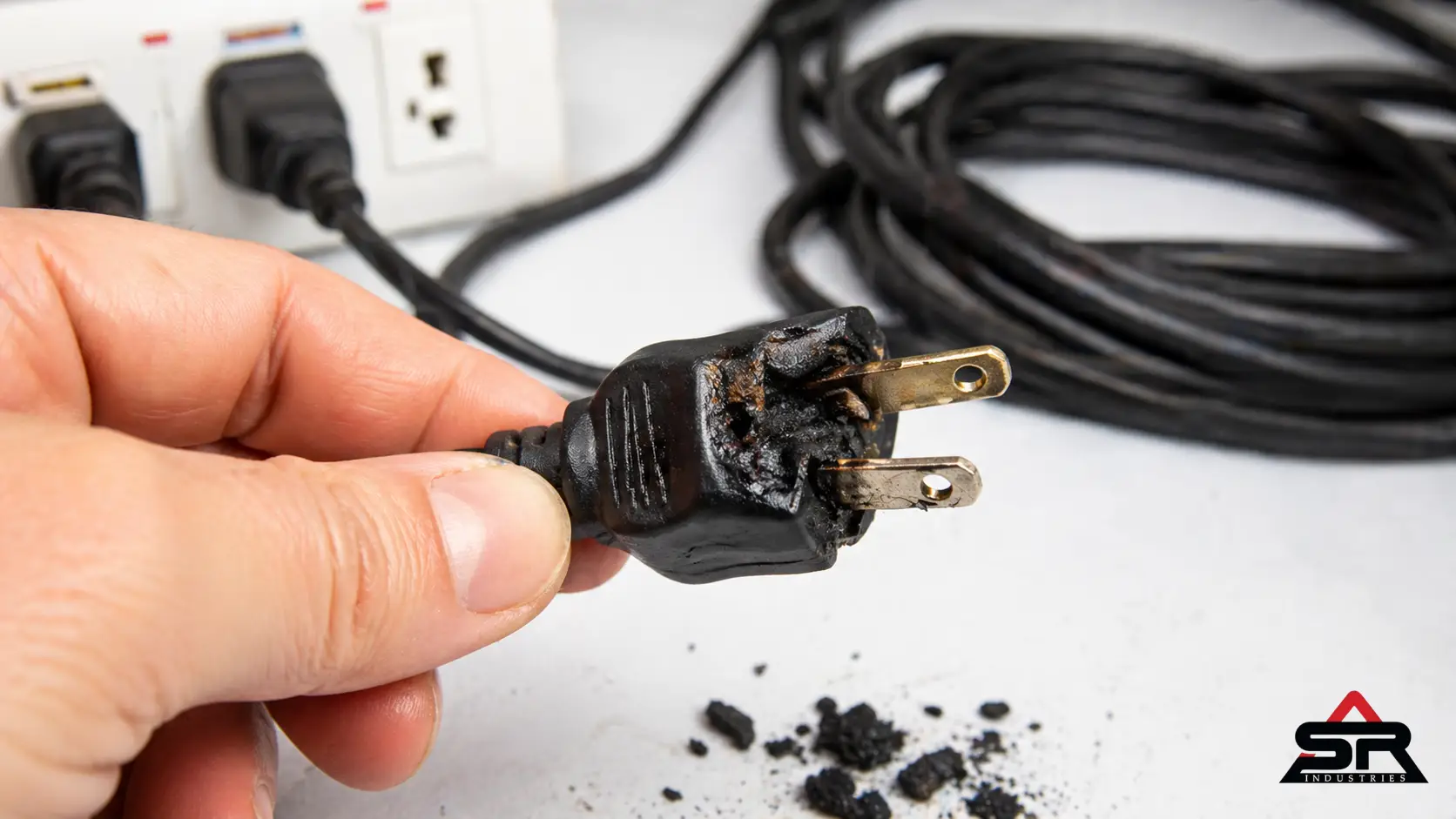
If a cord lacks the proper power cord current capacity for the load it carries, the internal temperature skyrockets. The insulation starts to bake. It gets brittle. It cracks. Once the bare conductors touch, you get an arc flash. Sparks fly. Insulation ignites.
This is not a hypothetical scenario. Substandard electrical power cords are a leading cause of industrial facility fires globally. The insulation melts away right at the molded plug—the weakest point of any cable.
Compliance Isn’t Optional: Power Cord Safety Standards
You cannot eyeball safety. You have to verify it.
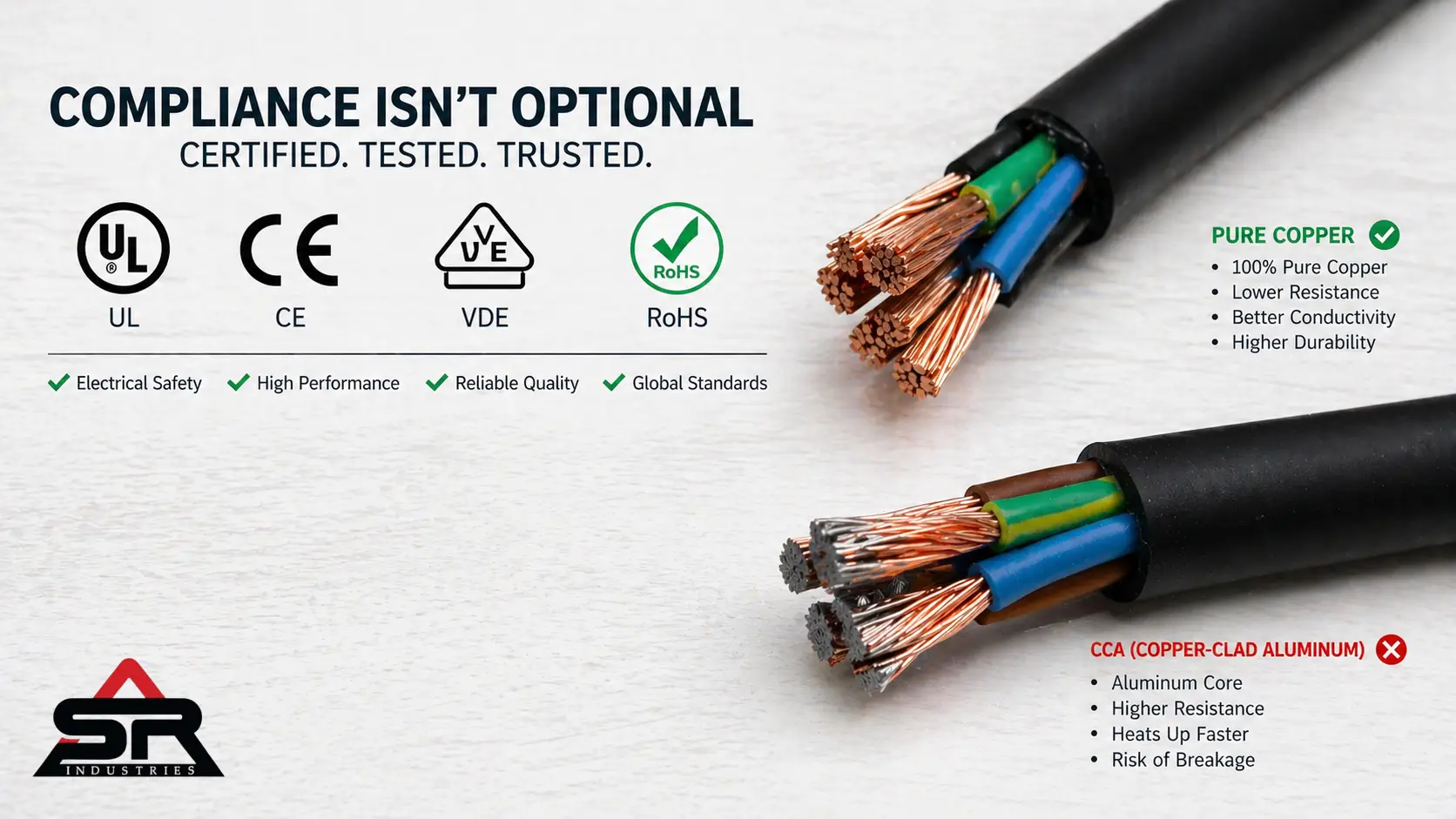
Legitimate manufacturers subject their products to brutal testing to meet power cord safety standards. Organizations like UL (Underwriters Laboratories), CE, VDE, and RoHS don’t hand out certifications for fun. They stress-test products to failure.
A certified power cord manufacturer proves their cables can withstand electrical surges, physical crushing, and extreme temperatures. If you use uncertified cords in industrial machinery, you are likely voiding your equipment warranty. Worse, if a fire occurs, insurance companies will investigate the point of origin. If they find a non-compliant, unlisted power cable caused the blaze, your claim gets denied immediately.
Expert Pro-Tip: Never trust a CE or UL mark stamped on a cheap cord without verifying the registration number in the official database. Counterfeiters mold fake certification logos directly into the plug. Always ask the OEM power cord supplier for their official compliance certificates.
Under the Jacket: Power Cord Material Quality
Cut open a power cable. What do you see? The anatomy of a cord dictates its power cord lifespan. It comes down to two primary components: the conductor inside and the jacket outside.
The CCA Trap: Why Pure Copper is Non-Negotiable
There’s a dirty little open secret flooding the electrical supply chain right now: Copper-Clad Aluminum (CCA) disguised as premium wire. At first glance, a CCA cable looks and feels identical to pure copper, which makes it incredibly easy for unaware buyers to get duped. But the moment you connect it to a high-draw piece of machinery, the performance gap becomes dangerously obvious. Because aluminum naturally holds a much higher electrical resistance, it heats up remarkably fast under load. Even worse, if you integrate CCA into automated systems where the cable faces continuous bending and torsion, the brittle internal aluminum core will inevitably snap. If your equipment demands steady, heavy-duty current, demand 100% pure, oxygen-free copper—the heavier weight alone is usually a dead giveaway.
Insulation Breakdown: Knowing When to Ditch PVC for Rubber
For everyday office environments or basic indoor electronics, standard Polyvinyl Chloride (PVC) is perfectly fine. It’s cost-effective and molds easily. However, standard PVC is notoriously stubborn in extreme environments. Drop the temperature toward freezing, and that same flexible cord suddenly becomes as rigid as a steel pipe, cracking the second someone accidentally bends or steps on it.
This is exactly why heavy industrial applications rely on Neoprene or EPDM rubber power cords. Rubber is essentially built for war on the factory floor. It shrugs off cutting oils, resists ozone exposure, and maintains total flexibility in sub-zero environments. While it might sting your budget a bit more upfront, the survivability of a rubber jacket over a five-year timeline makes it the far smarter investment.
Drop the temperature below freezing, and a PVC power cord becomes as stiff as a steel rod. If you bend it, it cracks. It also melts easily if exposed to welding slag or hot machinery.
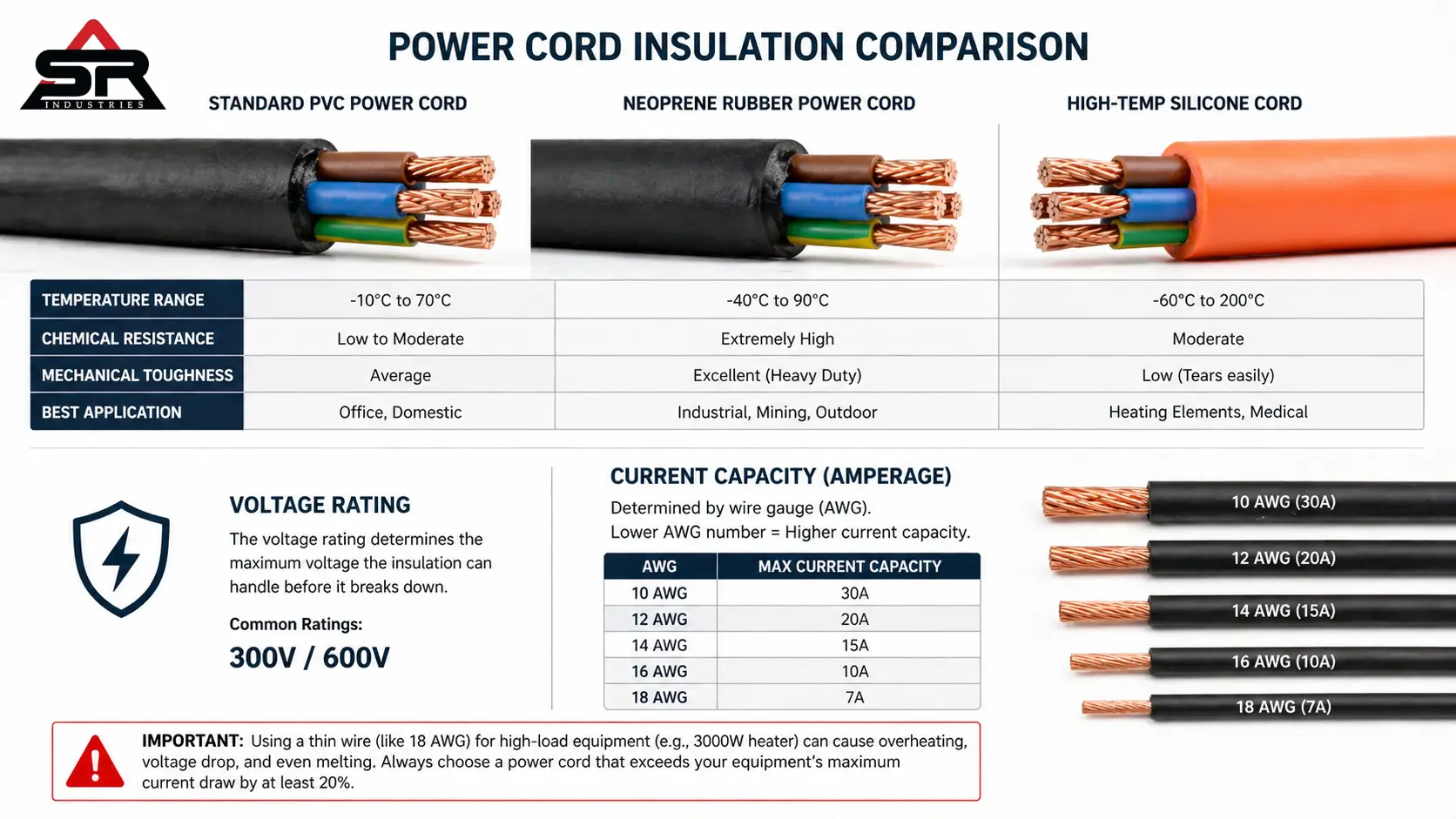
Feature Comparison | Standard PVC Power Cord | Neoprene Rubber Power Cord | High-Temp Silicone Cord |
Temperature Range | -10°C to 70°C | -40°C to 90°C | -60°C to 200°C |
Chemical Resistance | Low to Moderate | Extremely High | Moderate |
Mechanical Toughness | Average | Excellent (Heavy Duty) | Low (Tears easily) |
Best Application | Office, Domestic | Industrial, Mining, Outdoor | Heating Elements, Medical |
Engineering for Extremes: Power Cord Performance Metrics
How do you quantify a durable power cord? You look at the raw engineering metrics. You don’t guess. You calculate.
Power Cord Voltage Rating and Current Capacity
Every cord has a limit. The power cord voltage rating determines the maximum voltage the insulation can handle before it breaks down and allows current to leak. Common ratings are 300V or 600V.
More importantly, look at the power cord current capacity (Amperage). This is dictated by the wire gauge (AWG or cross-sectional area in mm²). A 10 AWG wire can carry far more current than a 16 AWG wire.
If you plug a heavy load—like a 3000W industrial heater—into a thin 18 AWG cord, the cord will act like a resistor. It will heat up, choke the power delivery, and eventually melt. Always calculate the maximum draw of your equipment and specify a reliable power cord that exceeds that capacity by at least 20%.
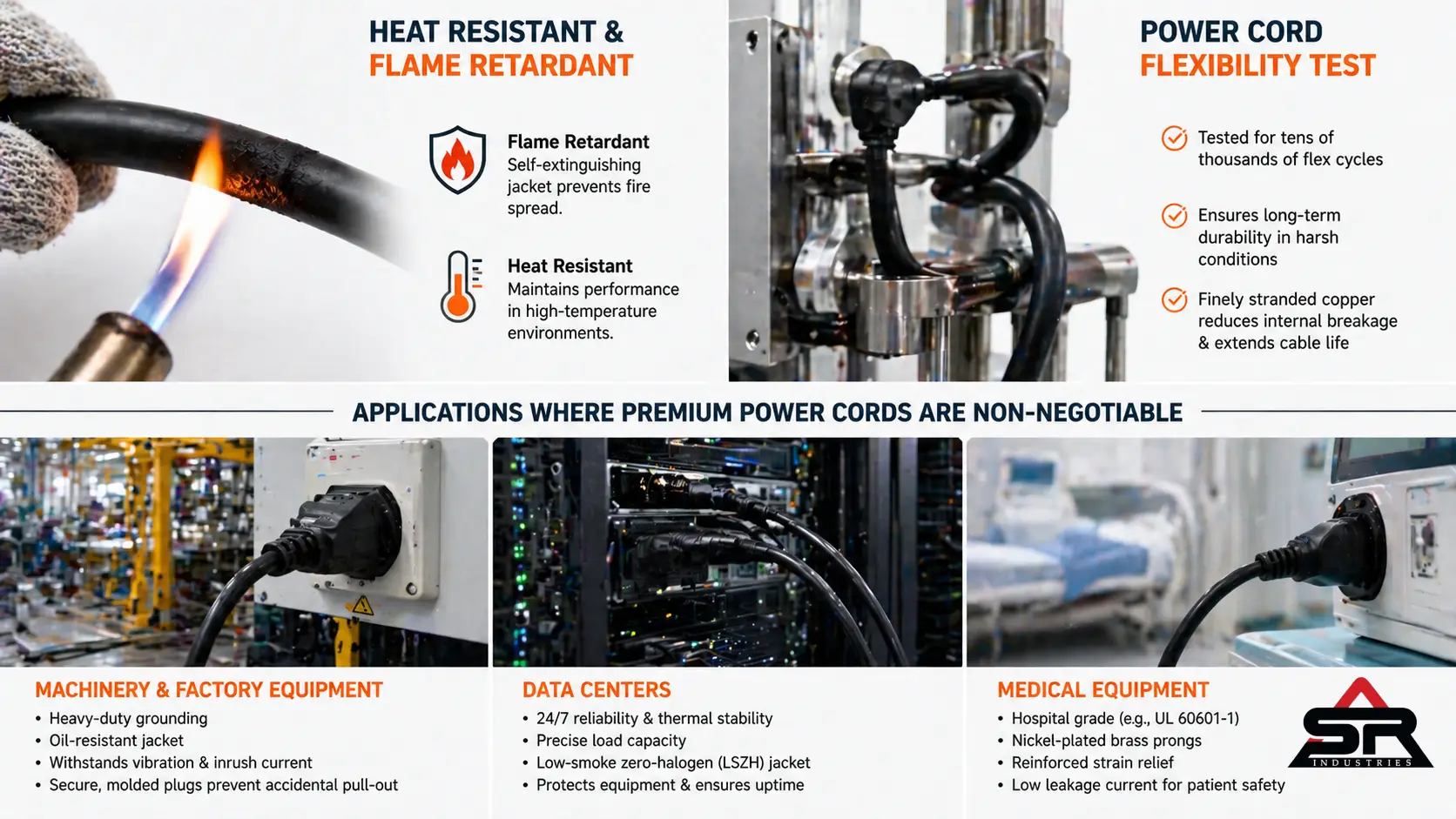
Heat Resistant and Flame Retardant Specifications
Industrial environments are hot. A standard cord degrades rapidly near injection molding machines, commercial ovens, or heavy engines.
You need a heat resistant power cord. These cables use specialized cross-linked insulation (like XLPE or Teflon) that maintains chemical stability at extreme temperatures.
Furthermore, the cord must be a flame retardant power cord. If a fire starts elsewhere in the facility, standard plastics act like a fuse, carrying the fire from one room to another along the cable trays. Flame retardant jackets are chemically engineered to self-extinguish the moment the external flame source is removed.
The Power Cord Flexibility Test
Cables move. They get dragged across concrete floors. They are coiled, uncoiled, and stepped on.
High-end manufacturers subject their designs to a rigorous power cord flexibility test. They load the cable with weights and run it through a machine that bends it back and forth at a 90-degree angle tens of thousands of times. A premium flexible power cord uses finely stranded copper (Class 5 or Class 6 stranding) rather than thick, solid conductors. The finer the individual copper strands, the more flex cycles the cable can survive before internal breakage occurs.
Application Breakdown: Where Premium Cords Are Non-Negotiable
Context is everything. A cord that works perfectly behind a TV will fail catastrophically on a factory floor. Let’s break down specific industrial use cases.
Power Cord for Machinery and Factory Equipment
Industrial machines generate intense vibrations. They leak oil. They draw massive, sudden spikes of current during motor startup (inrush current).
A power cord for industrial machines needs heavy-duty grounding. It requires oil-resistant jacketing. The plugs must be heavily molded to prevent the wires from ripping out when a forklift accidentally snags the cable. If you are a plant head, standardizing on a premium industrial power cord across your facility instantly reduces maintenance tickets.
Power Cord for Data Centers
Servers run 24/7/365. Downtime costs thousands of dollars per minute.
A power cord for data centers requires absolute thermal stability and precise power cord load capacity. These cables are often routed tightly under raised floors or inside packed server racks. They must have low-smoke zero-halogen (LSZH) jackets. In the event of a fire, LSZH cables do not emit toxic, acidic smoke that corrodes expensive server motherboards.
Power Cord for Medical Equipment
Hospitals have zero margin for error. A power cord for medical equipment must meet stringent “Hospital Grade” standards (like UL 60601-1).
These cords feature solid brass, nickel-plated prongs to prevent oxidation. They have heavily reinforced strain reliefs to survive nurses constantly yanking them out of wall outlets. They must also possess extremely low leakage current to protect sensitive patients connected to monitoring devices.
Power Cord for Automation Systems and Wiring Harnesses
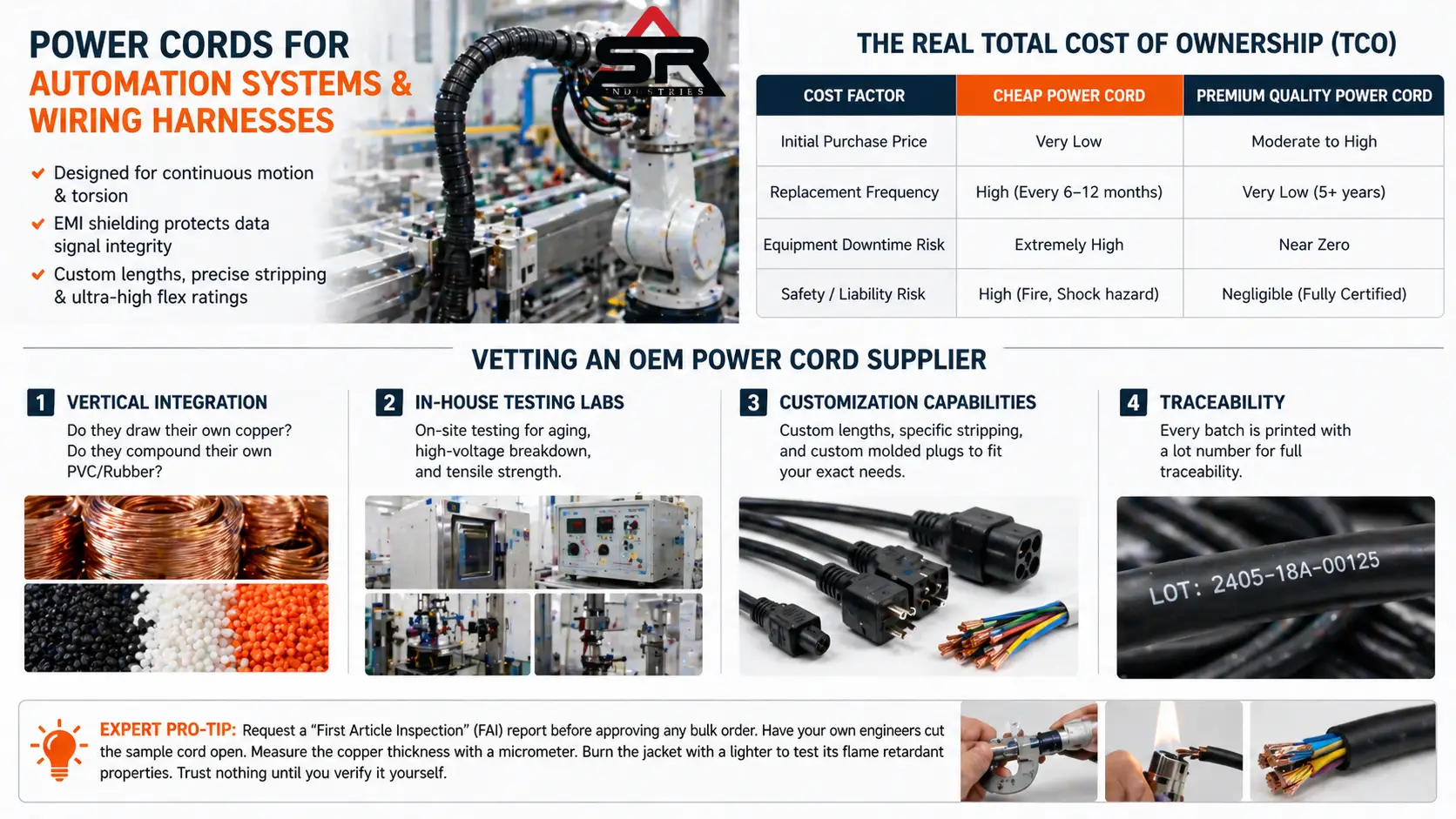
Robotics and automation arms move constantly. Standard cables snap under continuous torsion.
A power cord for automation systems uses specialized shielding to block Electromagnetic Interference (EMI). If EMI corrupts the data signals running parallel to the power lines, the robotic arm will miscalculate its position. These cables are often integrated into complex wiring harnesses, requiring exact custom lengths, specific stripping dimensions, and ultra-high flex ratings.
The Buyer’s Blueprint: Choosing an Industrial Power Cord Supplier
Sourcing matters. You can design the perfect spec sheet, but if your manufacturer lacks quality control, you receive garbage.
The Real Total Cost of Ownership (TCO)
Procurement departments frequently fall into the trap of prioritizing the lowest initial unit price, which is a fundamentally flawed approach in electrical engineering. You truly get what you pay for. When a manufacturer slashes the price of a power cord, they aren’t inventing a revolutionary new manufacturing technique; they are quietly thinning out the insulation or mixing scrap metal into the conductor.
Think about the actual cost when a substandard cord fails. You aren’t just paying for a replacement cable. You are absorbing the cost of dispatched maintenance technicians, idled machinery, and potentially thousands of dollars in lost production per hour. Purchasing fully certified, heavy-duty electrical cords isn’t just another line-item expense—it is critical risk mitigation that protects your entire operation.
Cost Factor | Cheap Power Cord | Premium Quality Power Cord |
Initial Purchase Price | Very Low | Moderate to High |
Replacement Frequency | High (Every 6-12 months) | Very Low (5+ years) |
Equipment Downtime Risk | Extremely High | Near Zero |
Safety / Liability Risk | High (Fire, Shock hazard) | Negligible (Fully Certified) |
Vetting an OEM Power Cord Supplier
If you are a manufacturer looking to buy power cord inventory in bulk, you need a partner, not just a vendor. Whether you are looking for a bulk power cord supplier globally or specifically a power cord manufacturer India, demand the following:
- Vertical Integration: Do they draw their own copper? Do they compound their own PVC/Rubber? Suppliers who control raw materials maintain much tighter quality control.
- In-House Testing Labs: An industrial power cord supplier must have on-site testing for aging, high-voltage breakdown, and tensile strength. Ask to see pictures of their testing equipment.
- Customization Capabilities: The best power cord for industrial use is often custom-molded. Can they provide custom lengths, specific wire stripping, and custom molded plugs that fit perfectly into your proprietary equipment?
- Traceability: Every batch of cables should have a manufacturing lot number printed on the jacket. If a defect is found, they must be able to trace exactly which batch of raw copper it came from.
Expert Pro-Tip: Request a “First Article Inspection” (FAI) report before approving any bulk order. Have your own engineers cut the sample cord open. Measure the copper thickness with a micrometer. Burn the jacket with a lighter to test its flame retardant properties. Trust nothing until you verify it yourself.
The Bottom Line on Electrical Integrity
Engineering relies on predictable physics. When you specify exact materials, demand strict safety certifications, and align the cable’s physical properties with its operational environment, you eliminate the guesswork.
Power delivery is the foundation of mechanical performance. You cannot build a high-performance machine and starve it of clean, safe electricity. Stop compromising on raw materials. Stop falling for cheap copper-clad fakes. Stop gambling with your facility’s safety over a few dollars.
Inspect your current inventory. Cut open the cables powering your most critical assets. Measure the copper. Test the flexibility. If you find substandard wiring, rip it out. Partner with a certified OEM supplier who understands thermal dynamics and electrical loads. Prioritize heavily insulated, pure copper conductors.
Design for the worst-case scenario. When the voltage spikes, when the factory floor floods, and when the machinery runs at maximum capacity for 48 hours straight, a premium cable will hold the line. That is the true measure of industrial reliability.
Frequently Asked Questions (FAQ)
Q1. How do I physically tell the difference between a pure copper and a CCA (Copper-Clad Aluminum) power cord?
A: The fastest way is the weight test; pure copper is significantly heavier than aluminum. For absolute certainty, cut the wire and scrape the individual strands with a razor blade. If the shiny copper exterior scrapes away to reveal a silver/white core, it is a fake CCA cord.
Q2. Why does my industrial power cord get warm during operation, and is it dangerous?
A: Slight warmth is normal due to electrical resistance, but the cord should never be hot to the touch. If a heavy duty power cord feels hot or the plastic smells like it is burning, the cord is undersized for the current load (Amperage). Disconnect it immediately and upgrade to a thicker wire gauge (lower AWG number).
Q3. We need to buy power cords in bulk for outdoor machinery. What jacket material is best?
A: For outdoor industrial use, absolutely avoid standard PVC. You need an SJOOW or SOOW rubber power cord (typically Neoprene or EPDM). These materials resist ozone, UV sunlight degradation, water pooling, and remain completely flexible in freezing temperatures without cracking.
Q4. Does cord length affect the power cord performance or load capacity?
A: Yes. This is called voltage drop. The longer the cable, the higher the electrical resistance. If you run a high-draw machine on a 100-foot cord, the machine might receive a lower voltage than it requires, causing the motor to strain and overheat. For long runs, you must increase the thickness of the copper core to compensate.
Q5. Are branded power cords actually better, or am I just paying for the name?
A: You are paying for the safety liability and the testing protocol. A certified, branded industrial power cord supplier invests heavily in UL/CE compliance, pure materials, and rigorous flex testing. Unbranded or generic local cords often falsify their wire gauge ratings and skip safety testing entirely to lower the power cord price.