
UL vs CE vs BIS Cable Standards: Guide for Indian OEMs
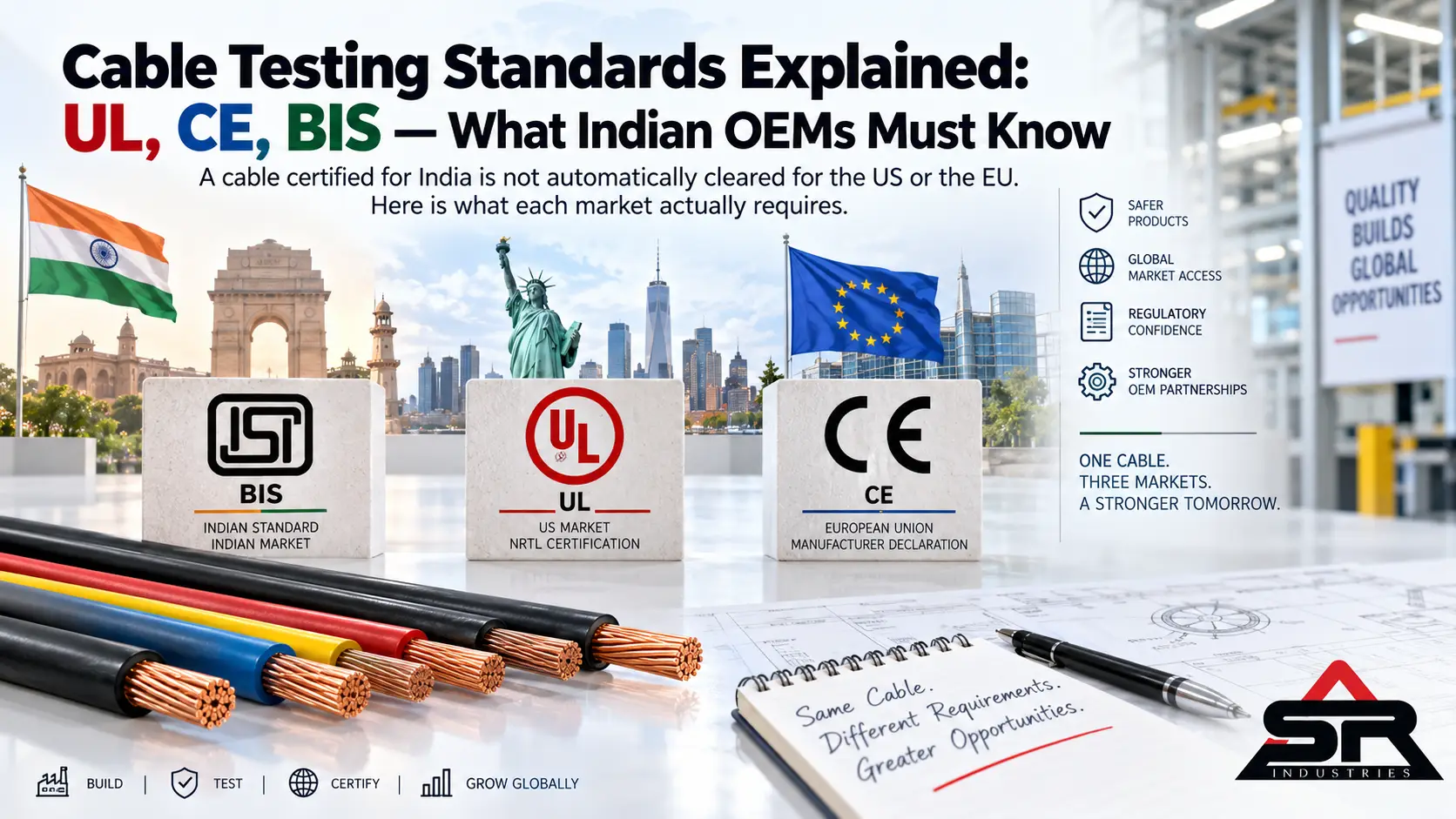
Cable Testing Standards Explained: UL, CE, BIS — What Indian OEMs Must Know
A cable certified for India is not automatically cleared for the US or the EU. Here is what each market actually requires.
Key Compliance Takeaways (At a Glance)
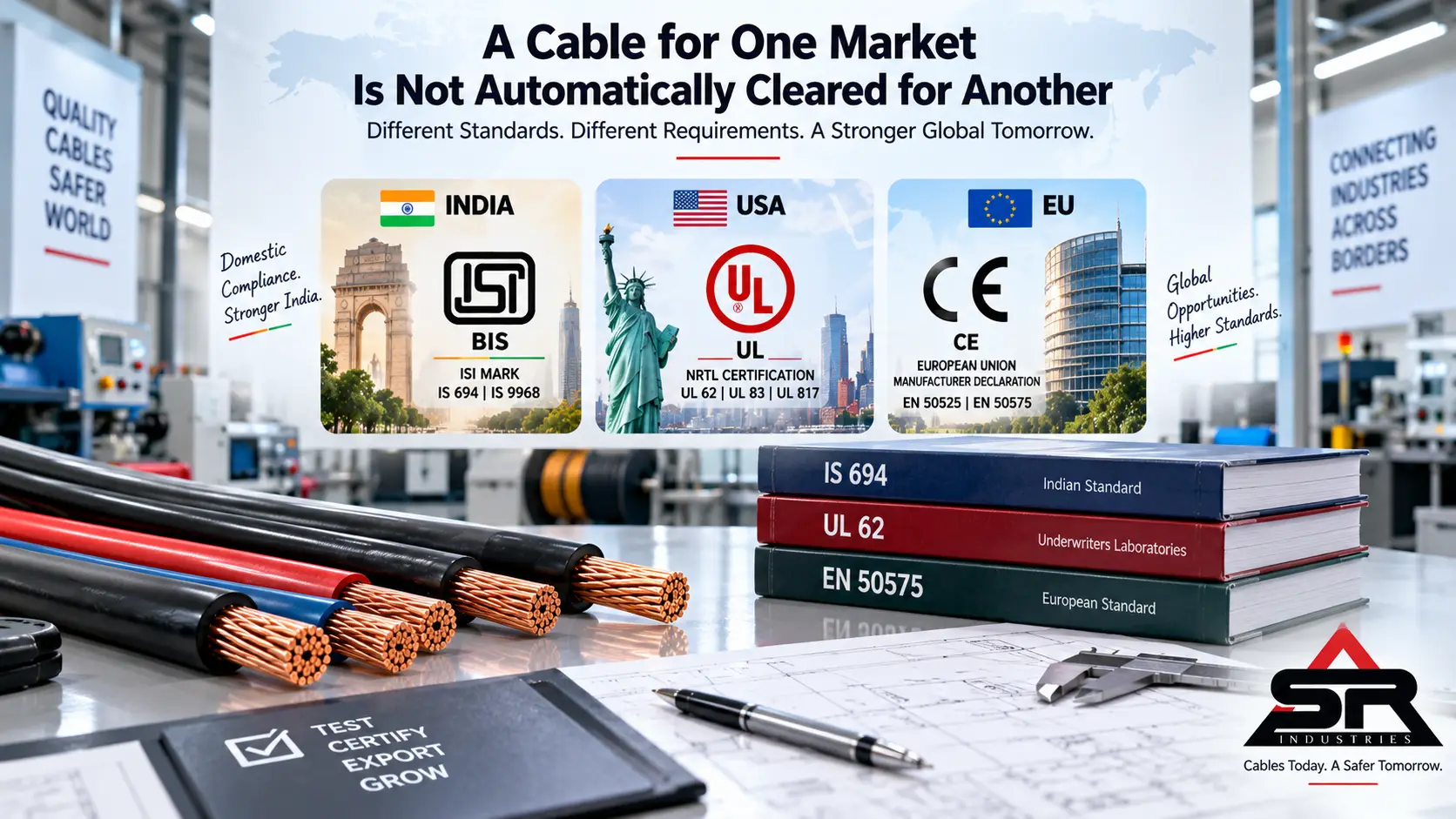
- BIS certification is mandatory pre-market approval for the Indian market. PVC insulated cables under IS 694 and elastomer insulated cables under IS 9968 (Part 1) were brought under compulsory certification by the Electrical Wires, Cables, Appliances and Protection Devices and Accessories (Quality Control) Order, notified in February 2003. The licence to apply the ISI mark is granted under Scheme-I after a factory inspection and independent testing of sealed samples.
- UL is one of several OSHA-recognised NRTLs, not a legal requirement in itself. US practice requires certification by a Nationally Recognized Testing Laboratory — UL Solutions, Intertek (ETL), CSA Group, TÜV, SGS and others hold that recognition. What matters commercially is holding an NRTL mark within the correct scope; which NRTL issued it is a sourcing decision, not a compliance one.
- CE marking is a manufacturer’s declaration, and cables take two different routes. Under the Low Voltage Directive 2014/35/EU the manufacturer self-declares against harmonised standards such as EN 50525. Cables for permanent installation in buildings fall additionally under the Construction Products Regulation 305/2011, where the harmonised standard is EN 50575 and a Euroclass reaction-to-fire rating under EN 13501-6 must be declared.
One thing most exporters do not know: goods manufactured in India exclusively for export are generally outside the scope of Indian Quality Control Orders. An export-only cable line may not need an ISI mark at all. The exemption is QCO-specific and must be confirmed against the applicable order before it is relied on.
Cable testing standards are not a single global rulebook. Three legal systems examine broadly similar physics for different reasons, and the sequence in which an OEM approaches them decides whether a container clears customs in Rotterdam or waits six weeks while a laboratory reruns a flame test.
Cable compliance India is the entry ticket for domestic sale, and nothing more. Indian cable safety standards are built around Indian installation practice, Indian voltage bands and Indian enforcement machinery. American and European regulators recognise none of that by default. What follows is a working breakdown of UL CE BIS cable certification for teams that have to qualify a product rather than read about one.
Why Cable Standards Vary by Market
Cable standards differ because each market regulates a different risk. India certifies the product before it reaches the market. The United States relies on private safety laboratories recognised by OSHA, whose marks inspectors and insurers accept. Europe regulates the manufacturer’s own declaration, backed by harmonised test evidence and legal liability.
Installation practice comes first. Indian wiring runs predominantly in concealed PVC conduit at 230 V single phase and 415 V three phase. North American branch circuits run at 120 V and 240 V, drawing roughly double the current for the same load, which shifts conductor sizing, temperature rating and insulation thickness assumptions. A 1.5 sq mm conductor and a 16 AWG conductor sit close in cross-section and are governed by entirely different ampacity tables. Substituting one for the other because the numbers look similar accounts for a meaningful share of failed first submissions.
Fire philosophy diverges next. Since CE marking under CPR became applicable to cables in 2017, Europe has treated a cable installed permanently in a building as a construction product, classified by how much heat and smoke it contributes to a compartment fire. American practice regulates flame propagation by application category through the National Electrical Code. Indian practice addresses flammability primarily at the single-cable level unless the specification calls out flame-retardant, FRLS or low-smoke halogen-free grades.
Then there is the question of who is left holding the liability. BIS holds the licence over the factory and inspects it. UL and the other NRTLs own their marks and enforce them through recurring surveillance. Under CE, nobody certifies anything unless the regulation demands it, and the manufacturer signs.
An OEM that treats these as three versions of the same audit will fail at least two. The questions overlap; the evidence formats, retention obligations and liability chains do not.
BIS Certification (India) — IS 694, IS 9968
BIS certification for cables is mandatory under India’s Electrical Wires, Cables, Appliances and Protection Devices and Accessories (Quality Control) Order. Manufacturers apply for a licence under a specific Indian Standard, undergo factory inspection covering in-house test capability, and submit sealed samples for testing at a BIS-recognised laboratory before the ISI mark may be applied.
The two standards that carry most of the load
Primary Indian Cable Standards
| Standard | Scope | Typical Application |
|---|---|---|
| IS 694:2010 | PVC insulated single and multicore cables and cords, rigid and flexible annealed copper or aluminium conductors, rated up to and including 1100 V (suitable for DC systems up to 1500 V to earth). | Power and lighting installations, domestic and light industrial wiring, flexible cords. |
| IS 9968 (Part 1):1988 Amendments A1, A2 & A3:2016 | Elastomer insulated cables for fixed wiring, flexible cables and flexible cords, rated up to and including 1100 V. | Heat exposure, high flexing duty, oil contact, trailing and welding applications. |
Supporting standards a BIS auditor will reference alongside them: IS 8130 for conductor construction, stranding classes and maximum resistance; IS 5831 for PVC insulating and sheathing compound properties; IS 1554 (Part 1) for heavy duty PVC cables to 1100 V; IS 7098 for XLPE insulated cables; and the IS 10810 series, which contains the test methods that the product standards call up by part number.
Licence scope is narrower than most applicants assume
The ISI mark is granted per standard, per factory, per declared range of varieties and sizes. A licence covering IS 694 flexible cords at one plant does not extend to a second plant, and does not extend to IS 9968 elastomer cables at the same plant. Each combination is a separate application, inspection and sample draw.
Multi-plant manufacturers routinely underestimate this. A five-plant operation supplying one product family across two standards is looking at up to ten distinct licences, each with its own renewal cycle.
The export exemption most OEMs miss
Here the article’s own premise needs qualifying, because the widespread assumption that every Indian cable manufacturer must hold BIS certification is not strictly correct.
Quality Control Orders generally exempt goods manufactured in India exclusively for export. BIS states this in its own product certification FAQ, with the important caveat that the exemption is QCO-specific and should be confirmed against the relevant order rather than assumed. Export-Oriented Units and, under DGFT notifications, Advance Authorisation holders have also been treated as outside QCO scope.
What this means in practice for a sourcing decision:
- A supplier running an export-only line may legitimately hold no ISI mark for that product, and its absence is not evidence of a quality problem.
- A supplier selling into both the Indian and export markets needs the BIS licence for the domestic portion, and its absence there is a red flag.
- Buyers should ask which lines are export-dedicated and which are not, rather than treating an ISI mark as a universal pass or fail.
certifications held across ASR plants
Where applications actually stall
Rejections cluster around evidence rather than product performance.
In-house testing capability is the recurring problem. BIS expects the factory to run its own routine and acceptance tests; an application backed entirely by third-party reports invites questions. Under the Foreign Manufacturers Certification Scheme the position is stricter still, with applicants treated as large entities and required to hold testing facilities in-house rather than outsourced.
Behind that sit three quieter failure modes: calibration certificates without an unbroken chain back through previous cycles, raw material batches that cannot be traced to the production lot they entered, and retained samples that do not reconcile with the test records for that lot.
UL Certification (USA)
UL Solutions is one of several private organisations recognised by OSHA as Nationally Recognized Testing Laboratories under 29 CFR 1910.7. Certification by a recognised NRTL — UL, Intertek (ETL), CSA Group, TÜV, SGS and others — is what US inspectors, insurers and OEM buyers look for. UL is the most widely recognised mark, not the only acceptable one.
This distinction matters commercially. An Indian exporter told that a customer “requires UL” should establish whether the customer means UL specifically, or an NRTL mark generally. Certification cost, lead time and laboratory availability differ between bodies, and acceptance by the authority having jurisdiction is worth confirming for the specific installation type rather than assumed.
Listed versus Recognized decides the bill of materials
UL Listed applies to a complete product installed as supplied: a cord set under UL 817, a building wire under UL 83. The Listing mark appears on the product and its packaging.
UL Recognized Component applies to a part evaluated for use inside a larger end product, where final safety assessment happens at assembly level. Appliance wiring material under UL 758, carrying an AWM style number, sits here.
The scope of UL 758 is explicit about what AWM is for. It covers wiring intended solely for factory installation, either inside the enclosure of appliances and other equipment, as external interconnecting cable between appliances, or for further processing into multi-conductor cables. It does not cover wire, cable or cord types already covered by the NEC, and AWM is not intended for installation in buildings or structures under the NEC except within the installation instructions of the end product it was evaluated for.
What that means at incoming QC: accepting an AWM style number against a specification calling for SJT or SJTW cord produces a part that passes visual inspection and fails at the customer’s site. For NEC building wiring, the relevant standards are UL 44, UL 83 and related; for portable cordage, UL 62.
The standards worth knowing by number
Key UL Standards for Cables & Cords
| Standard | Covers |
|---|---|
| UL 62 | Flexible cords and cables — SVT, SJT, SJTW, SOOW, and related type designations. |
| UL 83 | Thermoplastic insulated wires and cables. |
| UL 44 | Thermoset insulated wires and cables. |
| UL 758 Factory Install Only | Appliance wiring material (AWM), factory-installed use only. |
| UL 817 Complete Assembly | Cord sets and power supply cords, assessed as complete assemblies. |
| UL 1581 / UL 2556 Binational (CSA) | Reference test methods underlying the above; UL 2556 is binational with CSA C22.2 No. 2556. |
VW-1 and the flame test that does not cover bundles
VW-1 is a vertical flame test on a single specimen, defined in UL 1581 and applied across AWM styles and cord types. A controlled flame is applied in timed cycles. The specimen passes if flaming does not reach the indicator flag, the cotton beneath does not ignite from falling particles, and the specimen self-extinguishes within the permitted interval.
UL 1685 covers a different question: how a bundled arrangement of the same cable behaves in a tray or vertical run, evaluating flame propagation and, in defined configurations, smoke release.
Passing VW-1 therefore says nothing about riser or tray behaviour. Specifications for those applications need to call out the bunched test explicitly, or the submission arrives incomplete.
Follow-Up Services change the ongoing workload
NRTL certification is not a one-time event. Under UL’s Follow-Up Services, unannounced factory inspections continue for the life of the certification, with the field representative checking that production still matches the file description, that the compounds in use are those on record, and that marking is accurate and legible. Other NRTLs operate equivalent surveillance programmes.
For a factory used to preparing for a scheduled BIS inspection, this is a different operating discipline: the plant has to be auditable on any given day.
CE Marking (Europe)
CE marking on cable is a manufacturer’s declaration of conformity, not a third-party certificate. Under the Low Voltage Directive the manufacturer compiles a technical file and self-declares. Under the Construction Products Regulation, cables for permanent installation must additionally declare a reaction-to-fire Euroclass, with third-party involvement determined by the class claimed.
Route one — the Low Voltage Directive
Directive 2014/35/EU covers electrical equipment operating between 50 and 1000 V AC. Conformity for cables and cords is normally demonstrated against the EN 50525 series, the harmonised family for low voltage energy cables rated up to 450/750 V, together with EN 60228 for conductor classes: Class 1 solid, Class 2 stranded, Class 5 flexible, Class 6 extra flexible.
EN 60228 classes map closely to IS 8130 but are not interchangeable with them, and the difference shows up at resistance measurement rather than visual inspection.
Route two — the Construction Products Regulation
Most Indian exporters encounter CPR (EU) 305/2011 late, usually after a first order has been quoted.
The harmonised standard is EN 50575, covering power, control and communication cables for general applications in construction works subject to reaction-to-fire requirements. Cables in scope are classified under EN 13501-6 into seven Euroclasses — Aca, B1ca, B2ca, Cca, Dca, Eca, Fca — with supplementary classifications for smoke production (s), flaming droplets (d) and acidity (a). In practice, commercially available cables sit between B2ca and Fca; Aca and B1ca are effectively unattainable for organic-insulated constructions.
The tests behind the classification:
Reaction-to-Fire Test Methods for CE Marking
| Test Standard | What It Measures | Where It Applies |
|---|---|---|
| EN 50399 Core Bunched Test | Heat release, flame spread, and smoke production on bunched cables. | B2ca to Dca — Principal Euroclass classification benchmark. |
| EN 60332-1-2 Single Wire Test | Vertical flame propagation on a single insulated wire or cable. | Eca and above — Baseline Euroclass flammability criterion. |
| EN ISO 1716 Calorific Value | Gross heat of combustion (calorific potential). | Aca and B1ca — Non-combustible / minimal combustion classes. |
| EN 61034-2 3 m Cube Chamber | Smoke density and light transmittance under defined burning conditions. | The "s" classification (s1a, s1b, s2, s3 smoke ratings). |
| EN 60754-2 Corrosive Gas Analysis | Acidity (pH) and electrical conductivity of evolved combustion gases. | The "a" classification (a1, a2, a3 halogen-free acidity ratings). |
AVCP: who has to be involved, and when
This is where a common misstatement circulates. Notified body involvement is not simply “required for higher classes” — it is mapped to the declared class through the AVCP system:
AVCP Systems & Notified Body Involvement
| Declared Euroclass | AVCP System | Third-Party Role |
|---|---|---|
| Aca, B1ca, B2ca Highest Fire Performance | System 1+ | Notified product certification body performs initial type testing, audits factory production control (FPC), conducts continuous surveillance with periodic re-sampling, and issues a formal Certificate of Constancy of Performance. |
| Cca, Dca, Eca Standard Commercial Baseline | System 3 | Notified test laboratory performs initial type testing and issues an official test report. The manufacturer maintains FPC with no ongoing notified body surveillance audits. |
| Fca No Performance Determined | System 4 | Manufacturer self-declares conformity; no notified body or external laboratory involvement required. |
The output in every case is a Declaration of Performance issued by the manufacturer, supported by the test report and the CE marking on the product and packaging. A supplier that offers a “CPR certificate” without a DoP has not understood the framework.
Where HAR fits
HAR is not CE marking. It is a voluntary certification agreement operated through CENELEC member certification bodies, identified by a coloured marker thread or repeated printing along the cable. Some European distributors and installers use it as shorthand for third-party verified conformity and will ask for it; others will not. Treat it as a customer-specific commercial requirement to be confirmed per account, not as a regulatory obligation.
Key Tests Every Cable Must Pass
Across all three markets, the type test battery examines four things: whether the conductor carries current as specified, whether the insulation withstands voltage, whether the polymer survives heat and ageing, and how the cable behaves in fire. Test designations differ between BIS, UL and CE. The underlying physics does not.
Electrical performance. Conductor resistance at 20 °C with temperature correction, which is the direct check on cross-section and material purity. Insulation resistance expressed as a volume resistivity constant. High voltage withstand with the specimen immersed in water for a specified duration. Spark testing applied in-line to full production length.
Mechanical and dimensional. Insulation and sheath thickness at minimum and mean values, overall dimensions and ovality, tensile strength and elongation at break measured before and after ageing, and cord flexing or bending endurance for flexible types.
Thermal and ageing. Air oven ageing with retained tensile properties expressed as a percentage of the unaged value, hot set testing for cross-linked and elastomeric compounds to confirm cure quality, loss of mass in air oven, heat shock, cold bend and cold impact.
Fire behaviour is where the three systems diverge most visibly:
Fire Behavior & Flammability Standards
| Configuration | India (BIS) | USA (UL / NRTL) | Europe (CE / CPR) |
|---|---|---|---|
| Single Cable | IS 10810 Series Vertical flammability method | VW-1 UL 1581 / UL 2556 | EN 60332-1-2 Baseline single wire test |
| Bunched Cables | IS 10810 Method Bunched cable vertical test | UL 1685 Tray & vertical riser test | EN 50399 Classified under EN 13501-6 |
| Smoke Density | Applicable method for LSZH grades | UL 1685 Defined smoke release setups | EN 61034-2 3 m cube chamber ("s" rating) |
| Halogen Acid Gas | Applicable method for halogen-free grades | — Not federal / customer-specific | EN 60754-2 Acidity & conductivity ("a" rating) |
A supplier able to produce a complete type test report against one standard is usually within reach of another, because the test rigs are largely shared. The gap is rarely equipment. It is documentation discipline, calibration traceability and sample retention.
In-House Test Capability: What a Qualified Cable Plant Holds
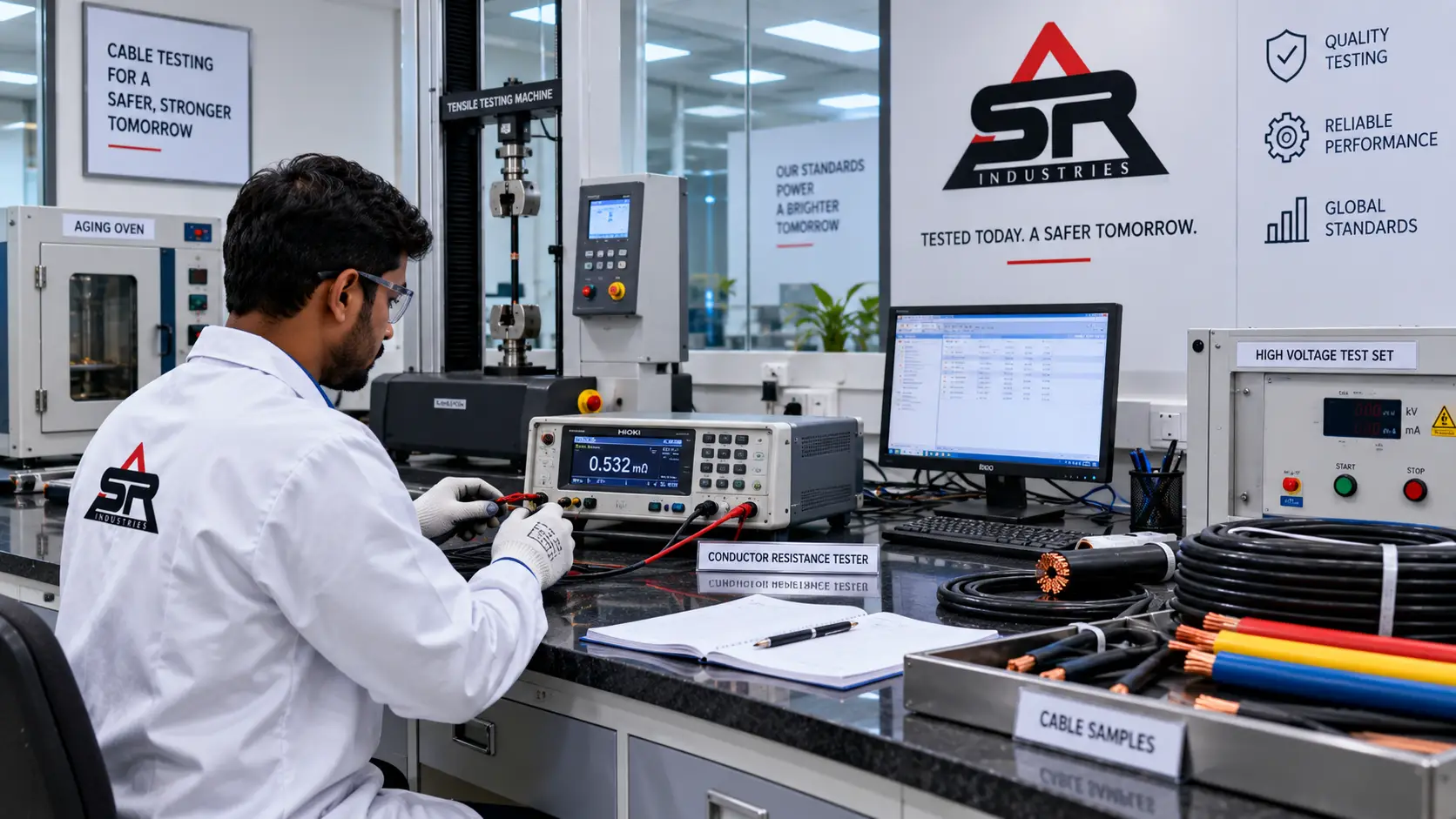
A factory laboratory adequate for BIS licensing and capable of supporting UL and CE submissions needs roughly nine instrument families under a documented calibration cycle traceable to national standards. Outsourced routine testing is a common reason a BIS application stalls at first inspection, and under the Foreign Manufacturers Certification Scheme in-house capability is explicitly required.
Essential In-House Cable Testing Equipment
| Instrument Family | Function | Specification Anchor |
|---|---|---|
| In-line spark tester | Continuous dielectric integrity check across full extruded length. | AC test voltage matched to insulation grade and wall thickness. |
| High voltage withstand test set | Immersed dielectric withstand for type and acceptance testing. | Timed application, range covering the product voltage grade. |
| Digital micro-ohmmeter / Kelvin double bridge | Conductor resistance at 20 °C with temperature correction. | Resolution sufficient for the smallest conductor in the declared range. |
| Universal tensile testing machine | Tensile strength and elongation at break, before and after ageing. | Dumbbell die set, extensometer, controlled jaw separation rate. |
| Forced-air circulation ageing oven | Accelerated thermal ageing and loss of mass. | Controlled temperature uniformity across the working chamber. |
| Hot set oven with weighted rack | Cure verification on cross-linked and elastomeric compounds. | Elongation under load at specified temperature. |
| Digital micrometer & profile projector | Insulation and sheath thickness, ovality, and concentricity. | Measurement at minimum and mean points per standard. |
| Vertical flame test chamber | Single-cable flammability per the applicable method. | Burner geometry, flame application timing, indicator flag position. |
| Cold chamber | Cold bend and cold impact conditioning. | Sub-zero conditioning to the temperature in the product standard. |
Every instrument in this loop needs a current calibration certificate traceable to national standards, with preceding certificates retained so the chain is unbroken. Auditors across all three systems ask for the chain, not the latest certificate.
RoHS, REACH and Material Compliance
EU RoHS restricts ten substances in electrical and electronic equipment. For cables the exposure sits in the PVC compound: lead-based heat stabilisers and phthalate plasticisers. India operates a separate and narrower RoHS regime under the E-Waste (Management) Rules, 2022, which restricts six substances and applies to equipment listed in Schedule I together with its components, parts and spares.
The EU list and the thresholds
Directive 2011/65/EU, as amended by Directive (EU) 2015/863, restricts lead, mercury, cadmium and hexavalent chromium; polybrominated biphenyls (PBB) and polybrominated diphenyl ethers (PBDE); and four phthalates added by the 2015 amendment — DEHP, BBP, DBP and DIBP. The threshold is 0.1% by weight in homogeneous material, except cadmium at 0.01%.
Where a RoHS cable actually fails
Risk concentrates in two cost-driven places. Legacy PVC formulations relied heavily on lead stabilisers, and older plasticiser packages relied on DEHP. Both are inexpensive and both perform well thermally. A manufacturer that has not formally requalified its compound suppliers since the 2015 phthalate amendment is carrying unquantified liability on every EU shipment.
The operative phrase is homogeneous material. Insulation, sheath, conductor coating and printing ink are separately assessable. A compliant sheath does not rescue a non-compliant ink.
India RoHS is not a copy of EU RoHS
Under the E-Waste (Management) Rules, 2022 (in force from 1 April 2023, subsequently amended), the restriction covers six substances — lead, mercury, cadmium, hexavalent chromium, PBB and PBDE — at 0.1% by weight in homogeneous materials, and 0.01% for cadmium. The four phthalates restricted in the EU are not part of it.
Scope also works differently. The obligation attaches to electrical and electronic equipment listed in Schedule I, together with its components, consumables, parts and spares. Cable therefore comes into scope as a component of listed equipment rather than as a standalone product category, which is a distinction worth confirming for any specific product before making a compliance statement about it.
REACH runs alongside, not inside
REACH is a regulation rather than a directive. Its Candidate List of Substances of Very High Concern obliges suppliers to communicate presence above 0.1% by weight of the article, and the list is updated roughly twice a year.
A REACH statement carrying no date and no Candidate List version reference is not usable. It makes a claim against a list that has since moved.
Standards Comparison Table
Cable Compliance Framework: BIS vs. UL vs. CE
| Dimension | BIS (India) | UL (USA) | CE (EU) |
|---|---|---|---|
| Legal Nature | Mandatory for products under the applicable QCO. | No federal mandate; NRTL certification required in practice by electrical code, insurers, and commercial buyers. | Mandatory for products within scope of the applicable directive or regulation. |
| Governing Instrument | Electrical Wires, Cables, Appliances and Protection Devices and Accessories (Quality Control) Order, 2003; enforced under the BIS Act, 2016. | NEC (NFPA 70) via the Authority Having Jurisdiction (AHJ); OSHA NRTL programme under 29 CFR 1910.7. | Low Voltage Directive 2014/35/EU; Construction Products Regulation (CPR) EU 305/2011. |
| Core Product Standards | IS 694, IS 9968, IS 1554, IS 7098 | UL 62, UL 83, UL 44, UL 758, UL 817 | EN 50525, EN 60228; EN 50575 under CPR |
| Test Method Reference | IS 10810 series | UL 1581 / UL 2556 | EN 60332, EN 50399, EN 61034, EN 60754, EN ISO 1716 |
| Mark on Product | ISI mark with mandatory licence (CM/L) number. | NRTL mark — UL Listed, UL Recognized Component, ETL Listed, and equivalents. | CE mark, with Declaration of Performance (DoP) identification where CPR applies. |
| Third-Party Role | BIS factory inspection and testing; mandatory for licence grant. | NRTL testing and certification; mandatory for applying the mark. | Determined by AVCP system: System 1+ (Notified Body), System 3 (Notified Lab), or System 4 (None). |
| Ongoing Surveillance | Periodic BIS factory inspections and market surveillance sampling. | Recurring unannounced factory audits (UL Follow-Up Services and NRTL equivalents). | Manufacturer factory production control (FPC); Notified Body surveillance only under AVCP System 1+. |
| Single-Cable Flame Benchmark | IS 10810 vertical flammability method | VW-1 (UL 1581 / UL 2556) | EN 60332-1-2 |
| Bunched Cable Flame Benchmark | IS 10810 bunched cable method | UL 1685 | EN 50399 with Euroclass rating under EN 13501-6 |
| Conductor Class Reference | IS 8130 | UL 1581 stranding tables, AWG sizing | EN 60228 Classes 1, 2, 5, 6 |
| Substance Restriction | E-Waste (Management) Rules, 2022 — six substances, applicable to Schedule I equipment and parts. | No federal RoHS equivalent; state-level restrictions apply (e.g., California Proposition 65). | RoHS Directive 2011/65/EU as amended by (EU) 2015/863 — ten substances; REACH SVHC compliance. |
| Export Exemption | Goods manufactured exclusively for export are generally outside QCO scope, subject to the specific order. | — | — |
| Who Carries Liability | Licence holder (factory) | Certificate holder | Manufacturer, or the EU importer where no EU establishment exists. |
Where an Indian manufacturer has no EU establishment, the importer inherits the liability. That single mechanism explains why European buyers scrutinise the technical file, the EN test reports and the DoP instead of accepting a certificate number.
What an OEM Should Actually Request From an Indian Cable Supplier
Before placing a first order, a buyer should be able to reconstruct the compliance chain from the supplier’s documents alone: which standard, which scope, which laboratory, which lot, and what happens when the compound changes.
Compliance Documentation Audit: What to Request & Verify
| Document | What to Check | Why It Matters |
|---|---|---|
| BIS Licence Domestic Indian Sale | Applicable Indian Standard, plant address, declared varieties, conductor sizes, and CM/L validity dates. | Licence scope is strictly granted per standard, per plant, per range — an active licence at one plant may not cover the specific line or item quoted. |
| NRTL Certificate / File North American Scope | Issuing NRTL (UL, Intertek/ETL, CSA), target standard, Listed vs. Recognized status, and AWM style numbers. | Distinguishes a field-installable finished cord set (UL 817 Listed) from an internal component (UL 758 Recognized) that cannot legally be installed on-site. |
| DoP & EN Test Reports EU CPR Compliance | Declared Euroclass (B2ca to Eca), AVCP system assignment, notified body number, or test laboratory identity. | A CPR claim without a manufacturer-signed Declaration of Performance (DoP) is legally void at EU customs. |
| Type Test Report Electromechanical & Thermal | Full parameter battery, test completion dates, accredited lab identity, and current standard edition. | Standard editions undergo periodic revision; a test report issued against a superseded standard version requires recertification review. |
| Calibration Certificate Chain Metrological Traceability | Current active certificate plus preceding continuous calibration cycles across all in-house test instruments. | An isolated current certificate does not prove continuous historical calibration; auditors from all three frameworks demand an unbroken audit trail. |
| RoHS & REACH Declarations Material & Chemical Safety | 10-substance RoHS list (including 4 phthalates), weight thresholds, issue date, and explicit REACH SVHC Candidate List version. | The REACH Candidate List updates bi-annually; an undated declaration referencing no specific version is legally unusable. |
| Compound Change-Control Quality Process Control | Designated authority sign-off for stabiliser, plasticiser, masterbatch, or ink revisions, and documented re-test triggers. | The majority of raw material and fire-reaction compliance failures stem from silent, unnotified compound or supplier changes. |
| Sample Retention Policy Traceability Protocol | Mandatory retention timeline, security sealing protocols, and batch/lot reconciliation numbering. | Market surveillance officers and certifying bodies require retained production samples during field failure disputes; reconstructed data is rejected. |
Designing One Cable for Three Markets
Multi-market compliance is decided at the design and compound stage, not at certification. Choosing a conductor class, insulation compound and sheath system that satisfies IS, UL and EN requirements at once avoids maintaining three parallel bills of material for what the customer sees as a single product.
Four decisions tend to separate manufacturers that export successfully from those that repeatedly re-test.
Conductor construction gets specified to the strictest applicable class, because an EN 60228 Class 5 conductor will generally satisfy an IS 8130 flexible class requirement while the reverse is not guaranteed.
Compound qualification happens once, against the hardest ageing and flame requirement in the target set. Running a domestic grade alongside an export grade guarantees eventual mixing on the shop floor, and the failure surfaces at a customer rather than at QC.
Sealed samples and full test records are retained per production lot, since reconstructed data satisfies nobody.
Termination and over-moulding stay inside the audited quality system. A cord set carrying a UL 817 Listing or a CE declaration is assessed as a complete assembly, so a subcontracted moulding operation outside that system becomes the weakest link in the file.
Manufacturing base
ASR Industries operates five manufacturing plants across Noida, Delhi NCR, Haryana, Uttarakhand and Rajasthan, with quality management certified to ISO 9001:2015 and IATF 16949:2016, occupational health and safety management under ISO 45001:2018, and a ZED Gold rating.
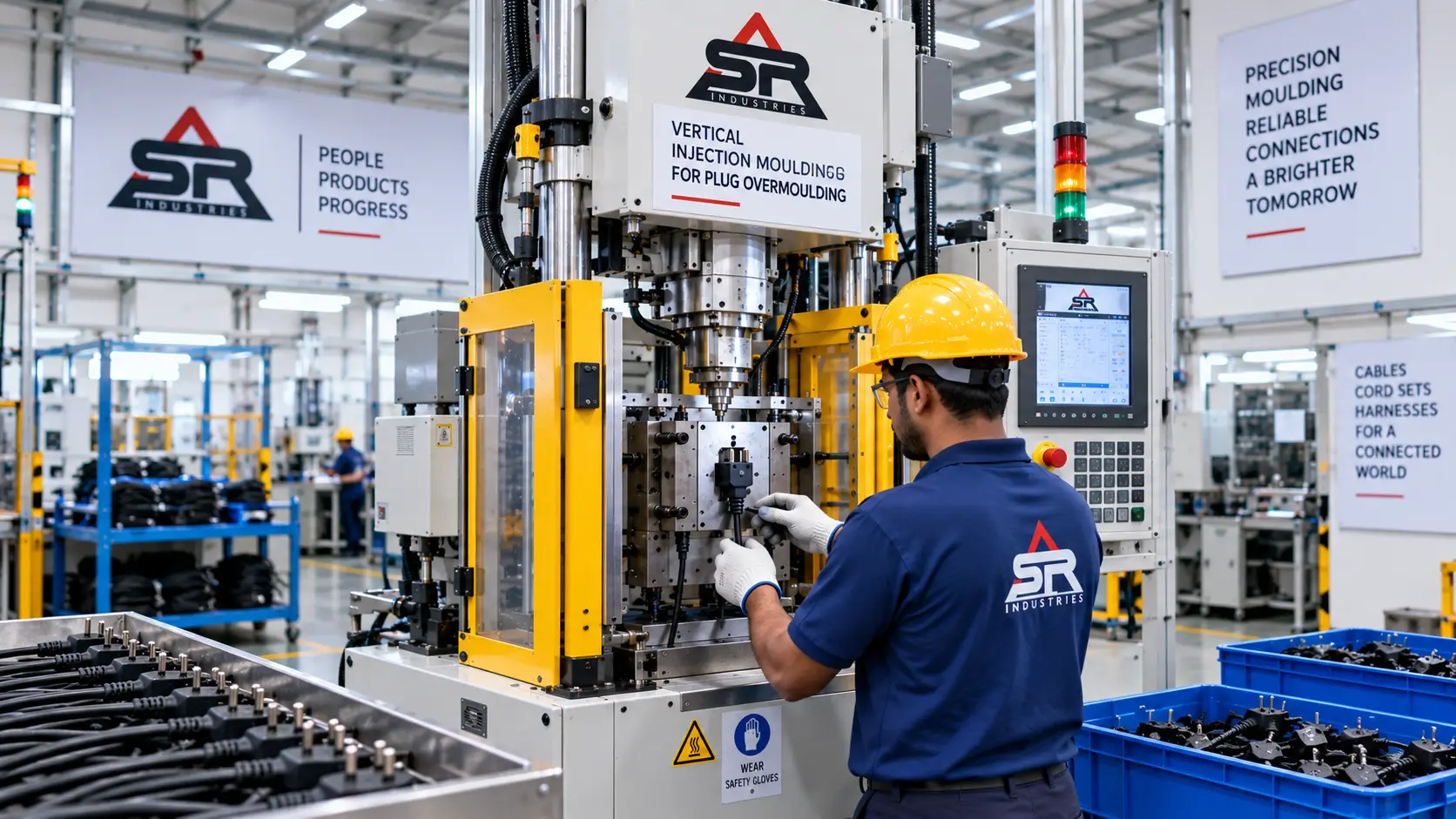
Cord set and harness assembly capability includes 10 vertical injection moulding machines in the 25 to 55 ton range, 5 insert crimping machines, and 5 spot and pin welding stations. Keeping conductor termination and plug over-moulding inside the audited system means the operations a certifier assesses as part of the finished product are not distributed across uncontrolled subcontractors.
FAQ: Cable Testing Standards
Is BIS certification valid for export?
BIS certification is not valid in export markets. The ISI mark demonstrates conformity with Indian Standards for the Indian market only. Exporting to the United States requires certification by an OSHA-recognised NRTL, and exporting to the European Union requires CE marking under the applicable directives and regulations.
The licence does help indirectly, because the calibrated equipment, documented process controls, and traceability discipline it requires are examined in UL and CE assessments too. The certificate itself carries no legal weight outside India.
Do cables made only for export need BIS certification?
Quality Control Orders in India generally exempt goods manufactured exclusively for export, so an export-only cable line may fall outside the ISI mark requirement. BIS notes this in its product certification FAQ while advising that the exemption is specific to each QCO and should be confirmed against the applicable order.
The practical implication for buyers is that a supplier without an ISI mark on an export-dedicated line is not necessarily non-compliant. What matters is whether the same product is also sold domestically, in which case the licence is required.
What is the difference between UL Listed and UL Recognized?
UL Listed applies to a complete product ready for end use, such as a cord set certified under UL 817. UL Recognized Component applies to a part evaluated for use inside a larger product, such as appliance wiring material under UL 758 with an AWM style number. They are not interchangeable in a specification.
UL 758 limits AWM to factory-installed wiring inside or between appliances, and excludes cable types already covered by the NEC. Substituting an AWM style for a Listed cord type produces a part that fails at installation rather than at incoming inspection.
Is UL certification legally mandatory in the United States?
UL certification is not mandated by federal law. What US practice requires is certification by a Nationally Recognized Testing Laboratory recognised by OSHA under 29 CFR 1910.7. UL Solutions, Intertek (ETL), CSA Group, TÜV, and others all hold NRTL recognition, and their marks are treated as equivalent for the scopes they cover.
Acceptance still rests with the authority having jurisdiction (AHJ) for the specific installation, so a customer specifying "UL" should be asked whether that means UL specifically or any NRTL mark.
What is the difference between CE marking and BIS certification?
BIS is a third-party scheme: the Bureau of Indian Standards inspects the factory, tests sealed samples, and grants a licence to apply the ISI mark. CE is a self-declaration regime: the manufacturer compiles a technical file, applies harmonised European standards, and signs a declaration of conformity, carrying full legal liability.
Scrutiny lands in different places. BIS front-loads it into the licensing audit. CE back-loads it into market surveillance and liability, which is why European buyers examine the technical file and test reports rather than a certificate number.
What is CPR cable classification?
CPR classification assigns a cable a reaction-to-fire Euroclass under EN 13501-6, declared through the harmonised standard EN 50575. The seven classes run Aca, B1ca, B2ca, Cca, Dca, Eca, and Fca, with supplementary ratings for smoke (s), flaming droplets (d), and acidity (a). It applies to cables intended for permanent installation in construction works.
Third-party involvement follows the class claimed: AVCP system 1+ with a notified certification body for Aca to B2ca, system 3 with a notified test laboratory for Cca to Eca, and system 4 self-declaration for Fca. The output in every case is a Declaration of Performance (DoP).
What is the difference between VW-1 and UL 1685?
VW-1 is a vertical flame test applied to a single cable specimen under UL 1581. UL 1685 evaluates a bundled arrangement in a tray or vertical configuration, assessing flame propagation and, in defined configurations, smoke release. A cable that passes VW-1 has not been evaluated for bundled installation.
Tray, riser, and trunking specifications need the bunched test named explicitly. This is one of the most frequent gaps in cable submissions prepared against a single-cable requirement.
Does RoHS compliance require third-party testing?
RoHS does not mandate third-party testing. Conformity can be demonstrated through supplier material declarations, full material disclosure, and internal controls. In practice, most OEM customers require analytical test reports under the IEC 62321 series for insulation and sheath compounds, because declarations alone have proven unreliable.
Testing frequency should follow compound change rather than the calendar. A change of stabiliser, plasticiser, masterbatch, or printing ink supplier resets the evidence for the affected homogeneous material.
Discuss Multi-Market Compliance Before Tooling
Certification failures are rarely caused by bad cable. They are caused by a specification written for one market reaching a factory qualified for another, with the mismatch surfacing at the test laboratory after tooling has been cut.
The cheaper sequence is fixed: define the target market set, select conductor class and compound against the strictest requirement in that set, confirm which assembly operations sit inside the audited quality system, and only then commit tooling.
To scope a cable or cord set programme, send the ASR Industries technical team the following:
- Target market or markets
- Cable, cord or harness type
- Applicable standard, if already specified
- Voltage and current rating
- End application and installation environment
- Required certifications (BIS / NRTL / CE, including CPR Euroclass if relevant)
- Target export country
- Estimated annual volume