
Custom vs Standard Wire Harness: Sourcing Guide for Indian OEMs
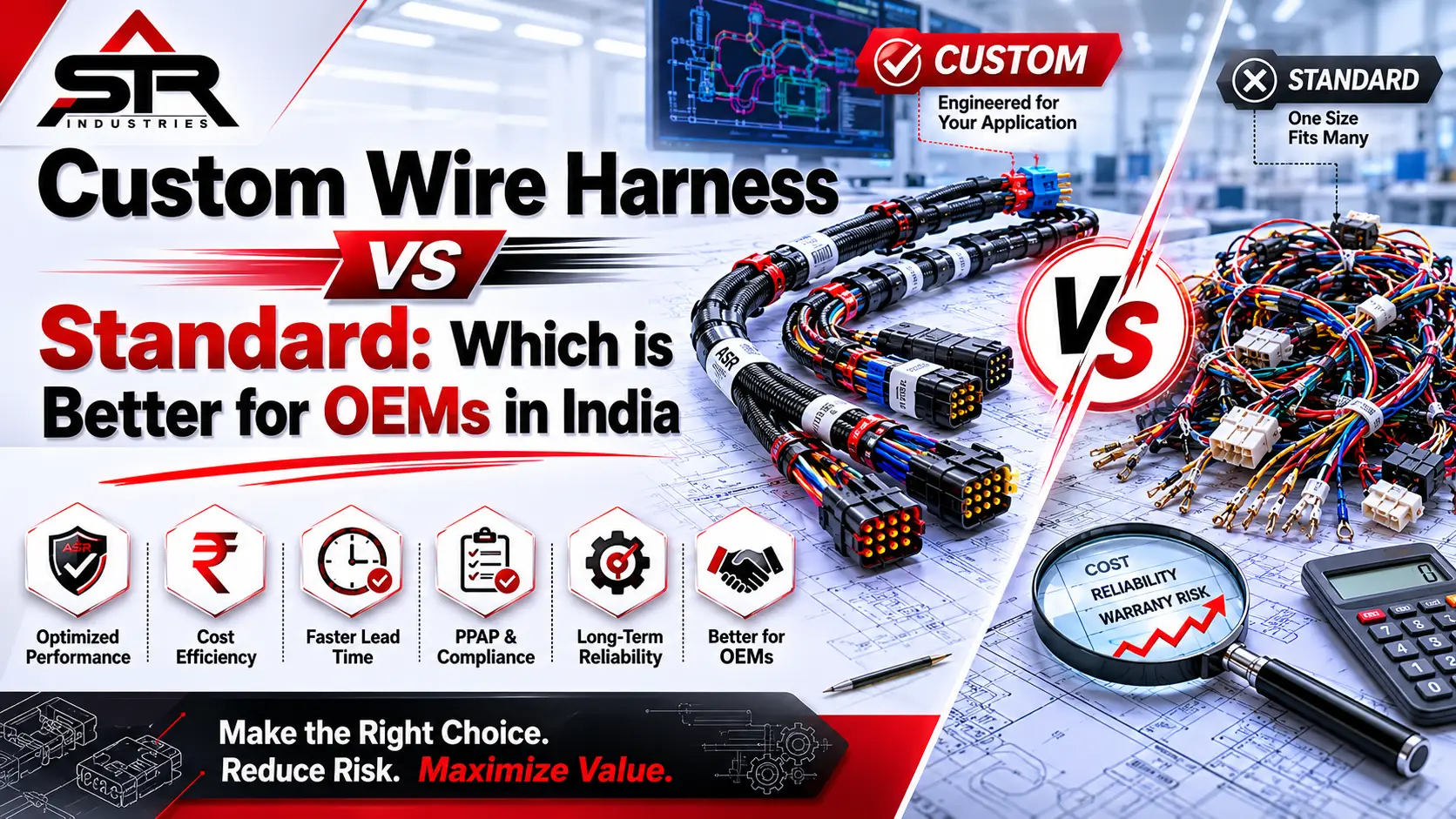
Custom Wire Harness vs Standard: Which is Better for OEMs in India?
Three weeks into an RFQ cycle, most procurement teams hit the same wall. Engineering drops a complex wire harness specification, timelines are already red-lined, and two conflicting options sit on the desk. Route one is fast but compromised: pull a catalogue part, patch a few branches together, and ship it. Route two is rigorous: engineer a custom harness from scratch, build dedicated tooling, and back it with airtight PPAP documentation. In the Indian manufacturing landscape, this decision shapes unit economics, field reliability, and vendor stress for the next five to ten years.
The trade-offs that follow come straight from what ASR Industries observes every week while working with OEMs across automotive, EV, solar inverter, industrial control, and appliance sectors. No marketing dressing on this one. Just an honest read on when each route actually fits, where the hidden costs sit, and how to know which side of the line a project belongs on.
What “Custom” and “Standard” Actually Mean in the Industry
Most buyers use these two words loosely, and that vagueness creates noise at the RFQ stage. Worth pinning down the definitions properly before anything else.
A standard wire harness is a pre-engineered, catalogue-listed harness produced to a fixed specification. The same part number ships to multiple customers, inventory may already exist on the manufacturer’s floor, and the design is frozen. Appliance manufacturers, generic industrial equipment makers, and aftermarket players rely heavily on this category.
A custom wire harness is engineered to one customer’s exact specification. The part number is unique, no off-the-shelf inventory exists, and the design lives or dies with that single application. Automotive OEMs, EV builders, and any brand putting its own label on a finished product almost always end up here.
The third category that online content tends to skip is modified standard. This is a catalogue base with customer-specific changes layered on top: a different connector at one end, a longer branch on the power line, a custom label, a different sleeve material. Cheaper than full custom, more flexible than pure standard, and often the right answer for projects that fall between the two extremes.
Getting these definitions right at RFQ stage prevents the most common misalignment in this industry: buyers asking for “custom” when modified standard would have served them perfectly, and buyers asking for “standard” when their application genuinely needs custom engineering.
Cost Comparison: Where the Money Actually Goes
Procurement teams open every article like this one at the cost section. Fair enough.
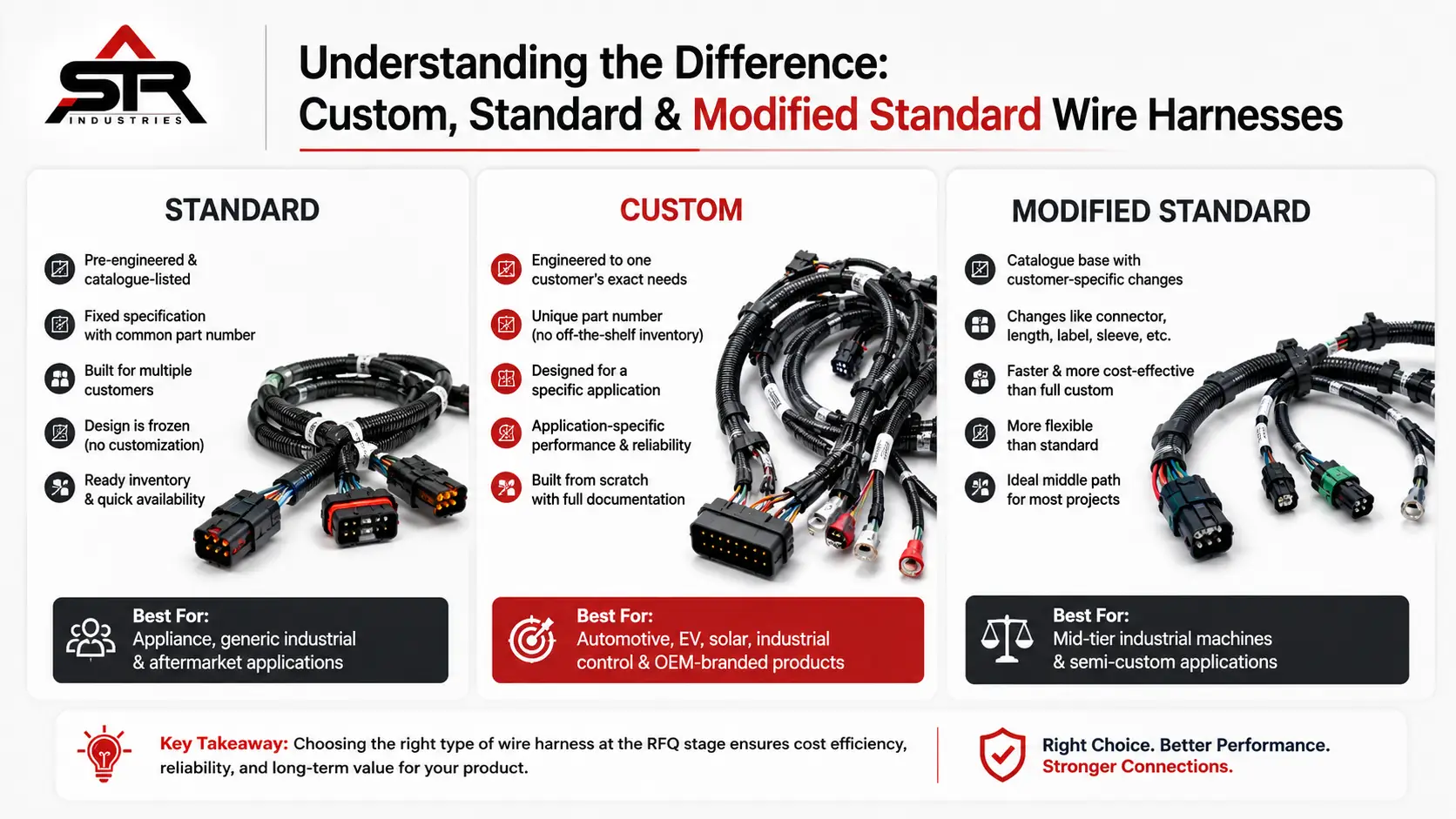
The standard harness cost structure has a lower unit price because the tooling and engineering have been amortised across multiple customers over years of production. There are no NRE (non-recurring engineering) charges. Minimum order quantities are reasonable because the manufacturer schedules production around existing inventory cycles. From a pure rupee-per-unit lens at low volume, standard wins.
The custom harness cost structure looks heavier on paper at first glance. NRE charges cover design hours, prototyping, tooling, PPAP submission, and customer-specific approvals. Per-unit cost runs higher at low volumes because that fixed engineering cost has to spread across a smaller production base. MOQs are typically higher because the manufacturer cannot resell unused inventory to anyone else.
Then there is the hidden cost that almost never makes it into the comparison spreadsheet. Field failure cost. A standard harness that nearly fits a custom application tends to generate warranty claims that dwarf the unit cost difference over time. Incorrect strain relief at a moving joint. A connector seating that loosens after thermal cycling. Insulation rated for indoor electronics quietly degrading in an under-hood environment. These failures rarely show up in the first six months. They show up in years two through five, after the original procurement decision has been forgotten.
The break-even question is where this gets interesting. At what annual volume does custom become cheaper than standard? Generally, once a harness sees consistent annual production of a few thousand units across a multi-year programme, the per-unit advantages of custom design (no excess wire, optimised gauge selection, fewer secondary modifications at the assembly line) start overtaking the amortisation advantage that standard carries.
For lifecycle-aware procurement, looking only at the initial piece-rate price is a massive trap. To help procurement teams run these numbers dynamically, we have mapped out the core operational differences. You can use the decision matrix below to evaluate your project’s specific parameters instantly before committing capital.
Custom vs Standard Wire Harness Comparison Matrix
Parameters | Standard Wire Harness | Custom Wire Harness | Modified Standard (The Middle Path) |
Unit Cost (Low Volume) | Lower upfront | Higher per unit | Balanced |
NRE / Tooling Expense | Zero | Applicable (High Initial) | Minimal modification charges |
Lead Time (Delivery) | Days to 2-4 weeks | 8 to 16 weeks | 4 to 6 weeks |
Traceability Protocol | Generic batch codes | Full IATF 16949 / PPAP | Application-specific tracking |
Best For | Prototyping, replacement | High-volume Indian OEMs | Mid-tier industrial machines |
Critical Procurement Risk Note: ASR Industries’ floor metrics indicate that over 40% of standard harness field failures in year three happen due to incorrect strain relief calculation under extreme field thermal cycles. Saving early on NRE can compound hidden warranty expenses heavily later.
Lead Time: What Each Route Actually Takes
Standard wire harness lead time, from purchase order to delivery, can be as short as a few days when the supplier holds inventory, and typically runs two to four weeks for catalogue parts that need to be scheduled into a production slot.
Custom wire harness lead time, from initial engagement to first production delivery, runs eight to sixteen weeks for moderate complexity programmes. That window has to cover design submission, prototype build, customer validation, design freeze, PPAP documentation, tooling readiness, and the first production batch. Compressing it usually means compressing quality, which defeats the purpose of going custom.
The lead-time trap that catches many OEMs is the assumption that a manufacturer with deep experience can deliver custom work in standard timelines, just because they “know what they are doing.” Experience reduces risk inside each phase, but it does not eliminate the phases themselves. A PPAP cannot be shortcut. Customer approvals cannot be skipped. The manufacturer who promises a custom programme in four weeks is either skipping critical steps or has already done most of the work for a similar customer (in which case, ask why).
Geography matters here too. ASR Industries operates a five-plant network across Noida, Delhi NCR, Haryana, Uttarakhand, and Rajasthan, which keeps transit times tight for OEMs running production lines across northern and central India. For just-in-time programmes, that physical proximity often makes more difference to total lead time than any individual production efficiency.
Performance and Reliability: Where Custom Pulls Ahead
This is the section that quietly justifies most custom decisions, and it has nothing to do with the cost spreadsheet.
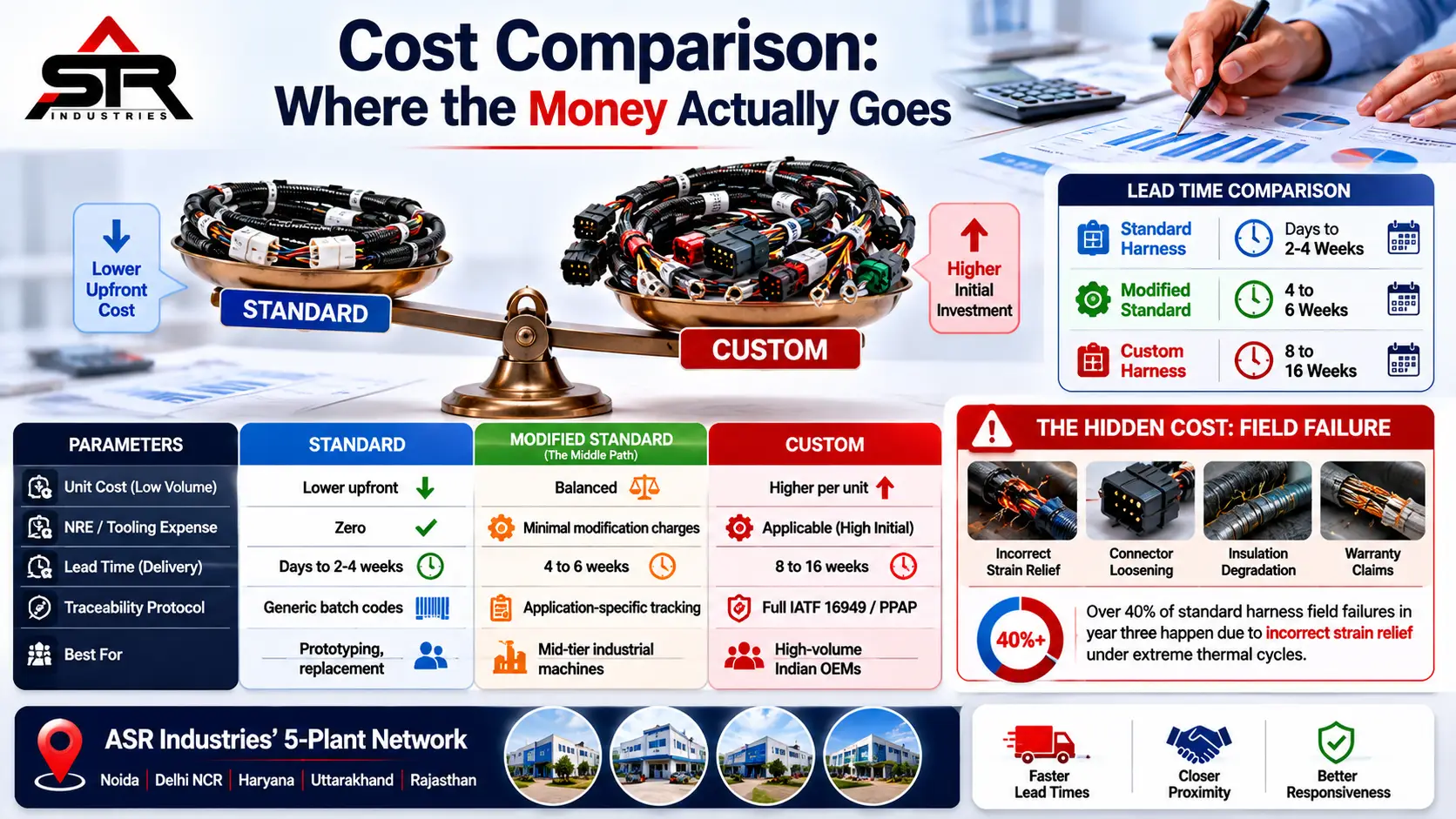
Wire gauge optimisation. A standard harness is built to serve a range of applications, which means some circuits are over-engineered with thicker gauge than needed (built-in safety margin) and others sit close to the marginal end (cost-driven design). Custom harnesses size each conductor to the actual current load, which reduces weight, heat, and material cost in production volume.
Routing precision. Custom harnesses are designed for one specific routing path through the host product. No excess length to tuck away. No chafing risk against moving components. No compromised bend radii. Assembly line workers stop spending time forcing a harness into a route it was not built for. That alone often pays back the NRE within the first year of production for a meaningful volume programme.
Connector selection. Custom harnesses use connectors chosen for that exact application’s vibration, temperature, sealing, and mating cycle environment. Standard harnesses use the connector that fits the catalogue. The difference matters when the host product sees real-world conditions, not lab conditions.
Environmental ratings. Critical for automotive, EV, solar, and outdoor applications. A standard harness rated for indoor electronics simply does not survive long-term in an under-hood automotive environment, regardless of how the unit price reads on the PO.
The honest real-world consequence: when a standard harness “almost fits” a custom requirement, the warranty cost over a five-year production cycle usually exceeds the entire NRE cost of doing custom properly from day one. Not always. But often enough that procurement teams in mature OEMs have stopped treating it as a close call.
Let’s ground this in real floor-level mechanics. When an OEM tries to run a standard harness in a high-vibration engine bay or a solar inverter box facing Rajasthan’s 48°C ambient heat, the failure isn’t immediate. The copper strands inside the over-tensioned joints undergo progressive micro-fatigue. Within eighteen months, resistance spikes, voltage drops occur, and your customer support desk gets hit with erratic error codes. Going custom isn’t about premium specs; it’s about establishing predictable structural safety lines.
Compliance and Certification: What Each Route Demands
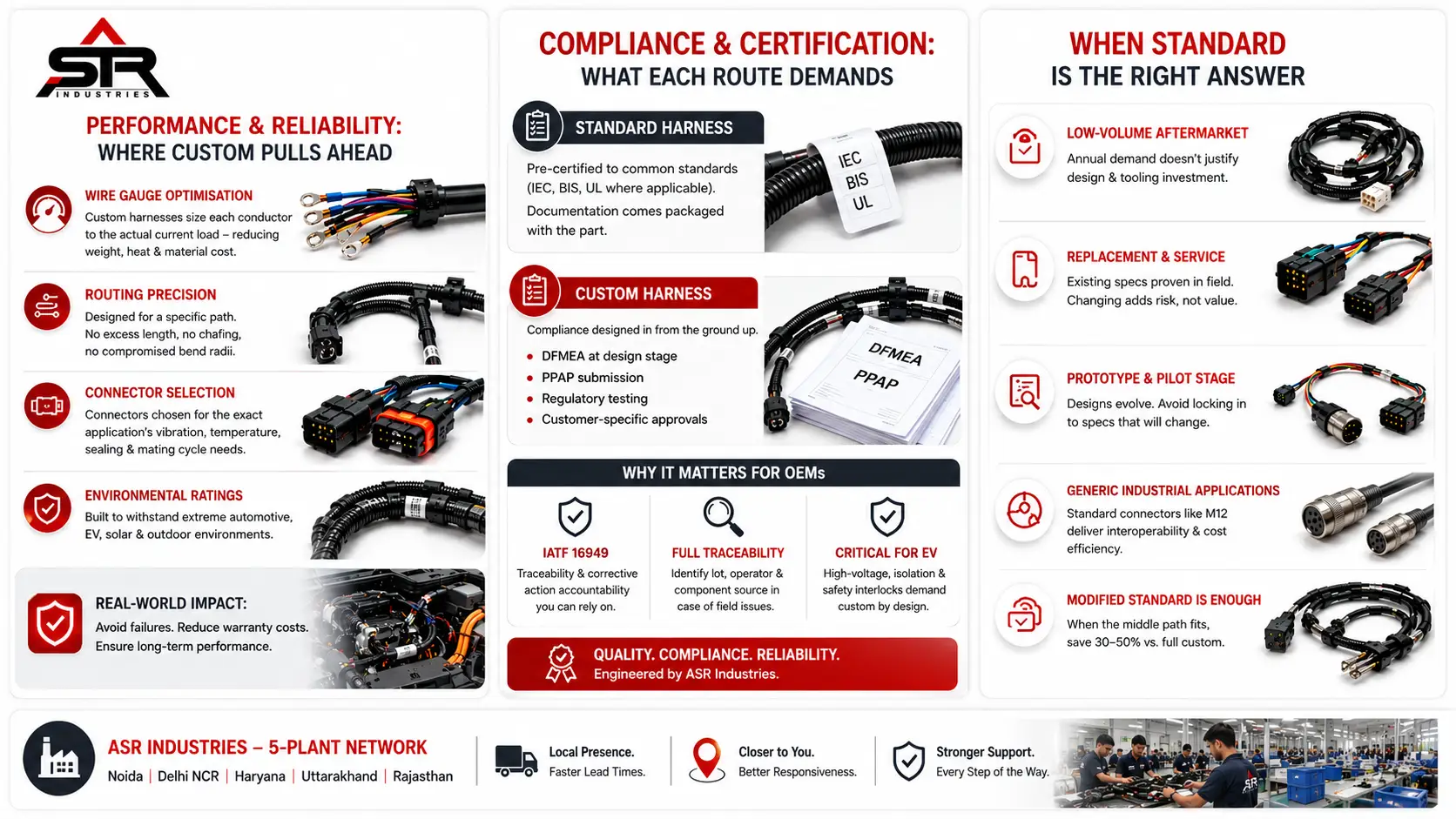
Standard harnesses arrive pre-certified to common standards (IEC, BIS, UL where applicable). Documentation comes packaged with the part, and the certification belongs to the catalogue specification.
Custom harnesses require compliance to be designed in from the ground up. DFMEA at the design stage. PPAP submission to the customer. Regulatory testing specific to the application. Customer-specific approval cycles that vary depending on the OEM. None of this is optional, and none of it carries over from a previous programme.
For automotive applications, an IATF 16949 certified supplier producing under a customer-assigned part number gives the OEM something a standard harness physically cannot: traceability and corrective action accountability. If a field failure traces back to a batch, the manufacturer can identify exactly which production lot, which operator, which component supplier was involved. That accountability is non-negotiable for any automotive Tier 1 or Tier 2 relationship. ASR Industries’ work with automotive OEMs leans heavily on this discipline, and buyers wanting deeper context can read more about why IATF 16949 matters for OEM wire harness sourcing.
EV high-voltage systems almost always require custom by definition. The voltage levels, isolation requirements, current ratings, and safety interlock arrangements vary too widely from one battery system to the next for any standard harness to bridge the gap responsibly.
When Standard Is Actually the Right Answer
Recommending custom for every application would be the easy commercial move, and it would also be wrong. There are several situations where standard (or modified standard) is the smarter choice, and an honest supplier says so upfront.
Low-volume aftermarket products where annual demand cannot reasonably amortise design and tooling cost. Standard or modified standard fits better.
Replacement and service applications where the harness specification already exists, has been proven in the field, and changing it would create more problems than it solves.
Prototype and pilot stage products where the design is still evolving. Going custom here locks in choices that will probably change six months later, wasting NRE on a specification that no longer matches the product.
Generic industrial applications with established connector ecosystems, such as M12 sensor cables in factory automation. The whole industry is built around interchangeability here. Custom adds cost without benefit.
When the supplier’s modified-standard option already covers the actual requirement. This is the underused middle path, and buyers who ask about it openly often save thirty to fifty percent compared to a full custom programme.
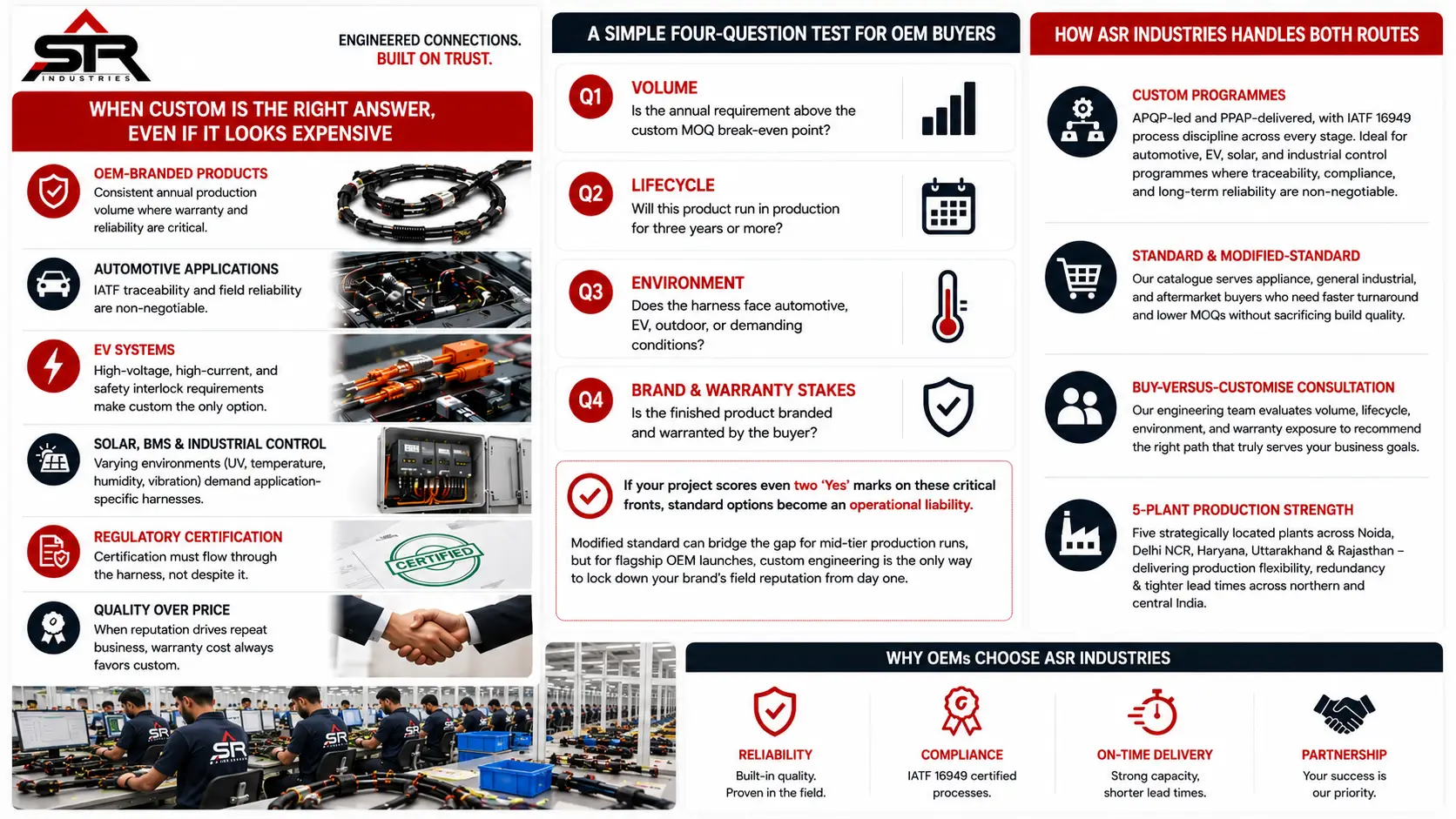
When Custom Is the Right Answer, Even If It Looks Expensive
The other side of the same honest assessment.
OEM-branded products with consistent annual production volume. The brand owns the warranty, and the warranty depends on harness reliability.
Automotive applications where field reliability and IATF traceability are non-negotiable. Standard simply does not deliver the supplier accountability that automotive QA frameworks require.
EV systems with specific high-voltage, high-current, or safety interlock requirements. Custom is effectively the only option.
Solar inverter, BMS, and industrial control applications with environment-specific exposure. UV, temperature swing, humidity, vibration profiles vary too much between installations for a standard harness to serve well across the product’s lifecycle.
Products with regulatory certification requirements specific to the final assembly. The certification has to flow through the harness, not despite it.
Products competing on quality rather than per-unit cost. When field reputation drives repeat business, the warranty math always favours custom.
Custom vs Standard Wire Harness: Side-by-Side Comparison
Parameter | Standard Wire Harness | Custom Wire Harness |
Unit cost (low volume) | Lower | Higher |
Unit cost (high volume) | Higher | Lower |
NRE / tooling cost | None | Yes |
Lead time (first delivery) | Days to a few weeks | 8 to 16 weeks |
Minimum order quantity | Low | Higher |
Performance fit | Generic | Optimised for application |
Field reliability | Variable | High |
Compliance flexibility | Fixed to catalogue spec | Tailored to application |
Supplier accountability | Generic part number | Direct, customer-specific |
Best suited for | Replacement, low-volume, generic industrial | OEM production, automotive, EV, branded products |
A Simple Four-Question Test for OEM Buyers
The most useful thing a procurement team can do before committing to either route is run a four-question test. Most projects sort themselves out cleanly once these answers are on the table.
Question 1 — Volume. Does the annual requirement sit above the manufacturer’s custom MOQ break-even point? If no, modified standard or pure standard usually makes more sense.
Question 2 — Lifecycle. Will this product run in production for three or more years? If yes, NRE costs amortise comfortably, and custom becomes economical even at moderate volumes.
Question 3 — Environment. Does the harness face automotive, EV, outdoor, or otherwise demanding operating conditions? If yes, standard rarely meets long-term reliability without significant modification, and modification cost often approaches full custom anyway.
Question 4 — Brand and warranty stakes. Is the finished product branded and warranted by the buyer? If yes, custom becomes a strategic decision rather than a cost decision, because the warranty exposure outweighs the per-unit cost gap.
If your project scores even two ‘Yes’ marks on these critical fronts, standard options become an operational liability. Modified standard can bridge the gap for mid-tier production runs, but for flagship OEM launches, custom engineering is the only way to lock down your brand’s field reputation from day one.
How ASR Industries Handles Both Routes
ASR Industries produces both custom and standard wire harnesses. The right answer for any given project depends on the customer’s situation, not on which option carries the higher margin.
For custom programmes, the process is APQP-led and PPAP-delivered, with IATF 16949 process discipline across every stage. This applies to automotive, EV, solar, and industrial control programmes where traceability, compliance, and long-term reliability are non-negotiable.
For standard and modified-standard requirements, the catalogue serves appliance, general industrial, and aftermarket buyers who need faster turnaround and lower MOQs without sacrificing build quality.
The engineering team also runs buy-versus-customise consultations for OEMs unsure which route fits their project. The consultation works through volume projections, lifecycle expectations, environmental requirements, and warranty exposure to land on a recommendation that genuinely serves the customer’s interest rather than just closing the order.
The five-plant network across Noida, Delhi NCR, Haryana, Uttarakhand, and Rajasthan provides production flexibility, redundancy, and tighter lead times for buyers operating across northern and central India.
Frequently Asked Questions
Q1: What is the difference between a custom and standard wire harness?
A standard wire harness is a pre-engineered, catalogue-listed product built to a fixed specification and sold to multiple customers under the same part number. A custom wire harness is engineered to one OEM’s exact application, carries a unique part number, and is not available off the shelf. A third category, modified standard, sits between the two and covers most projects that need minor customisation without full custom engineering.
Q2: Is a custom wire harness always more expensive than a standard one?
No. At low volume, custom looks more expensive because NRE and tooling costs concentrate across fewer units. At higher production volumes, and once warranty exposure, field reliability, and assembly-line efficiency are factored in over a multi-year programme, custom often becomes the cheaper option over the full production lifecycle. The break-even point depends on annual volume, programme duration, and the operating environment.
Q3: What is the minimum order quantity for a custom wire harness?
MOQ varies with complexity and the manufacturer’s setup costs. Proven designs returning for repeat orders can run at lower MOQs. New custom programmes typically carry higher MOQs to amortise design, tooling, and PPAP costs across a sensible production base. For genuinely low-volume requirements, modified standard usually serves better than full custom.
Q4: How long does it take to develop a custom wire harness?
A moderate-complexity custom programme takes eight to sixteen weeks from initial engagement to first production delivery. That window covers design submission, prototype build, customer validation, PPAP documentation, tooling readiness, and the first production batch. Compressing the timeline usually means compromising on quality or skipping verification steps that exist for good reason.
Q5: Can a standard wire harness be modified for a specific OEM application?
Yes, and this is the underused middle option in the industry. A catalogue base can take a connector swap, branch length adjustment, custom labelling, or sleeve material change at a fraction of the cost of a full custom programme. For projects where pure standard does not quite fit but full custom is overkill, modified standard is usually the right answer.
Q6: Does ASR Industries provide design support for OEMs developing custom wire harnesses?
Yes. ASR Industries provides engineering consultation, DFMEA support, APQP-led design discipline, and PPAP documentation as part of every custom programme. Buy-versus-customise consultations are also available for OEMs who want an objective recommendation before committing to either route.
Every manufacturing floor has unique constraints, and generic templates don’t solve real engineering bottlenecks. If you are balancing tight launch timelines against multi-year warranty targets for a new project, let’s look at the actual numbers together. Our application engineers across our five-plant network can run a direct component-by-component feasibility review to map out the exact technical and financial path for your project.